Thursday Oct 15, 2026
Thursday Oct 15, 2026
Monday, 31 August 2026 00:00 - - {{hitsCtrl.values.hits}}
By Safna Malik
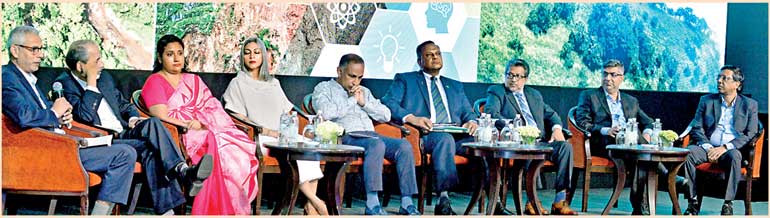
The Asian Development Bank (ADB) hosted a knowledge-sharing session titled “Investing in Sri Lanka’s Upper Watersheds: Unlocking Natural Capital for a Resilient Future” under its Serendipity Knowledge Program (SKOP) series, bringing together Government officials, policy experts, plantation operators, conservationists, development partners and research institutions to discuss practical implementation pathways for watershed protection and restoration.
The session centred on one of the most pressing environmental and economic questions facing the country: how to sustainably finance the restoration and protection of Sri Lanka’s upper watersheds before the cost of doing nothing becomes irreversible.
The panel brought together Independent Consultant in Structured Finance Abhijit Bhaumik, ADB Senior Natural Resources and Agriculture Specialist Sumit Pokhrel, Energy Ministry Acting Secretary and Senior Additional Secretary to the President on Finance and Economic Affairs Russel Aponsu, Finance, Planning and Economic Development Ministry Department of External Resources Deputy Director Shashini Withana,
UNDP Country Economist Dr. Vagisha Gunasekara, Hayleys Plantations Managing Director Dr. Roshan Rajadurai, and PLANT Chairman and former Wildlife and Nature Protection Society President Sriyan de Silva Wijeyeratne.
What are the key challenges and mechanisms for financing nature?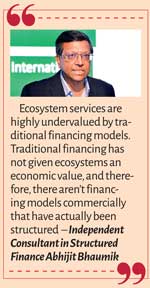
Bhaumik outlined the structural barriers that prevented private and institutional capital from flowing into nature finance, before walking through a series of international case studies that carry direct lessons for Sri Lanka.
The core problem, he argued, is that ecosystem services remain deeply undervalued by traditional financing models. The economic value of a functioning watershed has never been properly priced, which means the tools to manage risk around financing it are also poorly developed. Compounding this is the timeline mismatch: the costs of restoration are upfront and immediate, while the benefits unfold over 10 to 15 years. No conventional financing market is designed to absorb that kind of structure. And throughout, public money has been expected to carry the load, even as it becomes increasingly clear that government budgets alone cannot sustain the scale of intervention required.
Bhaumik said it’s not about whether private and institutional capital needs to come in, but how to design the structures that make it possible.
Several new ways of funding projects are becoming popular around the world. One method is pay-for-results funding, where money is only handed over after real, measurable success is proven. This approach is being used more and more in environmental and carbon-credit markets. While paying for nature protection is common, combining different funding sources through well-managed conservation funds is now vital for long-term environmental investment.
Vietnam’s Payment for Forest Environment Services program proves the power of unified funding. The platform collects revenues from direct forest beneficiaries, such as utilities and tourism businesses, to fund community-led conservation. By pooling these local contributions with $ 70 million in international climate finance from the Green Climate Fund and World Bank, Vietnam has created a single, highly powerful mechanism for long-term nature investment.
The Maldives Green Fund offers an immediately replicable model for Sri Lanka. The fund is financed by a tourist levy of approximately $6 per night and managed by the Environment Ministry to support renewable energy, waste management, and viability gap financing. For example, when the ADB financed a Maldivian waste-to-energy project, this fund covered the ongoing operational shortfall to ensure economic viability. Sri Lanka, with its own substantial tourism base, has the means to implement a comparable mechanism.
The AGRI3 Fund, established in 2020 by the UN Environment Program and Rabobank, highlights the efficacy of partial credit guarantees. When an Indian bioenergy firm required $20 million in working capital to purchase harvest-cycle agricultural residue, the fund issued a 75% guarantee to a commercial bank. As Bhaumik noted, such mechanisms allow relatively small amounts of guaranteed capital to be leveraged eight to twelve times, significantly multiplying local impact.
The history of Brazil’s Amazon Fund underlines the necessity of political insulation. The fund’s suspension in 2018, triggered by political interference and the subsequent withdrawal of Norwegian aid, and its 2023 revival prove that climate financing platforms require rigid legal safeguards. For Sri Lanka to secure long-term international finance, its funding structures must be legally robust enough to completely withstand shifts in Government administration.
The Shandong Green Finance Catalysing Facility proves the power of public-private leverage. By blending a $ 100 million ADB loan with $ 400 million from development partners and matching provincial capital, the facility reached $ 1.1 billion. This framework successfully multiplied every $ 1 of sovereign funding into $ 6 to $ 7 of real-world green project investment.
How are plantation companies contributing to upper watershed management?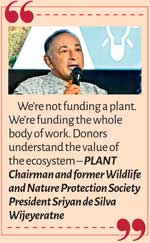
Rajadurai responded to it as both a practitioner and as a representative of the regional plantation company sector, situating Hayleys Plantations within the broader context of Sri Lanka’s tea industry. Of the country’s approximately 267,000 hectares under tea cultivation, the organised sector manages around 66,000 hectares across Uva, mid-country, low-country and upcountry regions. Roughly 25,000 of those hectares sit in the upcountry, directly within the upper watershed area.
His main message was that soil and water conservation in the plantation sector is not philanthropy. It is an operational necessity. A vegetative crop harvested every seven days, managed over 150 years with intensive pruning cycles every four to five years, would not have survived without disciplined agricultural stewardship. “Without soil, without water, there is no tea,” he said plainly. The major tributaries of the Mahaweli River flowing through plantation land, among them Agra Oya, Kothmale and rivers running through the Agarapatana estates, feed hydroelectric facilities and support the irrigation systems on which approximately 1.5 million households and 40% of downstream agricultural labour depend.
The practices that make this possible include continuous ground cover management, 100% bush cover for most of the year, green manure and shade cover, and systematic maintenance of rivers, streams, ravines, hill crests and boundary forest areas. Large-scale replanting, which once caused significant and visible soil disturbance, has been substantially reduced. When pruning does expose ground, it is for approximately two months every five years.
Hayleys Plantations also hosts around one million people across its plantation communities, whose drinking water, sanitation and health depend on the same water sources the company is working to protect. The business case and the social case are inseparable.
Where Rajadurai was candid about the limits of what plantation companies can control, however, was in what happens beyond estate boundaries. Vegetable cultivation running right to riverbanks, dwellings and holiday resorts with Government-approved permits alongside waterways: these were, in his view, a significant and under-addressed part of the problem. He called for minimum a basic enforcement of existing regulations, and suggested that every police station should have an officer with at least foundational knowledge of environmental and agricultural protection.
On payment for ecosystem services, he was direct. The plantation sector carries a disproportionate burden in maintaining the watershed. If the Ceylon Electricity Board and other downstream beneficiaries were to direct funding to plantation companies with the administrative capacity to manage planting and monitoring programs, the results would be measurable. A program run with Rotary, in which Hayleys plants, maintains, inventories and monitors, already achieves a 90% success rate within a controlled management system.
What does conservation work at scale look like on the ground?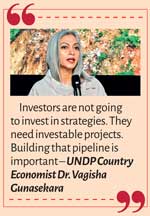
Wijeyeratne brought the discussion firmly to ground level with an account of what the Wildlife and Nature Protection Society’s PLANT program has built since 2020, when it began working on watershed protection before the concept became widely discussed in policy circles.
The model PLANT developed is a three-party structure that brings together landowners, donors and program managers to carry out restoration. Six plantation companies are currently part of the program, with Rajadurai among the earliest to commit. Today, PLANT is actively restoring approximately 60 kilometres of forest corridor, almost entirely in riverine areas directly adjacent to waterways.
What distinguishes the model is that donors are not funding individual plants. They are funding the entire body of work including planting, maintenance, monitoring and community engagement, and they are doing so because they understand the value of the ecosystem service they are purchasing. Donors are contributing five to six times what a conventional per-plant cost would suggest, because they recognise what a functioning forest corridor is worth. There are currently around 40 donors and 40 locations.
The problem, Wijeyeratne was frank about, is scaling. PLANT raises its own funds with no sustainable financing mechanism behind it. If the programme were put to a conventional tender process, it would attract bidders offering a plant plus a margin, with no commitment to the sustained management that determines whether the investment survives a decade. He described this as the “gap trap”: the disconnect between the scale of conservation need and the proportion of available funding that actually reaches the ground. Single-digit percentages of most conservation budgets flow to on-the-ground action, with the majority consumed by monitoring, workshops and administration. Addressing that imbalance, he argued, requires moving away from a cheapest-bid procurement model toward competency-based partnerships.
The social dimension of PLANT’s work reinforced the economic case. Unable to source the specialised native plants needed for the program from existing suppliers, PLANT funded the establishment of female-owned and female-run nurseries, purchasing their entire output and creating sustained livelihoods for the families involved. Corporate and bank donors have since shown strong interest in funding the community component as well, integrating livelihood creation with restoration in a way that requires little additional persuasion. “People know that we have to work with communities,” Wijeyeratne said.
How is Sri Lanka’s new Canopy Fund structured differently from traditional Government funds?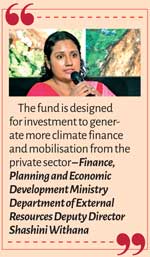
Withana traced the origins of the Canopy Fund to a 2022 screening by the Department of External Resources of more than 140 solutions to increase private-sector participation in climate action. Twelve solutions were subsequently incorporated into Sri Lanka’s National Climate Finance Strategy, with the Canopy Fund emerging as a climate- and nature-positive financing vehicle designed to differ fundamentally from existing statutory funds.
She highlighted five key differences. First, the Canopy Fund is designed for investment rather than disbursement, aiming to mobilise private climate finance while complementing public investment. Second, it offers instruments such as guarantees, viability-gap financing and partial capital guarantees, creating incentives for private-sector participation beyond conventional grants.
Third is its reinvestment and multiplier model. Rather than accumulating funds for transfer to the Consolidated Fund, resources will be reinvested in green, climate and nature-positive projects to generate further capital and reduce reliance on annual budget allocations. “The one rupee that you have in the fund is never going to be one rupee, but more,” Withana said.
Fourth, she emphasised its consultative governance, noting that the fund was developed with input from national planning authorities, chambers of commerce, banks and financial institutions. Fifth is its professional governance structure, including a legal consultant supported by UNDP and a financial consultant from the ADB to design the fund’s financing, reinvestment and operational mechanisms.
On performance measurement, Withana said the fund would use KPIs linked to its thematic bond framework and the achievement levels established for each eligible investment category. Bond proceeds would be held in designated accounts and reinvested in projects specified in the bond prospectus and governed by the broader framework.
Other potential sources of capital include impact funds, climate finance, philanthropy, and carbon and biodiversity credits.
How do the Watershed Authority and the Canopy Fund complement each other?
Aponsu approached the question from the policy level, drawing on the experience of Cyclone Ditwah as the clearest illustration of why the institutional framework being built now is necessary. When the cyclone struck, the Government’s existing disaster management systems handled immediate relief and rescue adequately. But the recovery and rebuilding phase exposed the absence of pre-positioned funding mechanisms with clear guidelines for collection and deployment. The rebuilding fund that was proposed as a policy response never fully materialised, derailed in part by geopolitical shifts including the Russia-Ukraine conflict and Middle East instability that redirected international attention and donor flows.
The Upper Watershed Management Authority is designed to address the institutional fragmentation that has left mandate, resources and accountability split across multiple line agencies with no consolidated oversight. The Cabinet has granted approval for both the authority and the fund. What Aponsu underscored is that the Canopy Fund, driven by technical and international partners rather than political cycles, offers a more durable foundation than policy instruments subject to administration changes. The authority and the fund, taken together, represent both the institutional home and the financing engine for upper watershed management, and their value increases precisely because they are being built before the next disaster rather than in response to one.
How is the global grant financing landscape changing for Sri Lanka?
Gunasekara offered three points that collectively amounted to a challenge to Sri Lanka’s default assumption that upper watershed work should be financed primarily through grants.
The first is that the grant landscape itself is changing. Grants globally are now being used more strategically, as instruments to unlock larger volumes of financing through guarantees, viability gap support and project preparation, rather than as the primary source of project capital.
In a context where the climate and nature financing needs to run trillions of dollars, grants cannot be the answer at scale. The second point is that the conventional model of receiving a grant, spending it on project activities and closing the account does not allow for replication or growth. It is a model that works once, not at the scale required. UNDP and Convergence identified over 345 blended financing transactions in South and Southeast Asia amounting to approximately $ 56 billion. Indonesia’s SDG 1 platform, backed by the Finance Ministry and operated through a state-owned entity, attracts private capital, public funds, concessional finance and philanthropy into a single vehicle. The infrastructure to replicate something similar exists.
Her third point was the most direct. “Having a preference is not a financing strategy,” she said, referring to Sri Lanka’s inclination toward grants given its debt position. The country needs to build a national financing infrastructure for climate and nature investment, structured around three requirements: a pipeline of investable projects that investors can assess and commit to, a platform in the form of the Canopy Fund that is positioned as national infrastructure rather than another government fund, and partnerships that bring together IFIs, development partners, private sector actors and philanthropy, each with different risk appetites and different tools to contribute.
What is ADB’s Upper Watershed Ecological Restoration Program?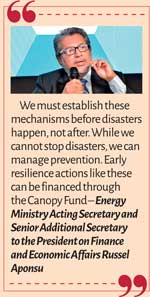
Pokhrel confirmed that ADB has a program in its pipeline for the coming year titled the Sri Lanka Upper Watershed Ecological Restoration Program. Its architecture is built around the recognition that upper watershed management is a public good and that the Government will remain the first buyer and the provider of seed capital. What is changing is the logic of how that capital is deployed.
The shift is from treating Government spending on upper watersheds as a sinking fund, money that goes in and diminishes over time, toward structuring it to generate tangible services, measurable outcomes and eventually revenue streams that make the investment sustainable over the long term. The program is being designed around performance-based metrics, consolidation of fragmented ad hoc grant interventions, evidence-based decision making, and institutionalisation through the authority, the fund, and a proposed centre of excellence drawing on universities and think tanks including Peradeniya University.
Pokhrel made a point of defending the pace of this process. “Slow is good,” he said. Consultation takes time, but it builds ownership across different stakeholder groups. Behavioural change in communities, which is at the heart of any durable improvement in land management, requires awareness building that cannot be rushed. The expectation is that the program will be completed and ready for approval by the end of next year.
Closing remarks from the Department of National Planning’s Additional Director General Rohitha Wickramaratna echoed the themes of the day. He stressed that Sri Lanka has historically underinvested in the upper catchment area relative to downstream development, and that the twin establishment of the authority and the Canopy Fund represents a structural turning point. Cabinet approvals for both are already in place. What remains is to build the project pipeline, complete the financing infrastructure and sustain the partnership architecture needed to attract capital beyond conventional sources. “This workshop is not the end,” he said. “This is the start.”
“If we are talking about behavioural shift, it’s the community. Building that awareness will take time. Overall, I think this program we are really looking forward to. Hopefully by the end of next year, we should be able to get it done.”
ADB, Agriculture, Food, Nature, and Rural Development Sector Office Director Au Shion Yee reminded that as the Secretariat of Environmental Sustainability of the ADB has already announced this year, Sri Lanka has a unique opportunity to showcase how these investments in nature can simultaneously strengthen livelihoods, water security, climate resilience, and economic development.
He also mentioned to achieve this as collective goal we must all work together in all different spheres of partnership to make sure that there’s a commitment and buy-in from the community, through the governments, and through the people that will make these actions on the ground fly.
Pix by Lasantha Kumara




