Tuesday Oct 13, 2026
Tuesday Oct 13, 2026
Tuesday, 13 October 2026 01:37 - - {{hitsCtrl.values.hits}}
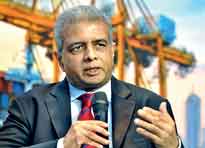 |
| President’s Chief Adviser on Digital Economy Dr. Hans Wijayasuriya |
The Government will hold to its target of a $ 15 billion digital economy by 2030 despite artificial intelligence (AI) eroding Sri Lanka’s IT services exports, the President’s top digital adviser said yesterday, calling on the private sector to move from back-office services to products and to invest far more in talent and data infrastructure.
“Whether we succeed or fail, the target must remain, because that is what Sri Lanka needs,” President’s Chief Adviser on Digital Economy Dr. Hans Wijayasuriya said at a conversation on digital transformation and the economy at the Sri Lanka Economic and Investment Summit (SLEIS) 2026, moderated by The Ceylon Chamber of Commerce (CCC) Secretary General and CEO Shiran Fernando.
The 2030 targets, including $ 5 billion in digital exports, were designed not as an IT or automation project but as the transformation of multiple industries and service sectors to lift productivity and, in turn, overall economic growth, Dr. Wijayasuriya said. The goal is a paperless, cashless and ‘presence-less’ economy, in which transactions with the Government and between businesses can be completed without being physically present.
He was candid on the export target. With IT exports at around $ 2 billion, according to Fernando, Dr. Wijayasuriya described the journey to $ 5 billion as very challenging, as AI was severely threatening the services side of digital exports while talent continued to migrate.
Sri Lanka needed a decisive shift from digital services to products and intellectual property (IP), and should no longer aim to be a location for cheap back-office services, he said. Sri Lankan firms that had built globally competitive products had in the past moved their headquarters overseas or been acquired, taking their IP with them, due to capital mobility restrictions, he noted.
To address this, the Government, working with the Board of Investment (BOI), will soon announce a capital mobility facility allowing Sri Lankan startups and innovators to use foreign direct investment (FDI) they receive to expand overseas. Virtual special economic zones are also being enabled, allowing companies to operate virtually while registering in Sri Lanka, and global mobility provisions are being considered so that local talent can be combined with larger talent pools overseas.
Dr. Wijayasuriya said Sri Lanka could position itself as a location for global capability centres, where multinationals increasingly house their IP and talent in place of traditional outsourcing.
He placed much of the responsibility for talent on the private sector, urging companies to benchmark their spending on human capital against revenue relative to global peers, where he said many would find themselves under-indexed. Firms needed to spend more on IT and AI talent, pay better and offer career progression in Sri Lanka. “Otherwise, it’s just crocodile tears,” he said.
On infrastructure, Dr. Wijayasuriya said Sri Lanka’s data centre capacity of around 5 megawatts (MW) lagged well behind Malaysia’s 1.5 gigawatts. The country needed 25-50 MW of AI-capable cloud capacity in the short term to remain globally competitive, but would take a conservative approach, targeting 25 MW initially, given environmental and energy concerns.
The Ministry of Digital Economy is working with the BOI on an investment and incentive framework for data centres. While the Government would make some investments, it was creating an enabling environment for private investors and new FDI, he said, adding that energy pricing for data centres had to be resolved. Banks were already seeking sovereign, locally resident cloud infrastructure, providing clear demand signals. “The private sector can take this ball and run,” he said.
He cautioned, however, that data centres not serving domestic demand effectively amounted to an energy export, and Sri Lanka would take a calibrated approach, weighing the economic value of each additional megawatt generated.
5G has been launched, and the Government aims to achieve 100% broadband coverage by the end of 2028. A viability gap financing scheme will be approved this year, with an accelerated programme from next year to encourage private operators to invest in less profitable areas.
The first phase of the digital ID, on a limited scale, is expected to begin at the end of this year or early next year. The main project will follow completion of the Government of India grant, which is expected to take about a year, after which registration of the entire population is expected to take around 18 months at a rate of 25,000-30,000 a day.
On payments, over 350 institutions are now connected to GovPay, with a target of 2,000 within six to 12 months. Dr. Wijayasuriya admitted QR payments had achieved only moderate success, saying the Government had not yet cracked the behavioural barriers to wider adoption.
A Digital Economy Sandbox, in which 20 Government institutions and several banks have placed mock databases and APIs, will be opened to the public and developers in the next month or so, allowing them to build applications for the future digital economy. A Digital Economy Authority is being set up, with the Digital Economy Bill awaiting legislation.
The Government is also working with the National Procurement Commission on guidelines for procuring digital solutions on an outcome basis, giving precedence to Sri Lankan companies and allowing smaller firms to compete, alongside a Government marketplace for digital solutions.
Looking ahead, Dr. Wijayasuriya said digital public infrastructure could enable new ‘rails’ beyond payments, such as a unified lending platform where citizens and small businesses could seek credit using their digital ID, with AI-based risk assessment, as well as similar platforms for insurance and climate data. “If by 2028 we see Sri Lankan startups and IT companies building applications on this, I think it will be catalytic,” he said.




