Tuesday Oct 06, 2026
Tuesday Oct 06, 2026
Monday, 5 October 2026 04:18 - - {{hitsCtrl.values.hits}}
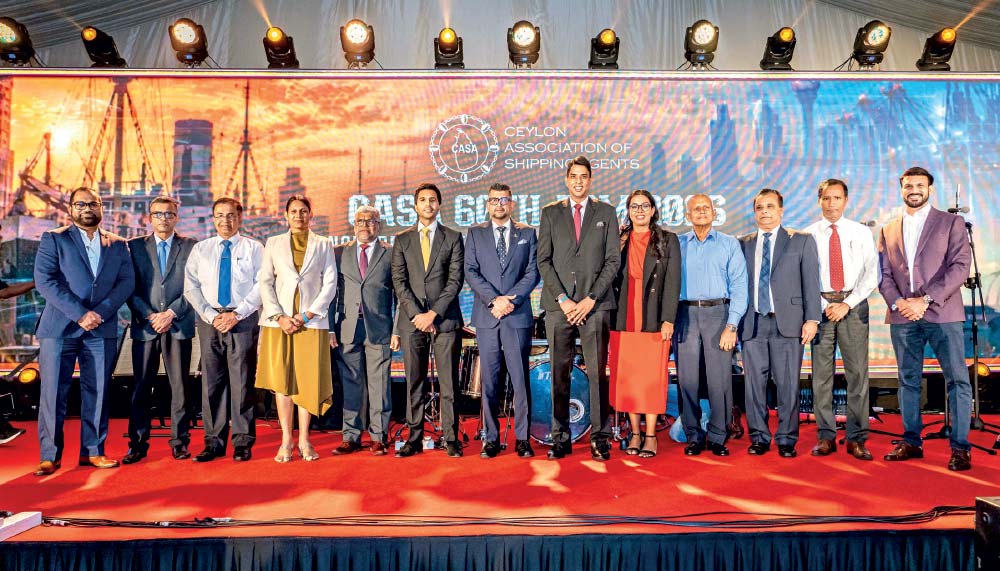
Newly-elected CASA Exco
 The future of Sri Lankan shipping will not be determined by location alone. It will be determined by how effectively the country turns that location into capability, connectivity and lasting competitiveness. And in that continuing journey, CASA remains an important institution at the heart of the industry — bringing the collective experience of Sri Lankan shipping to the table and helping turn that experience into progress
Sri Lanka’s position on the east-west maritime trade route has long given it an enviable geographic advantage. But geography, by itself, does not create a successful maritime hub.
The transformation of Colombo into a major regional transshipment centre has required sustained investment in infrastructure, continuous improvements in productivity, increasingly sophisticated regulatory and trade processes, digital transformation and, above all, a maritime industry capable of adapting to the demands of global shipping.
For decades, the Ceylon Association of Shipping Agents (CASA) has acted as “The Voice of the shipping Industry” and has been part of this evolving maritime landscape.
Established in 1966, CASA has evolved alongside Sri Lanka’s shipping industry, developing from an association representing shipping agents into an industry institution with a broad role across the maritime ecosystem.
Its work has reached into many of the areas that influence the competitiveness of Sri Lankan shipping: port capacity, operational efficiency, engagement with Customs and regulators, digitalisation, maritime human resources, professional standards, integrity and international connectivity.
What makes the Association’s contribution particularly significant is its proximity to the business of international shipping. CASA brings to national discussions the experience of an industry that operates at the intersection of ships, cargo, terminals, ports, Customs, regulators, customers and global shipping lines. It is this proximity to the daily realities of maritime trade that has enabled the Association to identify constraints, articulate industry requirements and participate in efforts towards practical solutions.
Capacity building: Preparing Colombo for growth
Colombo’s emergence as a major regional transshipment hub has transformed the scale and importance of Sri Lanka’s maritime industry.
As container volumes increased and shipping lines introduced larger vessels, the requirement for additional terminal capacity became increasingly urgent. The development of the East Container Terminal and supporting infrastructure became important elements of this evolution.
But capacity alone does not create a competitive port.
Cranes, yard equipment, prime movers, efficient inter-terminal transfers, terminal operating systems and coordinated operations across the port all determine how effectively that capacity can be converted into performance.
The underlying principle is straightforward: capacity must be matched by productivity.
A new berth creates potential capacity. The ability to use that berth efficiently creates competitiveness. This distinction is critical in a transshipment hub, where shipping lines make decisions based not simply on available infrastructure, but on reliability, turnaround times, connectivity and the overall efficiency of the port.
CASA has contributed to these discussions by bringing the operational requirements of shipping agents and the wider industry into conversations surrounding port development.
The Port of Colombo handled more than 8.2 million TEUs in 2025, according to Sri Lanka Ports Authority figures, underlining the scale of the port’s evolution and its importance to regional and global shipping networks.
Such growth represents both an achievement and a responsibility. Maintaining that momentum will require continued investment not only in physical capacity, but also in the systems, processes, technology and human capability that allow that capacity to perform at an international standard.
 CASA has also worked with the Ministry of Ports and Shipping, Customs and the Sri Lanka Ports Authority on process documentation and standard operating procedures. The importance of such procedures is often underestimated. Every unnecessary document can create a delay. Every duplicated process can create cost. Every manual intervention can create another point of friction. For a trading nation, trade facilitation is ultimately about one thing: reducing the friction between opportunity and movement
Beyond Colombo: Building a stronger national port network
The objective should not be to replicate the role of one port across another. Rather, it is to allow Colombo, Hambantota, Trincomalee and Galle to develop around their respective strengths.
A more integrated port network can provide greater resilience, broaden Sri Lanka’s maritime offering and strengthen the country’s ability to compete for regional and global maritime activity.
Port productivity: Turning capacity into performance
Infrastructure alone does not make a maritime hub competitive. The real test is how effectively the entire port ecosystem performs.
A vessel must be cleared. Cargo information must move accurately. Containers must transfer between terminals. Customs processes must operate efficiently. Documentation must be processed on time. The different participants in the port ecosystem must be able to communicate and coordinate effectively.
These operational connections have become increasingly important as Colombo’s terminal network has expanded. Inter-terminal transfers, for example, are now an important component of overall port efficiency.
Industry engagement with the Sri Lanka Ports Authority, Customs and other stakeholders has focused on identifying bottlenecks and pursuing improvements, while technology-led solutions, including AI-based navigation and transportation systems, offer further opportunities.
The focus has therefore moved beyond a simple question of whether the port has sufficient capacity.
The more important question is whether the entire system surrounding that capacity is operating at the standard expected by global shipping.
Realising the full potential of this national port network will also require stronger coordination across the institutions responsible for maritime activity. Shipping and logistics processes frequently extend across multiple ministries, regulators and operational agencies, making timely and consistent decision making essential. CASA has therefore advocated for a more unified maritime governance framework that can align policy, accelerate implementation and provide clearer accountability for the development of the sector.
That is where port competitiveness is ultimately determined.
Digitalisation: From paper to a connected maritime ecosystem
One of the most important transformations in global shipping is taking place not on the quayside, but in the way information moves.
For generations, maritime trade depended heavily on physical documents, manual submissions and multiple approvals. That model is increasingly incompatible with the speed and complexity of modern shipping.
CASA has consistently supported Sri Lanka’s move towards a more connected digital maritime ecosystem through its engagement in initiatives including the Port Community System (PCS), Maritime Single Window (MSW) and National Single Window (NSW).
Through its committees, CASA has worked with stakeholders including the Sri Lanka Ports Authority, Customs and consultants such as KPMG to review existing processes and develop more efficient “TO-BE” processes for shipping agency functions.
CASA has also supported the MSW pilot by offering industry members to the Sri Lanka Ports Authority, while contributing industry input to the development of the NSW blueprint from its early stages.
The Association has encouraged stronger governance and coordination across these strategic digital initiatives, recognising that individual systems will deliver their full value only when they are able to work together.
This approach extends to documentation and vessel clearance. CASA has supported the transition from manual Delivery Orders to electronic formats, including PDF and XML-based e-DOs integrated with terminals, helping reduce physical document exchanges and processing delays.
CASA has also supported the implementation of ASYHUB through awareness and engagement with its membership, contributing to smoother industry adoption. From 7 May 2025, ASYHUB became mandatory for cargo manifest submissions.
The wider objective is the digitalisation of vessel clearance and the reduction of manual touch points. Inbound manifest clearance has been completed, digitalisation of vessel recovery changes is scheduled to go live from 1 October 2026, while work continues on outbound and transshipment manifest clearance.
The Association has similarly advocated for clear and standardised SOPs covering areas such as inbound manifest reporting, vessel clearance and procedures for vessels bypassing Sri Lankan ports.
These initiatives reflect a broader principle: digitalisation should not simply replace paper with screens. It should remove duplication, reduce manual intervention and make the entire maritime process faster, more predictable and more transparent.
The competitive port of the future will increasingly be defined not only by what happens at the quay, but by how quickly, accurately and intelligently information moves around it.
Trade facilitation: Turning industry concerns into action
The efficiency of maritime trade is often determined by processes that are invisible to the public — a manifest submission, a vessel clearance, a Customs approval or a sufferance process.
CASA’s longstanding engagement with Sri Lanka Customs has focused precisely on these operational realities. Through regular strategic dialogue, the Association has worked with Customs on issues affecting shipping agents and the wider maritime community.
The engagement has contributed to practical developments including electronic submission of manifests for RO-RO vessels, greater automation of Customs charges and electronic processes for vessel sufferance approvals.
CASA has also deliberated internally through its committees on the modernisation of the Customs Ordinance and, following legal consultation, submitted comprehensive proposals towards this effort.
The Association has provided suggestions on proposed regulations relating to manifest reporting, with particular attention to maintaining international best practices while protecting Sri Lanka’s competitiveness in handling transshipment cargo.
CASA has also worked with the Ministry of Ports and Shipping, Customs and the Sri Lanka Ports Authority on process documentation and standard operating procedures. The importance of such procedures is often underestimated.
Every unnecessary document can create a delay. Every duplicated process can create cost. Every manual intervention can create another point of friction. For a trading nation, trade facilitation is ultimately about one thing: reducing the friction between opportunity and movement.
Building a stronger maritime industry
The infrastructure and systems supporting shipping are only as strong as the people operating them.
Professional development has therefore become an important component of the sector’s evolution. CASA’s collaboration with CINEC resulted in the CASA Basic Ship Agency Functions program, which had trained more than 600 industry personnel by the mid-2010s.
The Association has continued this commitment through professional seminars, workshops, industry programs and partnerships with international maritime institutions.
Its partnership with the Institute of Chartered Shipbrokers Sri Lanka Branch and CWIT, including fully funded scholarships for the ICS UK Foundation Diploma, has created opportunities for Sri Lankan maritime professionals to pursue internationally recognised qualifications.
Modern shipping is a knowledge-intensive global business. Developing that expertise strengthens the industry’s ability to serve international shipping and enhances Sri Lanka’s competitiveness as a maritime centre.
As technology changes the way ships, terminals and supply chains operate, the importance of people with the knowledge to manage that change will only increase.
Maritime human resources: Unlocking Sri Lanka’s global potential
CASA’s contribution to human resources extends beyond the shipping agency sector.
Sri Lanka has an opportunity to derive considerably greater economic value from its maritime workforce, particularly through the development of its seafaring sector.
CASA has been involved in discussions surrounding the development of Sri Lanka’s crewing industry and a broader national maritime human-resource framework, including issues relating to taxation, immigration, welfare, qualification recognition and the international acceptance of Sri Lankan Certificates of Competency.
Industry policy discussions have identified an ambition to increase the country’s seafarer workforce from approximately 16,000 towards 50,000 and raise the sector’s economic contribution towards $1.5 billion. These figures represent an opportunity and policy ambition, rather than an outcome already achieved.
Sri Lanka’s maritime economy is not limited to containers passing through Colombo.
It encompasses seafarers, maritime professionals, education, technical expertise and the export of skilled human capital to the global maritime economy.
Zero tolerance: Strengthening maritime integrity
The global shipping industry increasingly expects ports and maritime businesses to operate within strong frameworks of transparency, integrity and responsible governance.
CASA has also engaged with the Marine Environment Protection Authority on marine pollution legislation and matters affecting shipping agents.
The competitiveness of a modern maritime hub is increasingly determined not only by how quickly it can handle cargo, but also by the quality of its governance, regulatory environment and commitment to international standards.
Global connectivity: Taking Sri Lankan shipping to the world
Sri Lankan shipping exists within a global network. International regulations, trade patterns, shipping alliances, technology, environmental requirements and supply-chain disruptions can all have immediate consequences for Colombo.
CASA’s engagement with international maritime organisations and networks has helped connect the Sri Lankan industry with global developments while providing opportunities for local industry perspectives to be represented internationally.
The development of YoungShip Sri Lanka provides another example. What began as a CASA initiative to engage younger professionals evolved into a platform connecting Sri Lankan maritime talent with a wider international network.
In 2024, Colombo hosted the inaugural YoungShip Global Leadership Summit, bringing together more than 300 maritime professionals from over 25 countries to discuss leadership, digital transformation, climate change and workforce development.
The event demonstrated the growing international connectivity of Sri Lanka’s maritime community and the ability of Colombo to host meaningful dialogue on the future of shipping.
The next generation: Investing in the future of shipping
The long-term strength of an industry depends on the generation that follows it.
CASA recognised this through the establishment of the Young Professionals of CASA in 2013, creating opportunities for younger maritime professionals to develop industry knowledge, build networks and gain leadership experience.
The initiative attracted more than 100 young professionals shortly after its launch and subsequently evolved into YoungShip Sri Lanka.
Its importance lies not simply in the number of people involved, but in the professional pipeline it helped create.
Younger maritime professionals gained exposure to senior industry leaders, port and terminal operations, industry discussions and international networks.
For an industry undergoing rapid technological and structural change, developing the next generation is not simply succession planning.
The competitiveness of a modern maritime hub is increasingly determined not only by how quickly it can handle cargo, but also by the quality of its governance, regulatory environment and commitment to international standards
The power of an industry voice
The breadth of the maritime sector’s development is what makes an effective industry voice important.
The issues extend from port capacity and terminal productivity to Customs processes, digital systems, professional education, maritime human resources, integrity and international connectivity. They are interconnected: infrastructure requires efficient processes; efficient processes increasingly depend on digital systems; and both require skilled people, effective regulation and strong industry participation.
CASA’s role has been to bring the operational realities of the shipping industry into these wider discussions — identifying issues, engaging the relevant stakeholders and supporting practical solutions that strengthen the maritime ecosystem as a whole.
Shaping the next maritime economy
The global shipping industry is entering another period of transformation. Artificial intelligence, automation, integrated digital platforms, decarbonisation, alternative fuels, cybersecurity and increasingly data-driven supply chains are reshaping the competitive landscape.
For Sri Lanka, the opportunity extends beyond physical port expansion. It lies in building a maritime ecosystem that combines capacity with productivity, infrastructure with digital connectivity, and strategic location with skilled people and predictable processes.
A diversified and connected port network can broaden Sri Lanka’s maritime offering, strengthen resilience and allow the country to capture a greater share of the value generated by regional and global shipping.
A lasting contribution to Sri Lankan shipping
Over six decades, CASA’s contribution has extended across many of the foundations on which a competitive maritime sector depends — port development, productivity, trade facilitation, digitalisation, professional development, human resources, integrity and international engagement.
Its contribution can perhaps best be described as building the infrastructure around the infrastructure: the systems, processes, professional capabilities, relationships and industry dialogue that enable Sri Lanka’s maritime sector to perform.
As global shipping enters its next phase, the challenge is to build on these foundations.
The future of Sri Lankan shipping will not be determined by location alone. It will be determined by how effectively the country turns that location into capability, connectivity and lasting competitiveness.
And in that continuing journey, CASA remains an important institution at the heart of the industry — bringing the collective experience of Sri Lankan shipping to the table and helping turn that experience into progress.



