Wednesday Jul 01, 2026
Wednesday Jul 01, 2026
Monday, 27 April 2026 00:18 - - {{hitsCtrl.values.hits}}

X-Press Feeders Chairman Tim Hartnoll
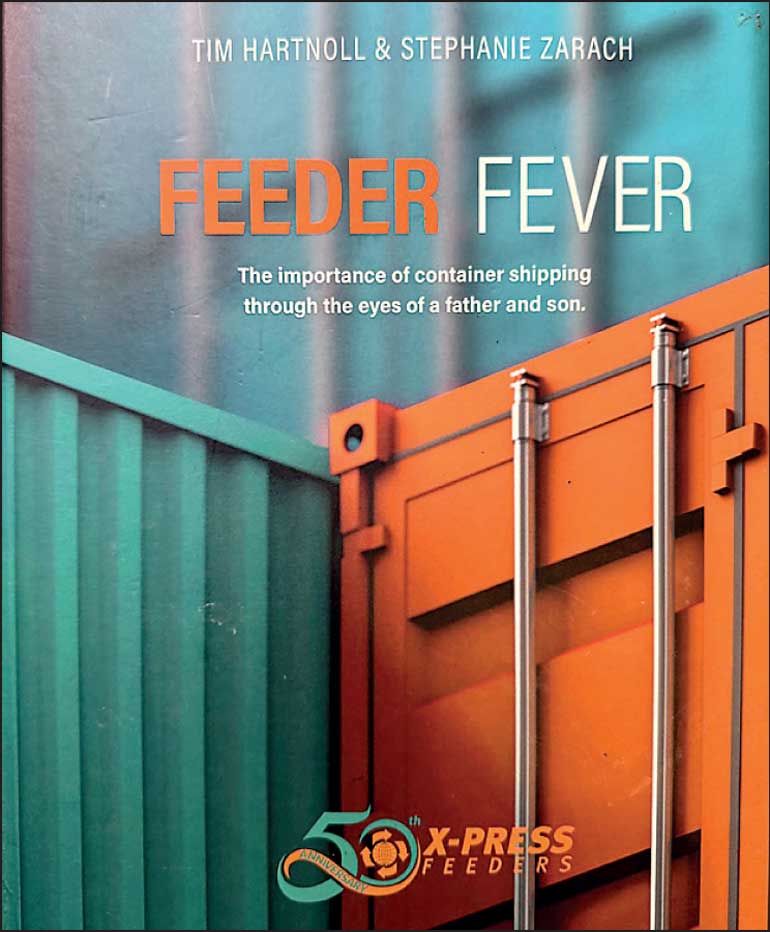
Feeder Fever book cover
 The story of Sea Consortium and its globally recognised brand, X-Press Feeders, is captured vividly in the commemorative volume Feeder Fever, co-authored by the company’s current Chairman, Tim Hartnoll. The book chronicles the journey of a family-owned enterprise founded by Christopher Hartnoll that would grow into the world’s largest independent feeder operator.
Yet for Sri Lanka, the significance of the story lies not only in the rise of a shipping company but in the parallel rise of the Port of Colombo itself. Over the past four decades, Colombo evolved from a regional port of call into one of the most important transhipment hubs in South Asia. The feeder networks developed by Sea Consortium played a pivotal role in that transformation, linking Colombo to ports across the Indian subcontinent, Bangladesh, the Arabian Gulf and eventually the wider global container network.
In many ways, the story of Sea Consortium and the story of Colombo’s hub status are inseparable.
Containerisation and the birth of a hub
To understand how Colombo emerged as a hub, it is necessary to step back to the revolution that reshaped global shipping; containerisation. Before containers, maritime trade relied largely on break-bulk cargo handling. Goods were loaded individually, creating slow turnaround times and significant inefficiencies. The introduction of standardised container boxes dramatically changed this system. Cargo could now move seamlessly from factories to ships, railways and trucks without being unpacked and repacked.
Containerisation did more than improve efficiency. It fundamentally restructured global trade by enabling integrated supply chains that connected manufacturing centres with markets across continents. Large mainline vessels soon began operating long-haul routes between Asia, Europe and North America. But these vessels could not economically call at every smaller port along the way. That role fell to feeder services. Feeder operators became the connectors of the global maritime system. They linked smaller regional ports with major hub ports where cargo could be transferred onto large mainline ships. In this emerging hub-and-spoke model, Colombo discovered its strategic opportunity.
The vision of Captain Christopher Hartnoll
 The architect behind Sea Consortium’s rise was Captain Christopher Amyas Hartnoll, known within the company simply as “The Captain.” Hartnoll’s maritime career began early. Going to sea at just sixteen, he eventually earned his Master’s licence by the age of twenty-seven. Over the following decades, he gained extensive experience in maritime operations, working in port management in the Port of Singapore ( PSA ) and liner services across Asia.
One formative moment occurred while he was working with American President Lines (APL) in Singapore. While handling one of the first ISO containers discharged in the port, Hartnoll recognised the transformative potential of containerised shipping. He saw beyond the steel box. He saw the future structure of global trade. In 1972 he founded Sea Consortium in Singapore. Initially, the company engaged in container leasing, shipping agency services and vessel chartering. But the real opportunity would soon emerge in feeder shipping.
The breakthrough with APL
When Captain Christopher Hartnoll secured a contract to carry feeder cargo for American President Lines (APL), operating through Colombo and using the port as a regional hub, the service was handled locally by Ceylon Shipping Lines, which acted as APL’s agent. Among the staff was Arjuna Hettiarachchi, then serving as an Assistant Manager, who would later become closely associated with the development of the feeder operations.
Hettiarachchi subsequently left Ceylon Shipping Lines to join Delmege Forsyth & Co. When Hartnoll later decided to transfer the agency from Ceylon Shipping Lines to Delmege Forsyth, Hettiarachchi became directly involved in managing the expanding feeder services.
As the Sea Consortium’s network through Colombo grew rapidly during the early 1980s and early 1990s, the scale and complexity of the operations increased by ten fold. The company gradually adopted a strategy of appointing exclusive agents in key hub ports, and Colombo, already emerging as a critical transhipment centre for South Asia, required a dedicated local structure.
In 1993, with the confidence of the Hartnoll family and Sea Consortium’s leadership, Hettiarachchi was invited to establish Sea Consortium Lanka Ltd., to represent the group’s interests in Sri Lanka. The company was initially structured as a joint venture but later became fully and independently owned by Hettiarachchi as the parent company chose to focus exclusively on feeder networks and vessel operations rather than agency management. Hettiarachchi continues to be the sole owner and functions as the CEO of Sea Consortium Lanka Ltd., to date.
With the approval to use the Sea Consortium name, the agency became Sea Consortium Lanka, cementing the group’s long-term presence in Colombo and supporting the continued expansion of its feeder network across the Indian subcontinent, Bangladesh, Pakistan and beyond.
Sea Consortium’s defining breakthrough came in the early 1980s when APL began restructuring its regional shipping network. At the time, APL operated a service linking North Asia with the Middle East through numerous port calls across South Asia. However, the service had become operationally inefficient. The route required as many as twelve port calls on a single rotation, stretching schedules and creating delays. Port productivity in several regional ports, including Karachi, Bombay, Cochin, Madras, Calcutta and Chittagong were inconsistent. Congestion, labour disruptions and limited infrastructure made schedule reliability difficult.
APL decided to rationalise its rotation, reducing the number of direct port calls and focusing on fewer principal hubs. This decision created a logistical challenge: how to continue serving secondary ports without compromising the efficiency of the mainline service. The answer lay in feeder networks. Captain Hartnoll recognised the opportunity immediately. While others hesitated, he proposed operating feeder services that would connect smaller regional ports to the mainline network. This led to the creation of West Asia Container Line (WAKL), with Sea Consortium acting as managing agent and operational coordinator.
 Colombo at the centre
Crucially, Colombo was placed at the heart of the new feeder network. In the early 1980s the Sri Lanka Ports Authority had begun transforming the conventional Queen Elizabeth Quay into a container terminal. This was a landmark development that positioned Colombo to participate in the emerging container shipping system. Sea Consortium’s feeder operations helped accelerate this transformation. Within two years of launching the WAKL service, vessels were linking Colombo with Karachi, Bombay, Bangladesh and Cochin while connecting onward to Dubai and the Gulf.
Despite operational challenges across the region, WAKL maintained schedule integrity, a rare achievement at the time. By 1983, the service had completed 41 voyages, making roughly 370 port calls and transporting around 26,000 TEUs. The reliability of the service strengthened Colombo’s reputation as a dependable hub within the regional shipping network. As feeder connectivity expanded, more mainline operators began routing cargo through Colombo. The growth of feeder services created a powerful multiplier effect for the Port of Colombo. Shipping lines soon realised that Colombo offered not only strategic geographic positioning but also a growing network of onward connections to ports across South Asia.
Sea Consortium established agency representation in every port served by its vessels, creating an integrated system of operational control and commercial coordination. The company’s customer base rapidly expanded to include some of the most prominent names in global shipping, including APL, CGM, Hapag Lloyd, Maersk, Contship and OCL. This expanding network reinforced Colombo’s role as a transhipment platform rather than simply a destination port.
Geopolitics and opportunity
Geopolitical developments in the Middle East further accelerated Colombo’s rise. During the Iran–Iraq war in the mid-1980s, risks to merchant shipping within the Persian Gulf increased significantly. As a result, APL began turning its mainline vessels around at Fujairah, outside the Strait of Hormuz. From there, feeder vessels operated by Sea Consortium carried cargo between Fujairah, Colombo and other regional ports.
Eventually, as the conflict intensified, mainline vessels began turning around directly in Colombo rather than entering the Gulf. This shift significantly boosted Colombo’s importance within the regional container network. Cargo arriving from global routes could now be redistributed through Colombo to destinations across South Asia and the Gulf via feeder services.
Sea Consortium expanded its regional presence further with the creation of Bengal Xpress Container Line (BXCL) in 1984. This service linked Colombo with Calcutta, Madras and Bangladesh, creating one of the earliest common-user feeder services in the Bay of Bengal.
Later, BXCL partnered with Ceylon Shipping Line to operate joint services linking Colombo with Chittagong and other regional ports. These routes strengthened Colombo’s role as a redistribution centre for cargo moving across the Bay of Bengal. By the mid-1980s, Colombo had evolved into a structured transhipment hub connecting the Indian subcontinent with global trade routes.
Another milestone occurred in 1985 when the German mainline operator DSR launched a container service linking Europe with the Arabian Gulf and the Indian subcontinent. The service called at only two regional hubs: Dubai and Colombo.
Feeder services operated by Sea Consortium connected these hubs with ports across India, Pakistan, Bangladesh and Dubai. This arrangement reinforced a critical shift in the structure of global shipping. Hub ports were no longer defined solely by geographic position but by connectivity. Ports that offered reliable feeder networks became central nodes within the global container system. Colombo had achieved exactly that.
From setback to transformation
Despite its success, Sea Consortium faced a major challenge in 1988 when APL, its largest customer, decided to establish its own feeder service. At the time APL accounted for nearly 80% of Sea Consortium’s cargo volumes. The decision was a significant blow. APL even offered Tim Hartnoll a position within its organisation in the United States, assuming the company would struggle to survive without the partnership. Hartnoll declined. Instead, Sea Consortium embarked on a strategic transformation.
The company repositioned itself as an independent common carrier feeder operator capable of serving multiple mainline shipping lines rather than relying on a single customer. This shift required extensive engagement with shipping companies across the industry to demonstrate that Sea Consortium could operate as a neutral and reliable partner. The strategy worked. New partnerships were formed with operators including Sea-Land, Merzario and DSR.
In 1989 Sea Consortium consolidated its feeder operations under a new brand: X-Press Container Lines. This marked the beginning of the modern X-Press Feeders network. Existing services were reorganised and expanded, covering routes linking Sri Lanka, India, Pakistan, Bangladesh and the Gulf.
By 1990 the company had stabilised its operations with a fleet of chartered vessels serving a growing regional network. Colombo remained the main operational centre of this system.
A different growth strategy
The strengthening relationship between Sea Consortium and the Port of Colombo was evident in the early 1990s. For three consecutive years, 1991, 1992 and 1993, the port recognised the company for handling the highest number of containers through Colombo. The recognition reflected the central role feeder connectivity played in the port’s growth.
Over the following decades, the global container shipping industry underwent significant consolidation. Many companies expanded through mergers and acquisitions, absorbing competitors to increase scale. Sea Consortium chose a different path. Instead of acquiring networks, the company built them organically. Routes were developed gradually, port relationships strengthened, and operational reliability maintained as the cornerstone of growth. This strategy allowed the company to expand beyond Asia, eventually establishing services in the Mediterranean, Northern Europe and the Americas. Throughout this expansion, Colombo remained an important hub within its Asian network.
As global trade volumes increased, Sea Consortium invested in larger and more efficient vessels to meet growing feeder demand. Modern ships with greater slot capacity and improved fuel efficiency were deployed across the network. These investments supported the rising volumes of transhipment cargo moving through Colombo. Feeder operators were no longer peripheral players within the shipping ecosystem. They had become critical infrastructure within global liner networks.
The legacy
Today, the success of X-Press Feeders stands as a testament to the strategic importance of feeder shipping. But for Sri Lanka, the story carries an additional dimension. The growth of feeder connectivity helped transform the Port of Colombo into one of the most important maritime hubs in the Indian Ocean.
Without reliable feeder networks linking South Asian ports with global trade routes, Colombo might never have achieved its current status. The rise of Sea Consortium and the rise of Colombo’s hub status were part of the same maritime evolution. As global trade continues to shift, the partnership between feeder networks and hub ports remains as important as ever. X-Press Feeders continued to be the largest container feeder operator at the Port of Colombo for three consecutive decades, a testament to its dedication and resilience.
X-Press Feeders remain committed to the continued development of its Colombo-based feeder network, supporting Sri Lanka and, in particular, the Port of Colombo, in maintaining its position as a key South Asian gateway and transhipment hub for East–West deep-sea networks, through extensive feeder connectivity across subcontinent trade lanes.
(The author is a senior industry professional with over 33 years of experience in container shipping across Asia Pacific, the Sub-Continent, the Middle East, the Mediterranean, North Africa and Continental Europe. He has had a long-standing association with Sri Lanka and the Port of Colombo, playing an active role in the development of its feeder network. A recipient of the Port of Colombo’s annual performance awards in consecutive years representing X-Press Feeders, he currently serves as Senior Director at the company, heading the North Europe/Scan-Baltic business unit)



