Friday Oct 02, 2026
Friday Oct 02, 2026
Monday, 22 June 2026 00:00 - - {{hitsCtrl.values.hits}}
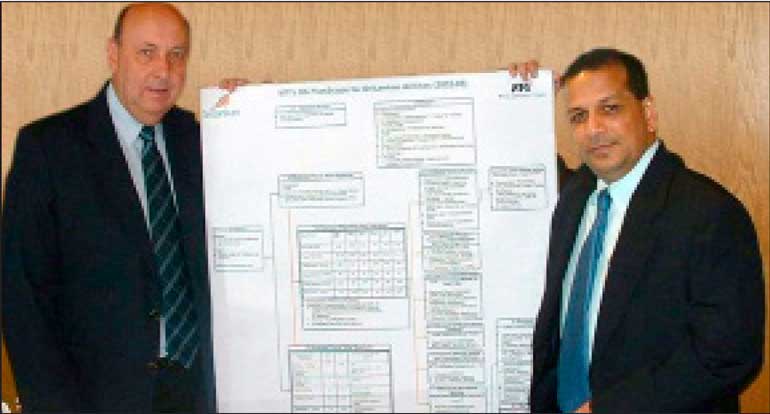
SriLankan Airlines CEO Peter Hill (left) and MTI CEO Hilmy Cader in 2005, with MTI’s 8S®-based Strategic Planscape that was deployed as the basis of monitoring the implementation progress
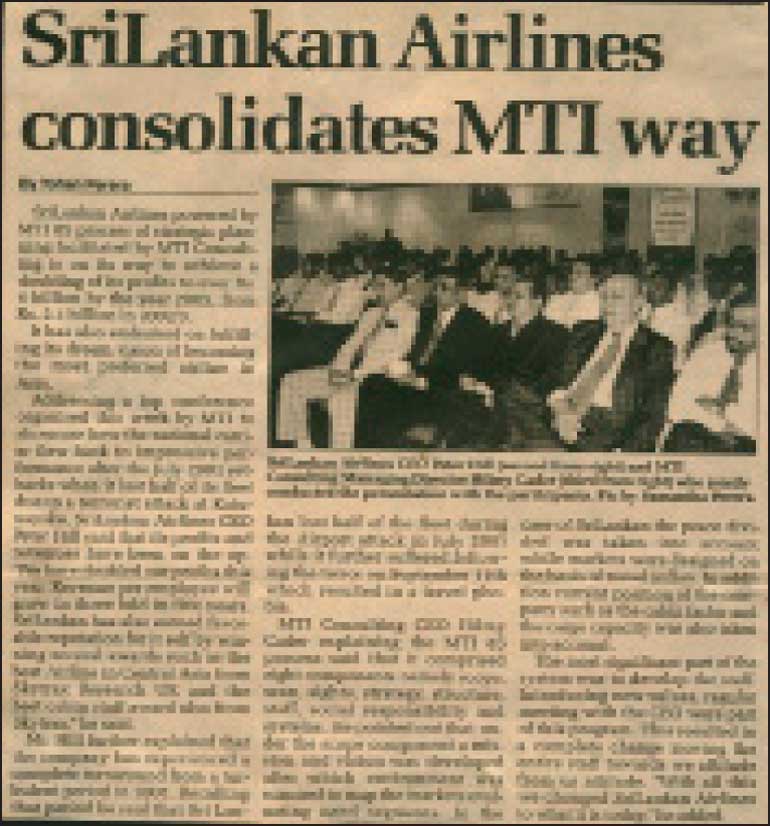
“MTI have understood our business and our needs very well - based on which they have delivered some excellent consulting across our global network of 18 countries”
In light of the Government’s recent announcement to strategically restructure SriLankan Airlines, MTI Consulting has revisited a pivotal case study from the airline’s history — a time when the national carrier overcame severe turbulence and charted a path to profitability.
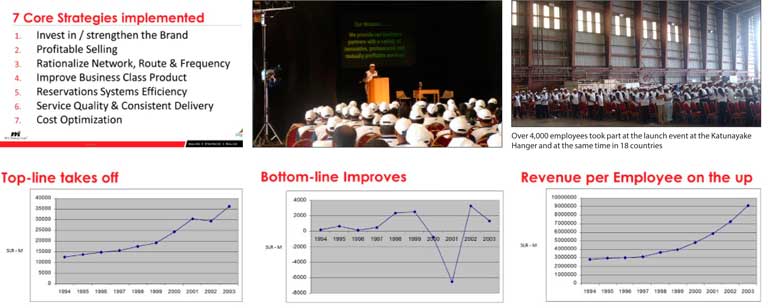
It said at the turn of the millennium, SriLankan Airlines was facing unprecedented challenges. The airline recorded losses of Rs. 750 million in 2000 and Rs. 6.5 billion in 2001, while half its fleet was destroyed in the terrorist attack at Katunayake Airport in 2001. Globally, the airline industry was reeling from the aftermath of the 9/11 attacks, and internally, SriLankan was burdened with unprofitable routes, an unsuitable aircraft mix, low yields, weak product development, and poor brand management.
In this environment, MTI Consulting, together with then CEO Peter Hill, initiated a ground-zero strategic planning exercise. The short-term goal was to achieve profitability of $ 48 million by 2005, while the long-term vision was to position SriLankan Airlines as Asia’s most preferred airline. Insights were gathered from 18 countries across Europe, Asia, and the Middle East, using ConsuLearning workshops, cross-functional teams, cross-industry learnings, and facilitated self-realisation.
The process narrowed the business focus to seven core strategies: building corporate brand equity through a world-class product, profitable selling, network and route rationalisation, upgrading the Business Class product, investing in IT for reservations efficiency, improving service quality and consistency, and cost optimisation. These strategies were broken down into measurable business health indicators linked to an automated performance management system, with 10 project champions appointed to drive execution. The exercise culminated in the launch of a new mission, vision, and values, with 4,200 employees participating across 18 countries — one of the largest corporate events of its kind in Sri Lanka.
The results were significant. Revenue per employee grew to Rs. 9 million in 2003, nearly three times the 1998/99 levels, while staff attitudes and service standards underwent a cultural transformation. Independent recognition followed, with SriLankan Airlines winning the Centre for Asia Pacific Aviation Award for Airline Turnaround of the Year in 2004, Skytrax Best Airline in Central Asia for four consecutive years (2001–2004), Skytrax World’s Friendliest Cabin Crew in 2002, and TTG Asia Best Airline in South Asia in 2002.
The relevance of this case study is particularly strong today. Between 2006 and 2015, SriLankan Airlines became the country’s third largest loss-making State-owned enterprise (SOE), incurring cumulative losses of Rs. 128 billion — greater than the Government’s recurrent health expenditure in 2014.
MTI Consulting CEO Hilmy Cader said: “This case study demonstrates that even with largely the same staff and resources, a SOE can achieve profitability if it follows a prudent strategic plan and if there is commitment at all levels of the organisation. It also serves as a stark reminder of the dangers of abandoning the strategic planning process and poor management, which can turn a profitable institution into one of the biggest loss-makers and a heavy burden to the treasury.”



