Friday Oct 02, 2026
Friday Oct 02, 2026
Monday, 11 May 2026 00:06 - - {{hitsCtrl.values.hits}}
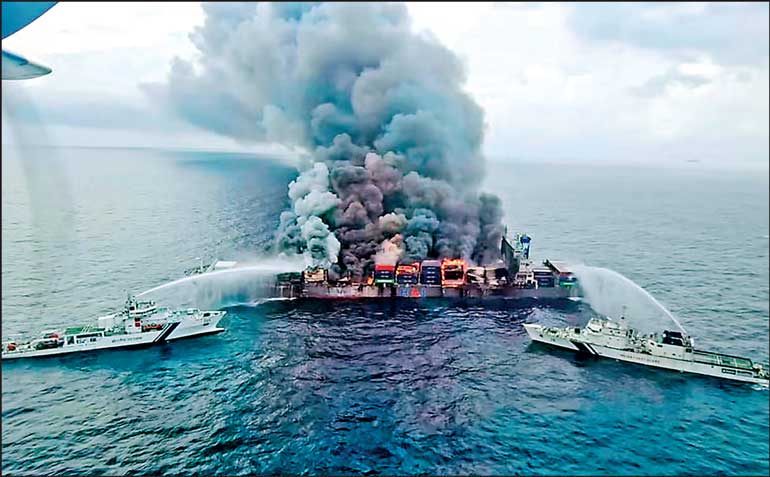
The global container shipping industry recorded 250 fires on board vessels in 2024, (the latest data available) the highest level in a decade, according to insurer Allianz, a 15 March report by the Financial Times (UK) said. Many were a result of misreported cargo, leading to hazardous goods not being handled correctly.
The report highlighted the growing frequency of fires which has become a key focus for the World Shipping Council (WSC), which represents leading shipping lines. In response, the WSC launched an artificial intelligence driven screening system in September last year, designed to scan booking in real time and flag risky containers.
Some of the risk comes from containers that have been declared incorrectly by “unscrupulous shippers,” said WSC chief executive Joe Kramek, adding that more than 75 percent of the industry by tonnage had signed up to the scheme. “We have seen too many tragic incidents where misdeclared cargo has led to catastrophic fires, including the loss of life,” Kramek said.
Industry experts told the Daily FT that while the initiative to use AI is a progressive step forward, it raises a more fundamental question: who should ultimately be held responsible when things go wrong at sea?
In recent incidents, vessel owners have often found themselves at the centre of blame, particularly in cases where mis-declared cargo leads to fires at sea. However, industry specialists now argue that responsibility, in most cases, lies much further upstream in the supply chain. When a vessel receives a container at a terminal, it does so under documentation that typically carries the terms “Shipper’s Load, Stow, and Count” or “Said to Contain.” In practical terms, this means the container is handed over in a sealed condition. The carrier has neither the legal authority nor the physical ability to break that seal and inspect how the cargo has been packed inside.
Under established maritime law, the carrier is entitled to assume that the cargo has been packed to withstand the ordinary perils of the sea, including rolling, pitching, and vibration during transit. As a result, liability for damage caused by poor packing or misdeclaration generally flows back to the party responsible for “stuffing” the container. In most cases, this is the shipper, the exporter. If cargo is improperly secured and causes damage, the shipper may be held liable not only for the loss of their own goods, but also for damage to the container and even third-party losses. For instance, poorly secured cargo that shifts during transit could destabilise other containers, leading to wider damage across the vessel.
In cases involving Less than Container Load (LCL) shipments, where cargo from multiple parties is consolidated into a single container, responsibility shifts to the freight forwarder or consolidation warehouse. In such scenarios, the forwarder effectively assumes the role of the shipper, and is accountable for how the cargo is packed and stowed.
The emerging consensus within the industry is clear: while the vessel is the most visible point of failure when an incident occurs, the root cause is often embedded much earlier in the chain; at the point of declaration, packing, and compliance.
With more than 900 million containers moving through global supply chains each year, even limited non-compliance is seen as a significant risk multiplier, industry analysts say. The issue is compounded by the structure of container shipping itself. Modern trade relies on a hub-and-spoke network in which ultra-large container vessels carry cargo between major ports, while feeder services distribute containers to smaller regional markets. While the model has driven efficiency and enabled globalisation, it depends heavily on accurate cargo declarations at origin.
However, when fires occur at sea, enforcement attention often centres on the vessel, which is within jurisdictional reach, rather than on the origin of the cargo. Analysts say this creates a structural imbalance in accountability, as the root cause of many incidents lies upstream in the supply chain. The introduction of AI-based screening tools is seen as an attempt to mitigate risk at the booking stage, but industry stakeholders say the underlying problem remains tied to enforcement at the point of origin.
Legal experts note that recent cases involving maritime incidents have seen those responsible to examine broader chains of responsibility, particularly where environmental damage or loss of life is involved. This trend is expected to increase pressure on jurisdictions to strengthen oversight of cargo declaration and container stuffing practices. Industry specialists say that unless compliance is tightened at the source, the risk will continue to be transferred through the system—from shipper to carrier, until it materialises at sea.
This highlights a systemic vulnerability in containerised trade: once a container is sealed and loaded, opportunities for intervention are limited, leaving prevention dependent on the integrity of declarations made at origin.



