Monday Sep 14, 2026
Monday Sep 14, 2026
Monday, 14 September 2026 04:24 - - {{hitsCtrl.values.hits}}
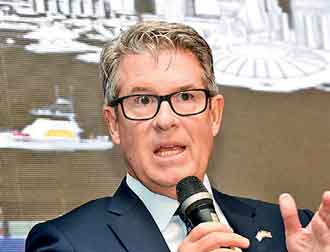
 American cargo doesn’t begin its journey when it reaches one of our ports. It often begins thousands of miles away, frequently in a place like Sri Lanka
— US FMC Commissioner Robert J. Harvey
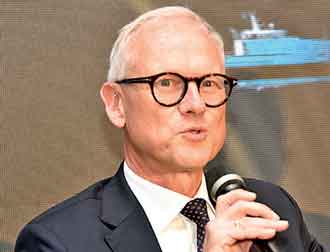
The real transformation happens when you combine a hub with strong logistics capability. That combination creates an ecosystem far bigger than the sum of its parts, and it’s also what attracts FDI
—AP Moller (Maersk) Singapore Managing Director René Piil Pedersen
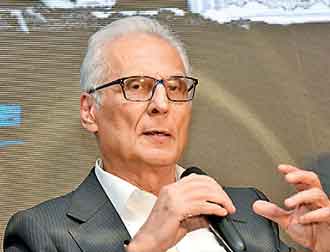
Fashion moves so fast now that a garment has almost become perishable: if it doesn’t arrive on time, it loses its value
—Brandix Lanka CEO
Ashroff Omar
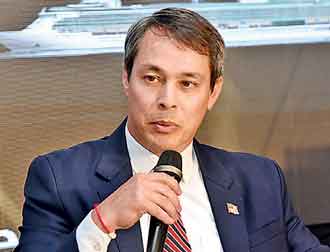
This isn’t purely altruistic support for Sri Lanka’s ports; it’s a genuine win-win for both economies
—US Embassy in Colombo Indo-Pacific Coordinator
Dustin Bickel
By Charumini de Silva
Sri Lanka’s maritime opportunity has reached a turning point, with global shipping, manufacturing and US maritime officials urging Colombo to move with urgency from being a successful transshipment hub to becoming a digitally enabled, high-speed and value-adding supply-chain hub.
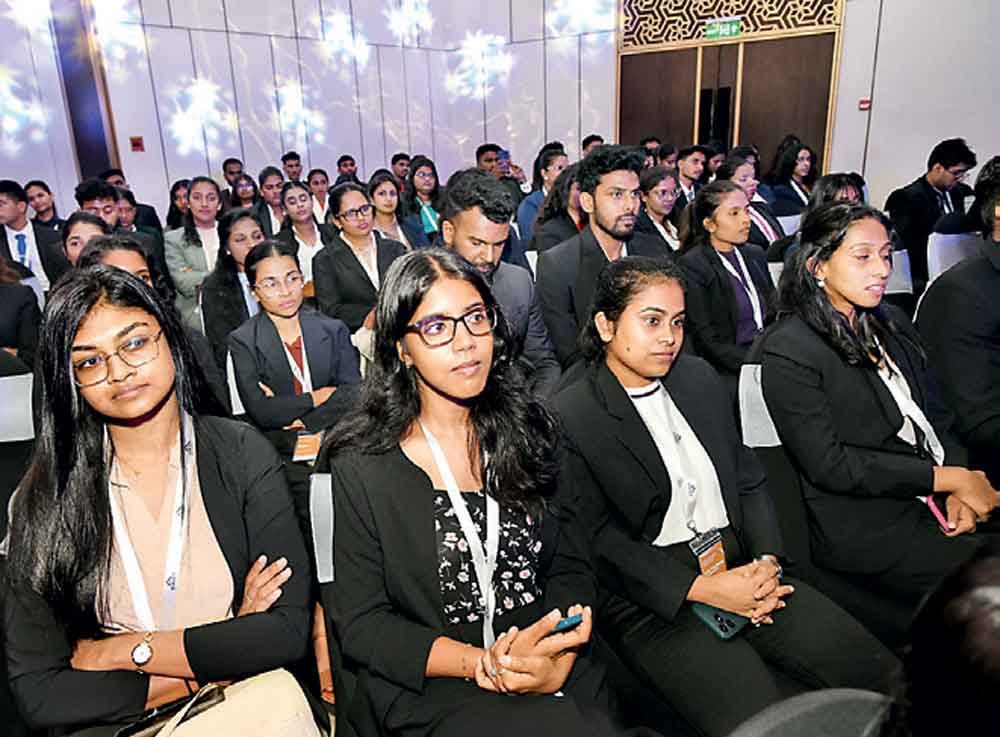
From cutting Customs clearance waiting times and digitising supply chains to developing value-added logistics, green-fuel bunkering and stronger port-to-port links, speakers at the Colombo International Maritime and Logistics Conference 2026 said Sri Lanka’s next challenge was no longer identifying its maritime potential, but converting it into competitive advantage.
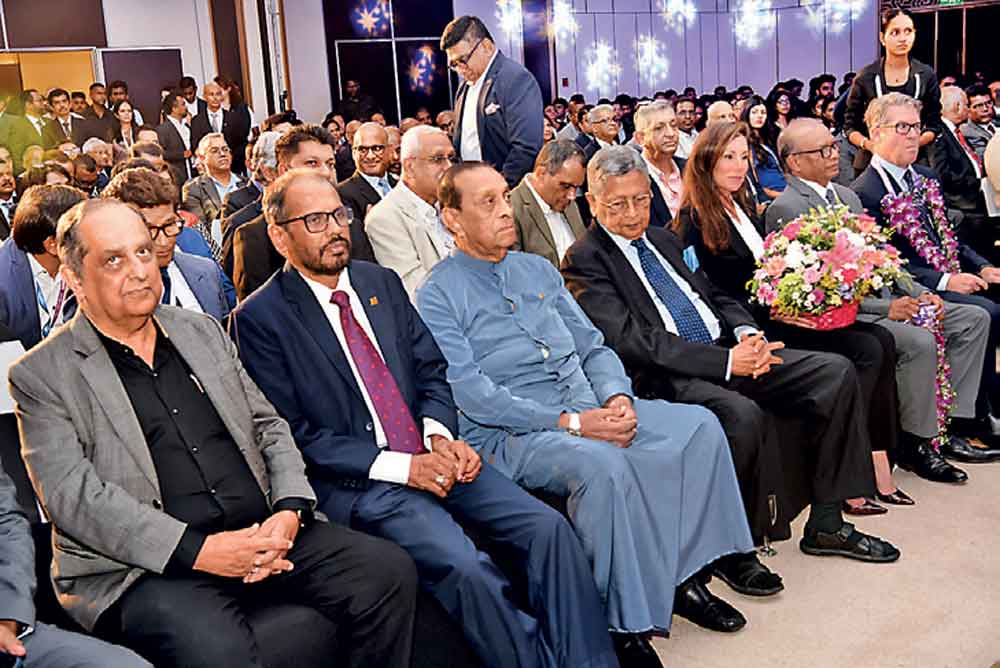
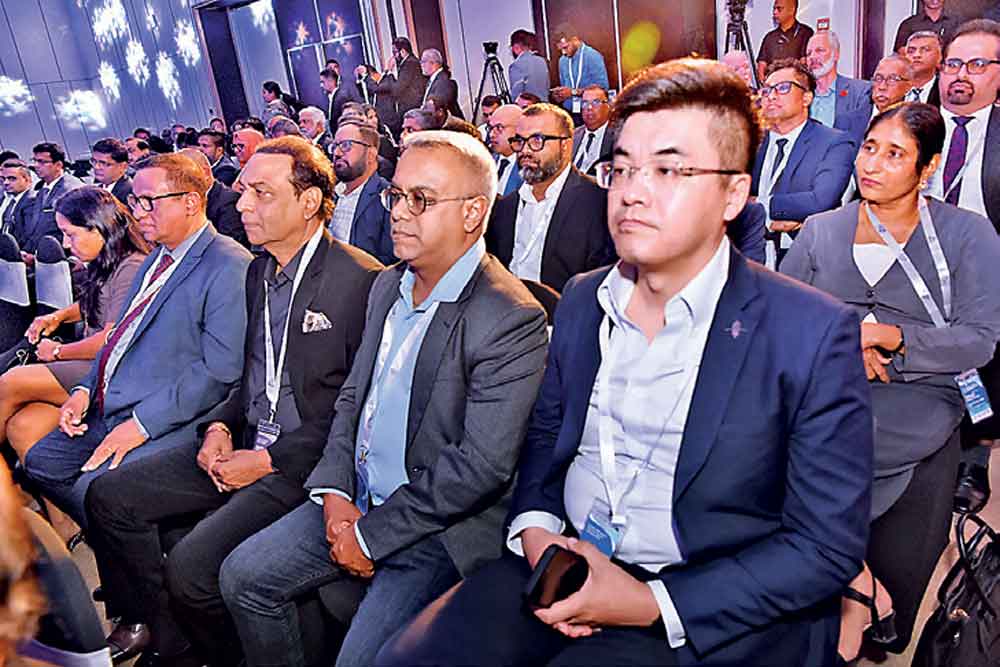
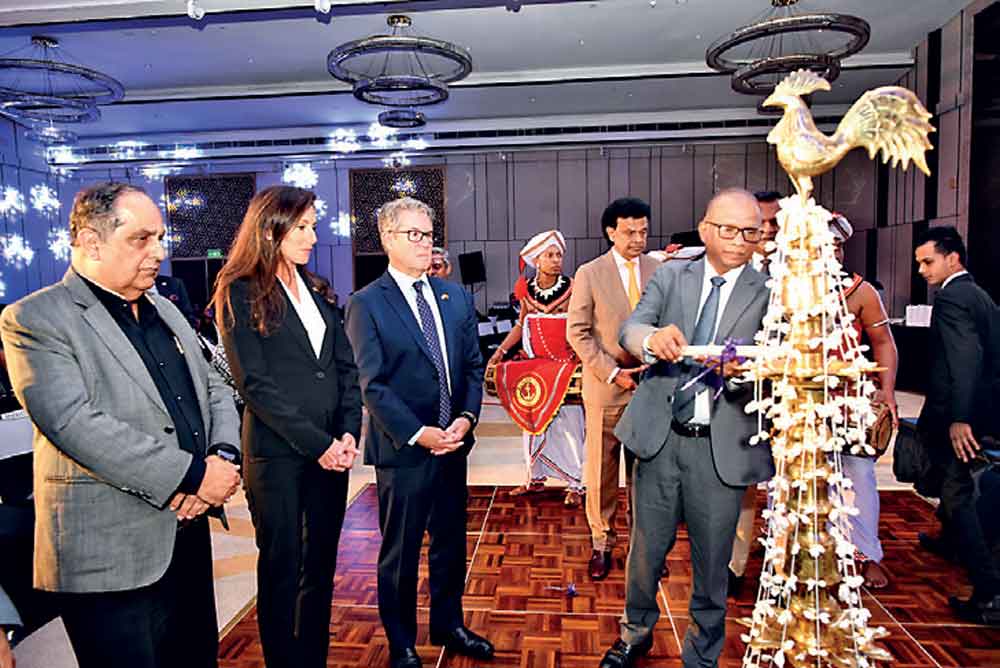
The discussion at the inauguration of the 8th edition of the Conference under the theme "Building a World Around Us", held alongside the 15th anniversary of the Shippers’ Academy last Wednesday featured; US FMC Commissioner Robert J. Harvey, AP Moller (Maersk) Singapore Managing Director René Piil Pedersen, Brandix Lanka CEO Ashroff Omar, and US Embassy in Colombo Indo-Pacific Coordinator Dustin Bickel. The session was moderated by Shippers' Academy Colombo CEO and CIMC Events Founder Rohan Masakorala.
Below are excerpts of the panel discussion:
Q: Can you give us a brief on what's happening in the fashion industry? With the global maritime sector facing supply chain challenges, what are your views on Sri Lanka and its maritime ecosystem? How would you like to see it evolve over the next 25 years as your company scales to the next level?
Ashroff: I think, looking at the way things are moving, a 25-year horizon is premature, because things are changing extremely fast. If you look at just the next three to five years, everything in our industry is being reshaped by customer demand. It's no longer just about cost and delivery; now it's cost, speed, and flexibility, often with smaller order volumes.
To meet that demand, logistics has to be treated as an integral, end-to-end part of the process, not something we hand off to a forwarder and forget about. Fashion moves so fast now that a garment has almost become perishable: if it doesn't arrive on time, it loses its value.
With the advent of AI, I believe current usage in our industry is under 0.5%. We might save five days in production, but the goods can then sit at port or with freight forwarders for another 10 days, erasing all those gains. Without a fully digital supply chain, that inefficiency will keep costing us.
As an industry, we are proposing that Customs clearance be pre-cleared straight from the manufacturing plant, so shipments aren't held up in documentation or other processes once goods are ready to move, those steps need to be digitised entirely. I'm not proposing faster ships; I'm saying we can eliminate the waiting time in the process. If we do that over the next year or two, we can gain much better leverage and competitiveness against other countries.
Q: Turning to Sri Lanka specifically, over the coming three to five years, what would you like to see change from service providers and policymakers? Where is your industry facing the biggest challenges right now?
Ashroff: As I said, speed is now critical, waiting time has to stop. That requires strong Government support to ensure digitalisation is executed quickly. Once goods are produced, they need to be shipped out as fast as possible. What we need are quick, practical steps rather than grand plans that don't get delivered. I think that's a view shared across the industry. We should be talking about the next five years, not 25 years.
Q: From your regional vantage point in Singapore, what critical physical and digital infrastructure changes should emerging hubs like Sri Lanka be focusing on? How can that East Asian experience be applied to South Asia, and specifically to Sri Lanka?
René: At Maersk, we operate across several parts of this industry. We're known primarily as a global shipping line, but we also operate terminals. As many of you know, we are a partner at South Asia Gateway Terminals (SAGT) in Colombo and we are active in landside logistics as well, including warehousing and distribution centres.
Fundamentally, what we do is enable trade. As one of the earlier speakers, I believe the Governor of the Western Province pointed out, we create opportunities for exporters and importers. It's the reason consumers in the US can buy apparel manufactured right here in Sri Lanka.
Looking at Sri Lanka alongside other hubs in Southeast Asia, Singapore, but also Vietnam and Malaysia, the real transformation happens when you combine a hub with strong logistics capability. That combination creates an ecosystem far bigger than the sum of its parts, and it's also what attracts FDI. A country like Sri Lanka has the opportunity to capture a much larger share of the value chain, not just in distribution, but in value-added services.
Take Singapore as an example. Scotch whisky exporters ship bottles into Singapore, store them in a free trade zone, and the labelling is finalised depending on the final destination, different requirements for the Philippines versus Jakarta, for instance. That value-added service is captured by Singapore, even though it doesn't produce whisky itself. Sri Lanka sits right on a major global trade route, which is exactly the kind of opportunity that presents.
Q: Given your background in maritime law and the Federal Maritime Commission's ongoing focus on global chokepoints and supply chain resilience — how do you approach your role at the FMC, and how do you manage disruptions to navigation and international trade affecting US supply chains?
Robert: American cargo doesn't begin its journey when it reaches one of our ports, it often begins thousands of miles away, frequently in a place like Sri Lanka. If our global supply chains had the resilience of the Sri Lankan people, we'd be in much better shape.
We investigate chokepoints on an ongoing basis, I can't speak to specific cases, but chokepoints can occur anywhere: at the origin of cargo, along shipping routes, at the terminal on arrival, or after cargo leaves the terminal gates. As a regulatory agency taking an increasingly assertive stance, we investigate any chokepoints that negatively impact American cargo, and we enforce where necessary.
Beyond our regulatory role, we also have enforcement authority, and we function in a quasi-judicial capacity, we operate transparently, so the results of our regulatory cases, fines, and the decisions we render in disputes between private parties are all publicly available. We have seven full-time administrative law judges handling these cases. Chokepoints are just one of many areas we monitor, but a very important one.
Q: As a country, how would you suggest the Government of Sri Lanka work more closely with the Federal Maritime Commission?
Robert: I think we continue doing what we've started, this kind of exchange, where you visit us and we're here in turn. It's an exchange of ideas and approaches to enforcement. We're happy to share that information; it's publicly available, but we're also glad to discuss it one-on-one. We'll work with anyone in the world to ensure American cargo isn't negatively affected and anytime you want to reach out, you can call me or the Chair directly.
Q: You've been based here for a couple of years now, having previously worked in South India as well. Given your broader regional perspective — where can Sri Lanka improve in terms of technology and other areas, in ways that would also benefit US exporters?
Dustin: Over the past three years, I've had the pleasure of watching Sri Lanka's port sector grow, watching terminals come to life, including the development of both WCT and ECT. The United States has partnered with the Sri Lankan Government and the Ports Authority for some time, but our focus has centred on the Port of Colombo, looking at how we can improve efficiency and strengthen both bilateral and broader Indo-Pacific trade. Everyone here knows Colombo is South Asia's predominant transshipment hub, and until relatively recently, it was one of the only deepwater transshipment hubs in all of South Asia. The port handled over 8 million TEUs last year, and SLPA has projects underway to expand capacity to 14–15 million TEUs within just a few years. As other speakers mentioned, roughly half a million of those 8 million TEUs represent US-inbound and outbound cargo, amounting to tens of billions of dollars flowing into our economy.
So our focus is on streamlining cargo handling at the Port of Colombo, because greater efficiency translates directly into reduced shipping costs, which benefits US manufacturers shipping through Colombo, and ultimately US consumers, since those savings get passed down. This isn't purely altruistic support for Sri Lanka's ports; it's a genuine win-win for both economies.
Some of the work we've done with the Sri Lankan Government and SLPA includes facilitating regional engagements that bring port sector stakeholders from across South Asia together, to build relationships, improve communication between ports, and enable them to call on each other for support when needed. We also run workshops and training programs involving multiple countries.
On cargo security, the US Department of Energy runs a program called the Nuclear Smuggling Detection and Deterrence Program, some of you may know it as "Megaports." This strengthens the port's ability to scan containers and prevent the movement of radiological materials, helping keep the whole world safer.
We're also building port-to-port relationships. Last year, we facilitated a memorandum of cooperation between the Port of Colombo and the Virginia Port Authority, and we're looking to expand these partnerships with more American ports, enabling knowledge exchange and shared development. Through these exchanges, workshops, training, and the provision of key equipment some of which we expect to announce in the coming months, the US Government continues to demonstrate its commitment to Sri Lanka's ports and maritime sector, and to advancing the shared prosperity of both our countries.
Q:On the subject of US tariffs, everyone wants to know how you manage this, especially given Laura's access to President Trump. How do you actually navigate it?
Ashroff: That's a tough question. The advantage for Sri Lanka's apparel sector has been that, relative to our competitors, we're on par, if not ahead. That's helped us in the short term. Whether that's sustainable long term is the real question, which is exactly why fixing our infrastructure and improving our speed to compete matters so much.
We can't control what tariff regime the US, Europe, or any other country chooses to impose. We can only control how competitive we make ourselves relative to our peers. Some competing countries have full duty-free access, but face other disadvantages; otherwise, there would be no exports coming out of this part of the world at all. Our Government needs to keep that relationship strong enough that we're not disadvantaged, and I think, so far, that's been managed reasonably well. Beyond that, we need to look inward, strengthening ports and the supply chain to reduce costs and improve efficiency is something entirely within our control.
Q: As the shipping industry moves toward greening its fleet, in line with global decarbonisation goals — what do you expect from the Port of Colombo on that front?
René: Decarbonisation remains high on our agenda, though the conversation has shifted somewhat with high oil prices, in many regions it's increasingly about energy independence rather than just emissions.
Being a hub creates an opportunity to be more than just a transshipment gateway, it can also become a bunkering hub. Some countries have already capitalised on this; Singapore, again, is a strong example, supported by its refining capacity. Being able to offer future fuels including; green fuels specifically creates real stickiness, making a location more attractive to shipowners like us.
That said, the key question for Sri Lanka is whether it can produce fuel domestically, green molecules, in particular and whether it wants to allocate that capacity to the international shipping industry. Becoming a bunkering hub is a genuine opportunity, and one that could also benefit the local economy by creating jobs and building new skills.
Q: So you see a role for Sri Lanka in the green shipping transition?
René: Absolutely. As I mentioned, Sri Lanka sits right next to one of the world's major shipping highways. As a shipowner, we operate around 150 vessels flying the Singapore flag, I'd welcome the opportunity to bunker here. I've discussed this with the Minister directly, and I recognise it isn't a simple undertaking. But it is a real opportunity, and if fuel can be sourced regionally and made available here, it would be an attractive option for other shipowners too.
More broadly, we have a strong ambition to decarbonise our entire supply chain, whether that's warehouses, port operations, or logistics. In several countries, we're introducing EV trucks for container transport, and all our new terminals are being built with decarbonisation and renewable energy use in mind. This is both a genuine commitment on our part and something that strengthens our competitiveness.
Q: Your CV mentions an interest in quantum maritime solutions, fleet optimisation, secure communications, and so on. Can you explain what that involves?
Robert: I'm a securities lawyer by background, but a scientist. In a prior role, I served as President of the Florida Opportunity Fund, the State's venture capital fund, where we were an active technology investor, including in quantum computing. I believe quantum will be one of the next major developments in maritime, particularly around communications and predictive maintenance. I recently attended the White House's AI summit, which also touched on quantum.
I'm a strong believer in backing technology and innovation. As a regulator, even as we pursue aggressive enforcement, I'm always mindful of the business implications of our decisions. We don't want our regulations to hamper innovation or discourage investment, because without investment, you don't get innovation. The rules need to apply equally to every player in the maritime ecosystem, and if a quantum-focused maritime startup is looking for a base, Colombo could be a genuinely attractive option, provided the regulatory and investment framework is transparent enough for investors to feel confident. That principle applies to every level of the supply chain. I'm sure René would say the same about how his terminals are run.
Q: Finally, what's your closing message to this conference?
Dustin: We see real opportunity in Sri Lanka's port sector, and on behalf of the US Government, we look forward to continuing to work with Sri Lanka, SLPA, and the Ministry to help grow this industry — because ultimately, we all benefit.
Ashroff: I think conferences like this can help push us beyond simply being a maritime hub, toward becoming a high-speed supply chain. I hope your deliberations over the next couple of days move us further in that direction.
René: Seize the day. You're sitting on a tremendous opportunity here, your geographic position, and your standing as an important hub for the region and globally. That's exactly why we have the FMC's representation here today. Seize the day, Sri Lanka has the opportunity to make this happen.
Robert: There's a tremendous opportunity here, but it now comes down to execution. Think of the country as a business; you need a plan, and at some point you need to execute it with urgency. Change is happening quickly, so there has to be a real sense of urgency to move things forward. You're blessed with an opportunity, now it's time to execute.
- Pix by Shehan Gunasekara