Friday Oct 16, 2026
Friday Oct 16, 2026
Monday, 6 April 2026 04:23 - - {{hitsCtrl.values.hits}}
As the apex body representing Sri Lanka’s shipping and agency community, the Ceylon Association of Shipping Agents (CASA) serves as the collective voice of the maritime industry. We engage policymakers, regulators, and stakeholders to ensure that port development and trade facilitation reflect global realities and national aspirations. Our observations aim to support sustainable growth, operational efficiency, and the strategic positioning of Sri Lanka’s ports in the regional maritime landscape.
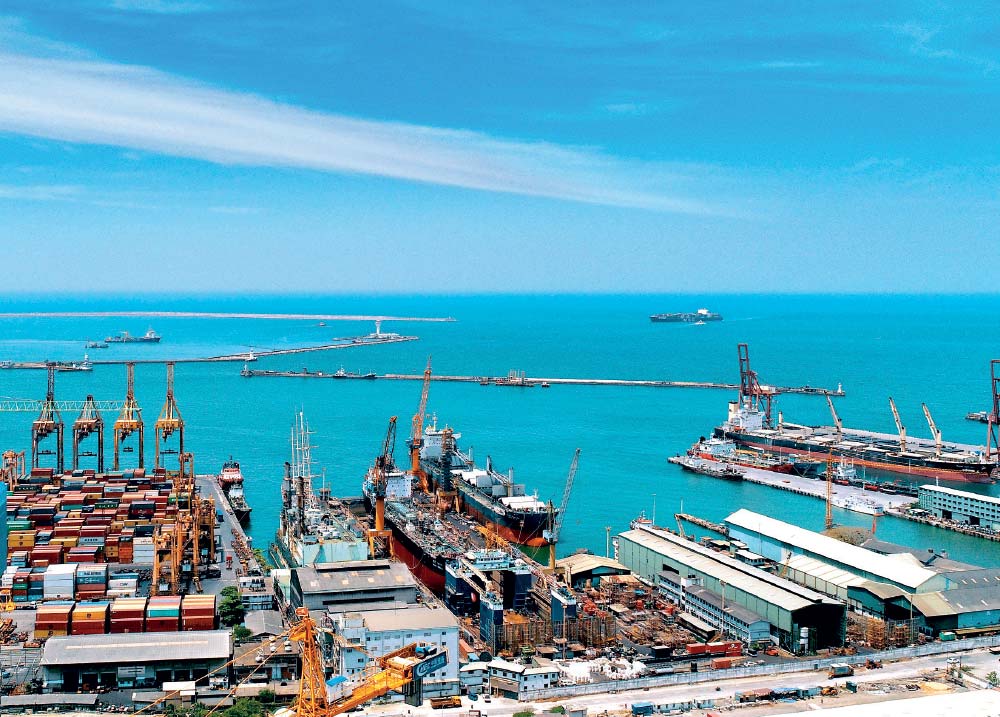
Sri Lanka’s Port of Colombo has long anchored the country’s role in global shipping. It remains a vital transshipment hub on the east–west trade route and a key node for South Asian cargo flows. Yet, as throughput grows and capacity stretches, there is a need to consider complementary development strategies that both diversify cargo types beyond containers and enhance resilience in a dynamic regional context.
Colombo Port: Strengths, constraints and emerging opportunities
The Port of Colombo continues to perform strongly, with 2025 seeing a record 8.2 million TEUs, reflecting sustained growth and global confidence in its operations.
Significant developments have reinforced this position:
At the same time, Colombo is approaching practical operational limits. Peak congestion and berth utilisation pressures are increasingly visible, and the port’s container-centric focus means other cargo segments — bulk, energy, and project shipments — are less optimally accommodated.
Geopolitical shifts and Colombo’s strategic relevance
The escalating conflicts in the Middle East, particularly the dual-chokepoint disruptions in the Red Sea and the Strait of Hormuz, have fundamentally altered global maritime logistics. As major liners reroute vessels around the Cape of Good Hope to avoid high-risk zones, the Port of Colombo has emerged as a vital transshipment pivot, handling significant overflow and serving as a gateway for cargo destined for the Middle East and East Africa via safer feeder loops.
CASA observes that this shift is more than a temporary surge; it is a testament to the need for a resilient maritime hub that offers reliability when traditional routes fail. By providing world-class bunkering, crew changes, and emergency maintenance services—away from the immediate conflict theater—Sri Lanka can offer the shipping industry the contingency it requires. Leveraging our strategic neutrality and multi-port capacity allows the nation to not only absorb immediate trade diversions but to also position itself as a permanent, indispensable node in a more fragmented and security-conscious global supply chain.
Integrating Free Zones into this strategic framework is also essential for evolving Sri Lanka from a simple transit point to a high-value Global Distribution Hub. Our Free Zones provide a unique legal and operational environment where goods can be imported, value-added, and re-exported without traditional customs intervention. To effectively market these zones, we must shift the narrative from storage to Agile Fulfillment. By utilising these facilities, shippers can slow down or speed up their supply chains, using Sri Lanka as a Virtual Warehouse to buffer against global volatility. This allows cargo to wait in a duty-free environment until the optimal shipping window opens, ensuring that the final product is perfectly tailored for the target market.
In response, the Sri Lanka Ports Authority has explored the WCT 2 and North Port projects, which could provide additional capacity for a mix of cargo types. While this remains at conceptual and feasibility stages, CASA observes that such initiatives could complement ongoing expansions, providing both operational flexibility and strategic breathing room for national port growth.
Regionally, competition is evolving. India’s Vizhinjam International Seaport, for example, has rapidly captured niche transshipment volumes with ultra-large container vessels with advanced automation, attracting carriers such as MSC. CASA notes that maintaining Colombo’s leadership will likely involve balancing container efficiency with targeted diversification into other cargo segments, alongside enhanced digitalisation and hinterland connectivity.
Trincomalee: Unlocking maritime and industrial potential
The Port of Trincomalee possesses one of the largest and deepest natural harbours in the world, with water area many times that of Colombo and extensive land available for industrial development. Currently, it handles bulk and break bulk cargo, oil products via the adjacent IOC tank farm, and limited industrial activity.
CASA identifies several areas where Trincomalee could play a complementary role in the national port ecosystem:
1. Bulk, break bulk and project cargo terminals
Trincomalee’s natural depth and space make it suitable for handling coal, clinker, fertiliser, grain, and other non-container commodities, serving as a regional gateway complementary to Colombo’s container focus.
2. Regional energy logistics hub
Discussions with India and the UAE envision pipelines, bunkering, storage, and potentially downstream processing. Major hubs in Singapore and Dubai demonstrate the value of integrating energy logistics with port operations, and CASA sees similar potential for Trincomalee to capture regional flows.
3. Ship repair, marine fabrication, and offshore services
Opportunities exist to develop repair yards, ship modification centres, and offshore fabrication facilities. CASA notes that global examples — including South Korea and Singapore — highlight how strategic investment in marine engineering clusters can generate significant economic and employment benefits.
4. Bay of Bengal logistics linkages
Trincomalee’s proximity to eastern Indian ports, Bangladesh, and Myanmar creates opportunities for integrated cargo distribution. Initiatives to develop a 600-acre logistic hub connecting sea, rail, and air freight underscore the potential to attract investment and strengthen regional integration.
Hambantota: Diversified transshipment and industrial node
Hambantota has already developed multiple functions: container transshipment, dry and liquid bulk handling, RO RO and vehicle operations, as well as bunkering and petrochemical logistics.
The planned $3.7 billion Sinopec refinery could further strengthen Hambantota’s role in energy logistics, while offering a complementary platform to Colombo and Trincomalee for specialised cargo flows.
CASA observes that Hambantota is well-positioned to serve as a strategic complement, absorbing specific transshipment lanes and industrial cargo flows, and reducing pressure on Colombo.
Regional context: Lessons from India and Singapore
Sri Lanka’s port strategy can benefit from international experiences:
CASA notes that by learning from these models, Sri Lanka could strengthen port efficiency, diversify cargo handling, and integrate national port development with regional trade corridors.
Observations and advisory insights
From CASA’s perspective:
Conclusion
Sri Lanka’s maritime future depends on a balanced, multi-port approach. Strategic expansion, careful diversification into new cargo sectors, and collaboration across Colombo, Trincomalee, and Hambantota can strengthen the national port network, enhance resilience, and position Sri Lanka to capture global trade flows effectively.
CASA remains committed to supporting dialogue, sharing industry insights, and contributing to a sustainable and competitive maritime ecosystem that benefits both the shipping community and the national economy.




