Friday Sep 18, 2026
Friday Sep 18, 2026
Wednesday, 25 March 2026 16:10 - - {{hitsCtrl.values.hits}}
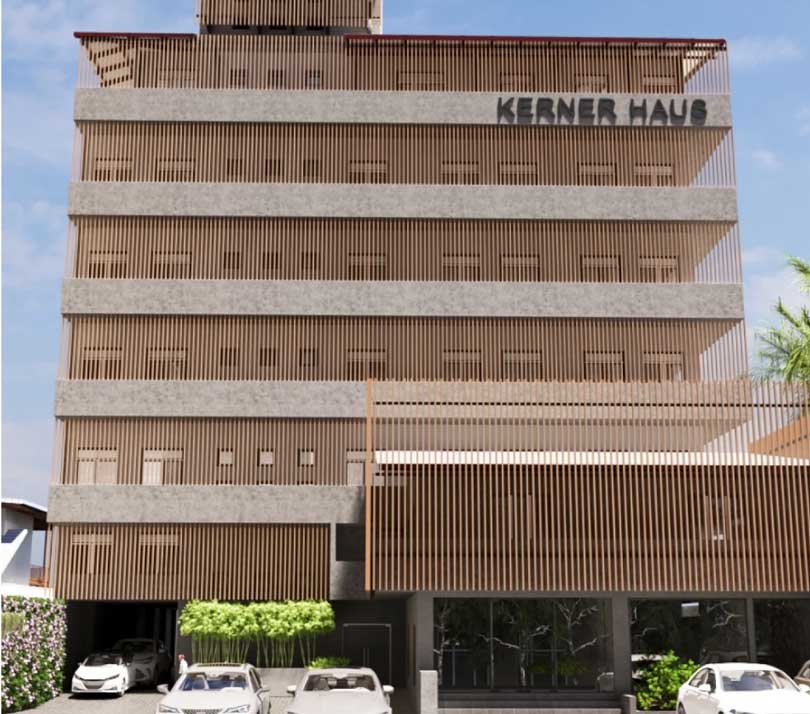
Kerner Haus’s managed office facility in Mount Lavinia.
As businesses place greater weight on speed, flexibility, and operating certainty, Sri Lanka’s office market is beginning to shift from simple occupancy toward business infrastructure.
Sri Lanka’s office market is changing, and the expansion of Kerner Haus offers a useful lens into that shift. The company’s public footprint now spans Nawam Mawatha, Kew Road, Mount Lavinia, and Kandy, with its managed office proposition centred on furnished space, business grade internet, backup power, security, and support services for teams typically ranging from 40 to 400 seats. That matters because it points to a broader change in what occupiers increasingly value: not just an address, but the ability to begin operating quickly and reliably. The company’s brochure makes that positioning explicit.
Kerner Haus’s story is not simply one of more office space entering the market. The company, which was renamed Kerner Haus Global Solutions PLC in August 2025, is now presented publicly as a managed office and business support platform under a listed vehicle. That distinction matters. In a conventional leasing model, the core product is physical space. In a managed model, the value lies in reducing setup time, lowering operational friction, and improving day one readiness for occupiers. The renaming and listed company record are set out in its CSE filing.
For many businesses such as BPO’s, KPO’ and especially SMEs, project teams, and overseas firms entering a new market, the old office proposition is increasingly too narrow. What matters now is not only location or rent, but how quickly a team can become functional. Furnished environments, reliable connectivity, power continuity, maintenance, security, and access to day to day support reduce the coordination burden on the occupier. In practical terms, that means the category is moving beyond workspace and toward operating capability. Kerner Haus’s public materials emphasise these features, including 24/7 access, backup power, high speed internet, and support services ranging from Human Resources, Accounting Support, Book Keeping, Marketing, Legal, IT and Security.
Sri Lanka is not moving in isolation. In India, listed operator Awfis reported that as of 31 March 2025 it operated 208 centres with more than 134,000 operational seats, positioning itself not just around desks but around flexible workspace solutions at scale. In the Philippines, KMC Solutions markets fully managed offices alongside IT enabled, enterprise grade environments. These models show that in more mature regional markets, flexible office demand is increasingly tied to service quality, reliability, and operational readiness, not square footage alone.
This has implications beyond the office sector. Markets such as India and the Philippines have strengthened their appeal to international businesses not only because of labour depth or cost, but because they have built easier operating environments around new entrants. Sri Lanka’s competitiveness will increasingly depend on similar qualities: faster setup, lower friction, greater reliability, and more credible launch platforms for businesses testing the market or building an initial presence. In that context, managed office supply becomes more than a real estate story. It becomes part of how a country presents itself as a place to establish and scale operations.
That may be the clearest way to understand what is changing. The real question is no longer whether a company can find office space. It is whether it can find an environment that allows it to operate from day one with fewer delays and fewer internal distractions. Seen in that light, the product is no longer just space. It is business infrastructure.
Kerner Haus’s growth is notable because it reflects that wider shift. The market is starting to reward providers that can combine location, flexibility, and reliability in a way that makes business setup easier. If that trend continues, the future of office demand in Sri Lanka is likely to be shaped less by occupancy alone and more by the strength of the operating environment surrounding it.




