Saturday Oct 17, 2026
Saturday Oct 17, 2026
Thursday, 16 July 2026 03:36 - - {{hitsCtrl.values.hits}}
By Roshan Madawela
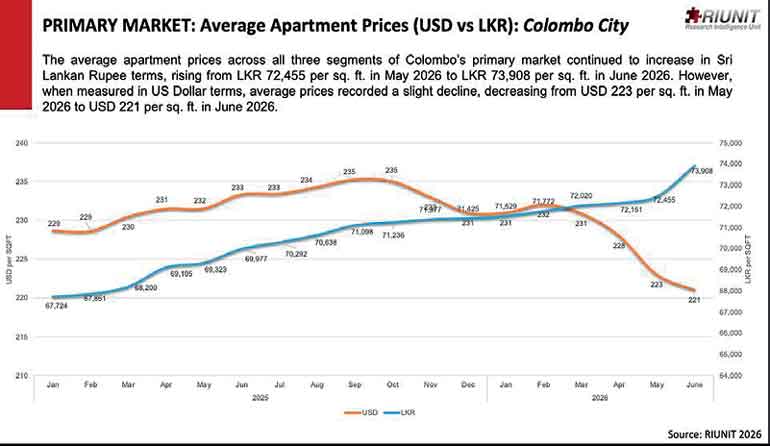
The most significant impact that reverberated across the real estate markets during June/July 2026 was a notable depreciation in the LKR against the greenback for multifarious economic and international trade related reasons. Consequently, the primary market value of apartments (Colombo and suburbs), gated housing units and bare lands all experienced a drop in price as measured in USD. Any type of price drop in real estate can trigger alarm bells as a knee-jerk reaction among investors because many confuse the primary market with capital gains which is the actual measure of what investors make as the fruits of their property ownership. By contrast, a drop in the primary market prices of organised real estate, which is the representation of the price that developers launch their products at, actually means that the island›s real estate is now more affordable to those earning and paying in foreign currencies. Moreover, given that unto 2 million members of the country’s diaspora community form an important segment of demand for Sri Lanka’s real estate assets, developers will find it in their favor when pitching to foreign or diaspora buyers anywhere in the world.
It is also important to note that whilst international and geopolitical pressures may push the LKR towards devaluation, the island›s property prices as measured in LKR have continued to climb at very healthy rates, as they always have since we at the Research Intelligence Unit (RIUNIT) started collecting transaction data in Sri Lanka over 20 years ago. Hence, the real demand for local property is underpinned by steady domestic demand at its core. A case in point, our data shows that average market absorption of apartment units in Colombo for tier 3 is almost at 100% with some local geography variations. Similarly, tier 2 absorption averages above 90%. In fact across all 13 Wards of Colombo and the 20+ suburban areas of the Western Province that RIUNIT surveys each month, absorption continues to increase.
Meanwhile, the World Bank officially upgraded Sri Lanka back to an ‘upper-middle-income economy’ following strong economic growth of 5%, increasing per capita income to $4,670 in 2025. So far in 2026, we have witnessed over $600 being invested into the Port City with the islands’ leading developers leasing multiple plots and launching 3 new ground-breaking projects that we believe will provide the essential momentum that is needed for the Port City Colombo to thrive despite challenging global conditions that will continue to shape the domestic economy.
(The author is Founder of Research Intelligence Unit)




