Monday Aug 17, 2026
Monday Aug 17, 2026
Tuesday, 17 February 2026 02:02 - - {{hitsCtrl.values.hits}}

CFA Society Sri Lanka President Rashmi Peiris

Moderator CE Committee, CFA Society Sri Lanka Member, and LYNEAR Wealth Management Advisory Head Rashmika Nissanga

Prime Group Founder and Group Chairman Premalal Brahmanage
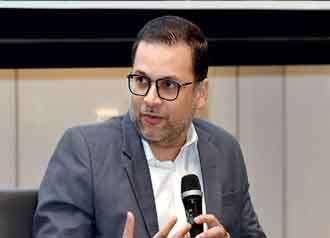
John Keells Holdings Vice President and Asset Management Head Rusiru Abeyasinghe

FJ&G de Saram Partner Manjula Ellepola
By Divya Thotawatte
Sri Lanka’s real estate sector is not short of demand but of financial and legal structures, said industry leaders recently, highlighting mortgage expansion and a functioning REIT market as key to future growth.
This discussion took place at an exclusive evening session titled ‘Real Estate Reimagined: Investment Opportunities in a Transforming Market’. The session, organised by the CFA Society Sri Lanka, in association with Prime Group and John Keells Properties, examined emerging investment opportunities and strategic considerations within Sri Lanka’s rapidly evolving real estate sector, against the backdrop of economic shifts and market transformation.
The resource panel featured Prime Group Founder and Chairman Premalal Brahmanage, John Keells Properties Asset Management Head and John Keells Holdings Vice President Rusiru Abeyasinghe, and FJ & G. De Saram Partner Manjula Ellepola.
They highlighted that despite many challenges to real estate growth, Sri Lanka was entering a structural shift in housing finance that could transform the sector.
Abeyasinghe said, “Sri Lanka has been a very low mortgage exposure country. Only about 10% of the bank assets are in mortgages. There has been very little innovation in products on that end. But of late, we are seeing that happening.”
Banks were beginning to move beyond traditional lending limits, he said, noting that banks were now lending 100% mortgages and, sometimes, even up to 120%, subject to stringent approval checks.
According to Abeyasinghe, expanding beyond the previous 70-80% loan-to-value was encouraging as it would make mortgages more accessible to a larger portion of the population, enabling more people to enter the housing and apartment markets. He added that increasing the share of mortgages within the banking system would be beneficial as the sector transformed further.
Limited access to commercial property investment
Despite growing residential demand, Sri Lanka offered few opportunities for investors to access commercial real estate. “From an investor perspective, Sri Lanka is still a little bit behind. Other than on the apartment, housing and land segment, there is very little opportunity to get into the commercial side of it.”
He explained that while individuals could purchase residential assets independently, commercial assets, due to their larger size, typically required a pooled investment scheme. Despite their potential, such collective investment opportunities were often absent in Sri Lanka.
Abeyasinghe said that emerging sectors linked to trade and technology were beginning to create demand for new types of property. Port-related development was creating opportunities for logistics facilities, while internationally, data centres were also becoming a major category in real estate.
“The port is really cranking away… there is warehousing opportunity around there. Also, globally and even in the region, we are seeing data centres picking up heavily. And Sri Lanka is still far behind.”
He also noted that in some commercial property segments, yields remained competitive, with warehouse returns broadly at around 8%. However, even as demand was growing in logistics and data infrastructure, investors had little access to commercial property. With major assets held by a limited group of owners, the market remained illiquid.

REITs as a missing mechanism
They repeatedly identified Real Estate Investment Trusts (REITs) as a key mechanism needed to unlock the sector. They stressed that REITs would broaden participation in property ownership beyond high-net-worth investors and improve liquidity in the market.
While globally, REITs allowed investors to gain property exposure through capital markets, Sri Lanka has yet to launch a single functioning REIT.
“As of 2025, there are about 40 REITs in Singapore, valued at $100 billion. We are not even close to it. We haven’t even bought a single REIT off the ground yet.”
Abeyasinghe highlighted tax treatment as a major obstacle, noting that in Sri Lanka, REITs were subject to corporate income tax, and taxing yields of 6-7% at 30% significantly reduced investor returns.
He added that high transaction costs made REITs less viable. Stamp duty, VAT on building value, and legal fees increased acquisition costs. “The value of the asset is significantly overstated because of all these tax elements.”
Ellepola said that legal challenges also affected REIT formation, pointing to provisions in the Land Restrictions on Alienation Act.
“The Land Restrictions on Alienation Act limits foreigners from buying properties,” she said, noting complications even when a REIT trustee is a licensed commercial bank with foreign ownership. She added that even condominium purchases by foreigners must be paid outright using foreign funds.
Ellepola also highlighted technical issues relating to apartment sales before completion. She explained ownership could not be legally transferred until the building was completed and registered.
“The deed of transfer cannot be done till the condominium building is completed,” she said, explaining that buyers instead must assign contractual rights to the properties until the final transfer becomes possible.
Despite these legal challenges, panellists said foreign investors and the Sri Lankan diaspora were an important market for the sector.
Foreign buyers and diaspora as growth market
Brahmanage said that the sector was increasingly targeting overseas investors and expatriate Sri Lankans. “Now we have the investor visa programme – the golden visa program – where you pay US $100,000, you will get five years tax exemption, and $ 150, 000 or $ 200, 000, you get a 10-year visa.”
He argued that Sri Lanka should actively market the country’s real estate internationally. He said it would be especially advantageous to market the sector to regional buyers like India, whose economy was seeing rapid growth.
“If we really capture the Indian market, that is more than enough,” he said, highlighting India’s large and growing buyer base, which also contributed to a large portion of Sri Lanka’s tourism.
Brahmanage said that the diaspora buyers, especially older migrants from USA, UK, Canada, and Australia were also showing growing interest in property ownership in Sri Lanka. There were diaspora buyers who wanted to return to Sri Lanka periodically, especially during the colder seasons in their countries of residence.
According to him, certain developments were seeing strong capital appreciation and above average yields due to high demand for apartments and leisure properties. He added that interest was especially strong in coastal areas, while land values in the southern and hill country regions were also rising, creating opportunities for villas and holiday homes.
Abeyasinghe added that macroeconomic stabilisation following the crisis has also begun to restore confidence. “The country is relatively stable now, after the economic crisis… stability in policy will help stability in the currency, which again will give confidence to the diaspora to come in and invest in our property.”
However, foreign buyers also faced financial limitations, Brahmanage noted. “For foreigners, we don’t give bank loans. They will have to pay outright.”

Economic impact
Speakers emphasised that a functioning REIT market would affect more than the real estate sector, contributing to the economy in multiple ways.
“If REITs are successful, it makes the economy function better. A developer is able to offload or transfer development into a REIT, realise capital, unlock capital, which then goes into a new development. It helps the economy significantly,” Abeyasinghe said, adding that the liquidity created by the REITs was a globally-utilised tool for broadening investor participation.
The panellists said that the future of the country’s real estate sector depended more on financial and legal reform than construction capacity. They highlighted how without proper reform, Sri Lanka’s property sector may remain structurally limited in its ability to attract large-scale capital, even despite the sector’s growth.
- Pix by Ruwan Walpola



