Friday Oct 16, 2026
Friday Oct 16, 2026
Thursday, 2 April 2026 05:23 - - {{hitsCtrl.values.hits}}
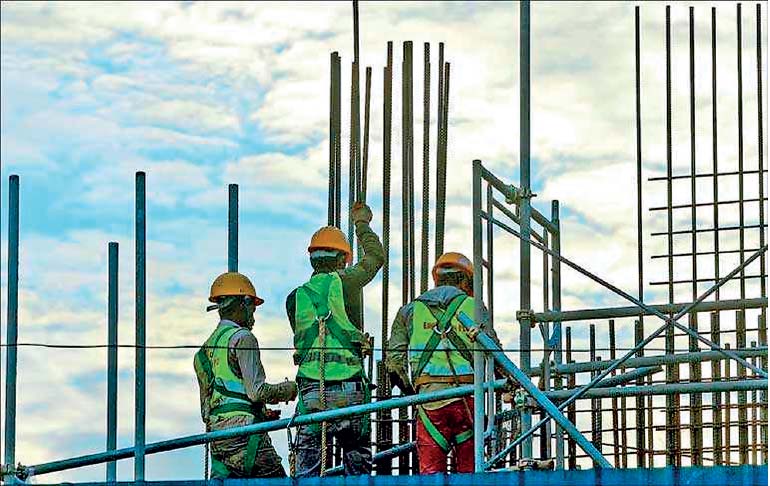
Sri Lanka’s construction sector is moving out of a post-crisis recovery into an expansion phase, supported by reconstruction demand and a multi-year public investment pipeline, according to CT Smith Securities.
In a report titled “Construction Sector: Recovery Broadens,” the firm said the sector, which historically moves at around 2.8 times the pace of GDP, is positioned to benefit disproportionately from the ongoing macroeconomic recovery.
“Following the 2022–2023 contraction, the sector is shifting from survival to growth, with downside risks easing while upside potential remains largely untapped,” CT Smith Securities said.
The sector’s contribution to GDP stood at Rs. 1.9 trillion in 2025 at current prices, with activity expected to strengthen as demand drivers build across both public and private segments.
A key near-term driver is reconstruction following Cyclone Ditwah in late 2025. The report said damage is estimated at around 4% of GDP, with Government estimates placing total rebuilding costs at approximately Rs. 878 billion as at January 2026.
The firm noted that the scale of damage exceeds that of the 2016–2017 floods, which supported construction activity at around 12% of GDP during 2016–2018.
“The rollout of relief program and insurance settlements are expected to generate a meaningful near-term boost to construction sector demand,” the report said.
Public investment is expected to remain the main source of demand over the medium term. The Government’s 2026–2028 public investment program allocates around 70% of capital spending to construction-related sectors, amounting to approximately Rs. 2 trillion over the period.
Within this allocation, highways account for 48%, irrigation 17.5%, and housing 9.3%.
CT Smith Securities said this provides visibility for contractors and construction-linked firms, particularly those exposed to infrastructure projects.
Private sector activity is also showing early signs of recovery. Outstanding credit to the construction sector increased by 15.5% year-on-year in 2025, indicating a gradual return of financing.
“Looking ahead, a gradual reallocation of credit toward production-oriented sectors in 2026–2027 is expected to broaden and deepen the private sector capex cycle,” the report said.
Additional support is expected from a recovery in condominium development, linked to rising land prices, alongside a gradual pickup in retail and private construction.
Over the longer term, projects such as Port City developments, Bandaranaike International Airport Phase 2 expansion, port infrastructure, and renewable energy investments are expected to sustain activity. The report said leading indicators point to an early growth phase, with new orders and purchasing volumes rising, while employment growth remains limited.
“Historically, this phase has delivered the strongest equity return,” CT Smith Securities said.
However, the firm flagged near-term risks, particularly from external shocks.
Ongoing tensions in the Middle East could increase material and energy costs, raise inflationary pressures, and push up interest rates, affecting project timelines and financing conditions.
“A material escalation in Middle East tensions could trigger a domestic energy shock, representing a key downside risk to both the sector and broader equity markets,” the report said.
Even without escalation, uncertainty is expected to weigh on sentiment over the next three to six months, with the Colombo Stock Exchange potentially seeing increased volatility.
Input costs are also beginning to rise after a period of relative stability.
“Material costs have remained stable for the better part of 18 months, but a cost escalation cycle is now underway,” the report said, adding that rising energy prices and supply chain pressures make further increases likely.
The impact is expected to vary across the sector. Smaller contractors, with limited liquidity and narrower margins, face higher risks of margin pressure and execution challenges, while larger contractors and Government-linked entities are better placed to absorb cost increases.
Other risks include delays or postponement of projects due to higher costs and tighter financing conditions, as well as a shortage of skilled labour.
The report noted that migration, an ageing workforce, and limited vocational training are constraining labour supply, increasing wage costs and affecting execution capacity.
Funding conditions may also remain tight despite the pickup in credit, with lenders likely to maintain cautious lending standards.
Over the longer term, the report pointed to structural risks from the gradual adoption of modern construction methods, including prefabrication and modular systems, which could alter demand for traditional construction models.
Despite these risks, CT Smith Securities said the sector is entering a favourable phase of the cycle, supported by reconstruction demand, public investment, and a gradual recovery in private sector activity.




