Saturday Oct 17, 2026
Saturday Oct 17, 2026
Thursday, 13 August 2026 00:03 - - {{hitsCtrl.values.hits}}
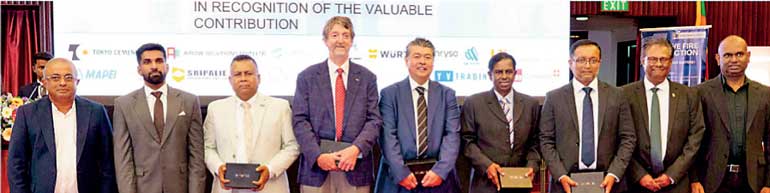
From left: CVU Sri Lankan Chapter Chair Eng. Shiromal Fernando, Secretary Eng. Yasas Gunadawardhana, Institution of Engineers Sri Lanka Past President Prof. Ranjith Dissanayake, IAPS President Prof. Mark Stewart, Institution of Structural Engineers President Prof. Brian Uy, Prof. Priyan Mendis (University of Melbourne, Australia), UNSW Australia NFPBS Academic Lead Associate Prof. Damith Mohotti, CVU Sri Lankan Chapter Treasurer Ruwan Paduruhewa, and Vice Chair Archt. Nirodha Gunadasa
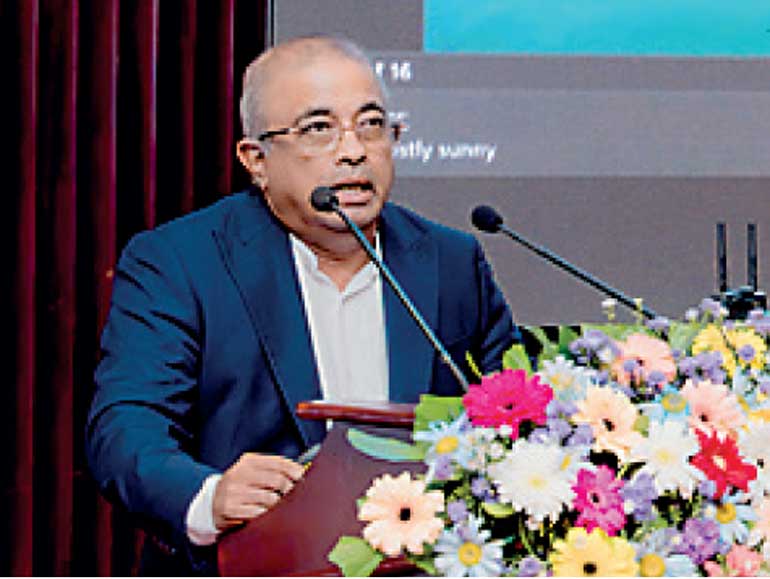
CVU Sri Lankan Chapter Chair
Eng. Shiromal Fernando
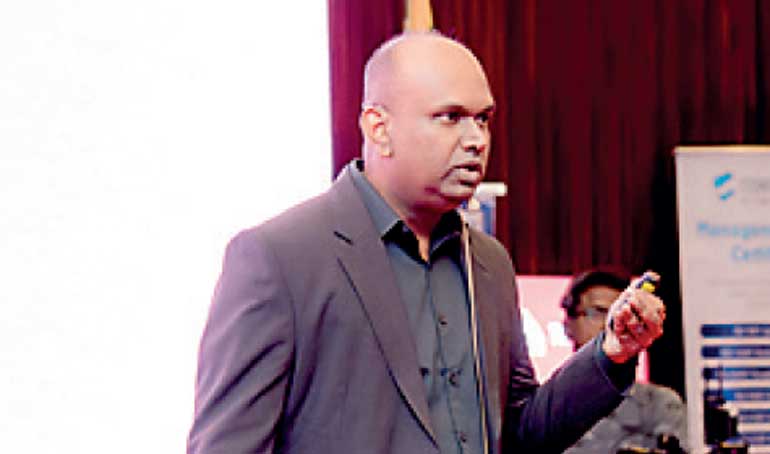
CVU Sri Lankan Chapter Vice Chair Archt. Nirodha Gunadasa
By Safna Malik
The Council on Vertical Urbanism (CVU) Sri Lanka Chapter recently hosted the Colombo Forum 2026 under the theme “Design to Survive: Tall Buildings in an Age of Global Instability.” The event gathered leading local and international experts in structural engineering, protective design, facades, architecture, and future-ready city planning to explore how high-rises can adapt to rising physical, technical, and geopolitical threats.
Marking twelve years since the organisation’s inaugural Colombo Forum in June 2014, the event served as a major milestone following the global rebranding of the Council on Tall Buildings and Urban Habitat (CTBUH) to the CVU in 2025.
In his welcome address, CVU Sri Lanka Chair Eng. Shiromal Fernando highlighted how modern cities face far more than just climate risks, pointing to rising geopolitical tension, security threats, and fast-paced technological changes. He explained the new global identity CVU reflects a fresh approach to urban planning, where cities are no longer seen as flat layouts of separate buildings, but as connected 3D spaces that blend transport, utilities, public services, and community areas together.
“True urban success is achieved not by constructing tall buildings alone, but by creating cities that are efficient, resilient, and places designed for long-term comfort and well-being. Design to Survive: Tall Buildings in an Age of Global Instability is a timely and essential dialogue for all of us, looking beyond climate change to tackle extreme weather, rapid urbanisation, and emerging technology.”
CVU Sri Lanka Vice Chairman Archt. Niroda Gunadasa noted that planners and engineers must consider long-term risks to high-rises 25 years ahead. Tall buildings are often demolished due to outdated technology rather than structural failure, much like 1970s office blocks that lacked adequate parking or wiring for modern computers. Looking ahead, he noted that rapid growth in robotics and AI will completely change how people live and use spaces.
Gunadasa also highlighted how changing military threats have always shaped city design by giving examples of damaged high-rises from recent global conflicts. He warned that packed tall buildings are easy targets for modern weapons, including coordinated drone attacks.
Highlighting the global reach of CVU, which operates across more than 100 countries with chapters in over 40 locations including Sri Lanka, he explained that the forum was organised to tackle pressing urban challenges by bringing together international experts alongside leaders from government, academia, and industry.
From the International Association of Protective Structures, President Prof. Mark Stewart delivered a keynote address on risk-based blast protection. He argued that decisions about security design must be based on mathematical risk analysis rather than worst-case assumptions. He explained a model that calculates an expected loss figure by combining four factors: the probability of a threat occurring, the chance of the explosive device functioning fully, the target’s structural vulnerability, and the projected economic and social costs of failure. The price of a protective measure is then weighed against this expected loss to determine if the investment is economically justified.
Speaking about explosive threats against commercial high-rises as an example, Prof. Stewart highlighted standoff distance as a key defense strategy. His findings showed that installing bollards to maintain a 10-11 metre distance offers the best return, yielding a 6-1 benefit-to-cost ratio. Warning against over-engineering, he noted that extending standoffs beyond this range does not proportionally improve outcomes, advising a focus on probable threats rather than conceivable ones to allocate finite resources effectively.
Institute of Structural Engineers UK, President Prof. Brian Uy delivered a presentation on the evolving role of composite systems in tall building construction. Presenting annual data from the CVU global database, he noted that steel and composite structural systems now dominate the world’s 100 tallest buildings. He outlined current standard limits, including concrete strengths up to 120 megapascals and steel strengths up to 690 megapascals, with an updated standard due for publication this year. He added that research into ultra-high-strength steel up to 1,000 megapascals is being prepared for future updates.
Addressing embodied carbon, Prof. Uy cited projections showing that as operational emissions fall, embodied carbon could reach 85% of the construction sector’s total carbon footprint by 2050. He highlighted floor systems as accounting for roughly 70% of a building’s embodied carbon, making them the primary target for reductions. To lower these emissions, he pointed to structural steel reuse as a path to near-zero embodied carbon, noting that repurposed steel carries just 1% of the emissions of traditional steel production.
The launch of the International Association of Protective Structures (IAPS) Sri Lanka chapter was formally announced, introducing Prof. Ranjith Dissanayaka as inaugural President and Eng. Shiromal Fernando as Vice President. Founded globally in 2010, the 650-member association focuses on engineering solutions to safeguard infrastructure and communities against extreme structural hazards. Highlighting the chapter’s relevance they pointed to Sri Lanka’s swift urban expansion, historical conflict, and ongoing vulnerability to natural hazards such as cyclones, flooding, and coastal threats.
The program featured key presentations from academic and industry leaders, including the University of Melbourne’s Prof. Priyan Mendis on resilient cities, University of New South Wales, The National Facility for Physical Blast Simulation Academic lead Assoc. Prof. Damith Mohotti on emerging threats to critical infrastructure, and CVU Sri Lanka Secretary Eng. Yasas Gunawardhana on artificial intelligence as a structural design tool under conditions of uncertainty.
The forum also featured the launch of “Design Calculation Manual - Reinforced Concrete High-rise Building Design” by the Structural Design Institute Colombo and “The Living Equation - Legacy of Parametric Architecture” by Architectural Design Firm Archedium. These two books serve as a practical guide for local designs that meet strict international peer review and safety standards. These manuals are particularly useful for high-rise developments in Colombo’s Port City.




