Saturday Oct 10, 2026
Saturday Oct 10, 2026
Wednesday, 13 May 2026 04:16 - - {{hitsCtrl.values.hits}}
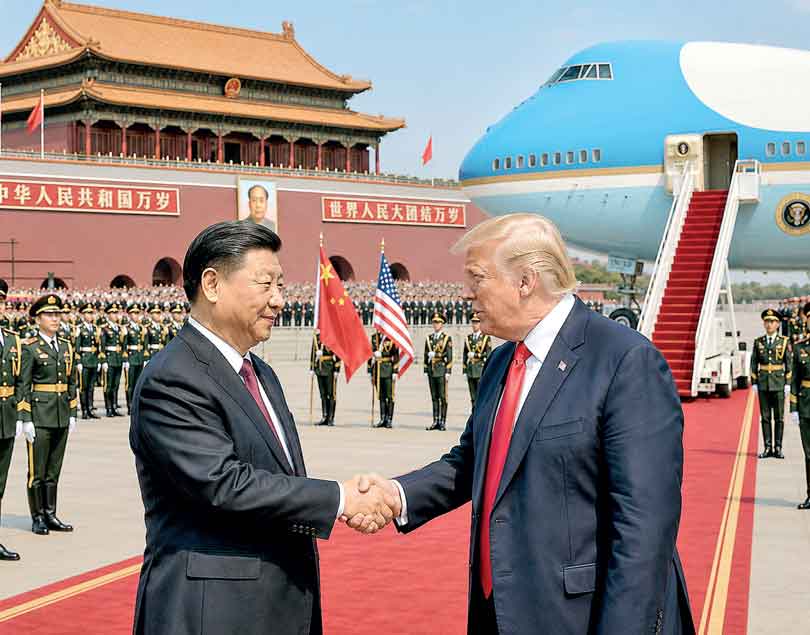
President Donald Trump and President Xi Jinping at the US-China summit in Beijing (AI generated image)
Washington is increasingly constrained by wars, domestic voter pressures, constitutional framework, and the weight of global expectations. China arrives prepared, patient, and positioned. And in Colombo, a smaller story unfolds—one that suggests even an island nation can navigate this new world with skill, foresight, and diplomacy
 Krakow, POLAND – As the world turns to the 14-15 May Beijing summit between the United States and China, the balance of power appears less symmetrical than diplomatic protocol suggests. At the very moment President Donald Trump arrives at the table, he is burdened—militarily, economically, and politically—while President Xi Jinping engages from a position of calibrated strength and mindful narrative.
Meanwhile, in Colombo, the presidents of Vietnam and the Maldives have just met with their Sri Lankan counterpart President Anura Kumara Dissanayake. These quieter summits, though less visible, mirror the same strategic lesson: power today is exercised not through confrontation, but through collaboration.
At first glance, these two capitals—Beijing and Colombo—appear worlds apart. Yet they illuminate a single, enduring truth about power in the 21st Century: the most decisive victories are not won on battlefields, but through positioning, patience, perception, and policy (4Ps).
Sri Lanka, a small island-state with so-called “inexperienced” new leadership, is often underestimated in global strategy and foreign policy. As a distant observer currently living in Europe, I try to see the Sino-American dancing floor from a balcony.
Washington’s burden and Beijing’s advantage
The Beijing summit is widely framed as a contest between rivals. But this framing misses the deeper asymmetry. China enters the dialogue not merely as a competitor, but as an architect of an alternative world order—what Chinese Rejuvenation envisions as a restoration of historical centrality: the Middle Kingdom.
The leader of the free world arrives in Beijing with Air Force One but is constrained by overlapping pressures. The American deep involvement in the Russia-Ukraine War and escalating tensions across the Middle East—particularly with Iran—stretch its strategic bandwidth. These engagements are not merely foreign policy challenges; they reverberate domestically with American voters.
Rising energy prices, inflationary pressures, and unpopular policy choices have eroded public confidence in Trump’s leadership. In an election-sensitive climate with sinking approval ratings, the president’s foreign entanglements translate into political vulnerability. Washington’s global commitments now carry a domestic cost, shaping its posture and credibility abroad.
Unlike traditional great-power confrontations, China’s approach reflects an ancient strategic ethos rooted in The Art of War by Sun Zi: the highest form of victory is to win without fighting. Rather than direct confrontation, Beijing leverages trade networks, infrastructure financing, technological ecosystems, and diplomatic breadth.
In this context, the United States faces a paradox. Its strengths—military reach, alliance systems, and ideological clarity—are less effective against a rival that avoids direct collision. The battlefield of aircraft carriers and precision missiles has shifted to supply chains, development assistance, and narrative legitimacy in human values. Here, China increasingly sets normative tones and engages in shaping international discourse.
Beijing approaches the summit with a longer horizon and fewer immediate constraints. Its vision of Chinese Rejuvenation is not reactive—it is systemic and strategic. Beijing does not need to win the argument in a single meeting; it seeks to define the terrain on which all future arguments occur, especially the Taiwan question.
Colombo’s parallel moment
Meanwhile, in Colombo, a different but parallel story unfolds. The meetings between Sri Lanka and leaders from Vietnam and the Maldives may lack the spectacle of a superpower summit, but they reflect a similar strategic recalibration.
Sri Lanka’s vision of a National Renaissance is often dismissed as aspirational rhetoric. Yet, like China’s Rejuvenation, it is rooted in geography and history. Sitting astride key Indian Ocean sea lanes—with critical chokepoints of the Hormuz Strait, Bab el-Mandeb Strait, and the Malacca Strait—Sri Lanka occupies a position of latent strategic leverage.
Vietnam brings its own experience as a state that has navigated great-power competition while maintaining autonomy. The Maldives represents a smaller but equally strategic maritime node. Together, their engagement with Colombo signals the emergence of a regional network that values flexibility over alignment, connectivity over confrontation.
Sri Lanka, like China, needs not overpower rivals to succeed. Size does not matter; it must instead position itself as indispensable.
The island that can
China’s rise was not inevitable; it was engineered through decades of disciplined strategy, institutional adaptation, and narrative coherence. Sri Lanka’s path will differ, but the principle holds. A “National Renaissance” does not require superpower status—it requires strategic clarity and leadership competence.
The ancient Chinese axiom of “winning without fighting” is particularly relevant here. For Sri Lanka, this could mean: a) leveraging its ports and logistics networks as neutral hubs; b) balancing relationships among competing powers without overdependence; c) investing in human capital and governance as sources of soft power, especially through Buddhist teachings; and d) framing itself as a connector rather than a contestant, where Colombo’s diplomatic agility plays a crystallising role in investment and trade promotion.
In other words, victory lies not in choosing sides, but in becoming the ground on which others seek cooperation—by being “pro-Chinese neutral” and “pro-American neutral” like in the Non-Alignment era. For Sri Lanka, this would be following the Middle Path of Buddhism in foreign policy: “friendship with all and enmity with none.”
This motto essentially resembles the founding vision of the United States: “peace, commerce, and honest friendship with all nations; entangling alliances with none.” This American phrase is attributed to President Thomas Jefferson but President George Washington also promoted a similar sentiment in his Farewell Address.
Colombo’s strategic echo
Against this backdrop, the recent presidential meetings in Colombo take on new significance. Sri Lanka’s aspiration for a National Renaissance may seem modest compared to China’s ambitions, but it reflects a similar strategic instinct.
Vietnam, with its experience balancing major powers, and the Maldives, with its strategic maritime position, both recognise the value of flexible but “neutral” alignment. Their engagement with Sri Lanka suggests the emergence of a regional logic that prioritises connectivity over confrontation.
Sri Lanka, like China, does not need to overpower rivals. It must instead leverage its location, infrastructure, and diplomatic agility to become indispensable. Nowhere is this more visible than in Sri Lanka. The development of Colombo Port City and Hambantota Port places the island at a critical junction of maritime trade routes. These are not isolated projects; they are nodes in a larger strategic architecture that allows China to navigate seamlessly from the Asian mainland to European markets.
In this sense, Sri Lanka’s advantage is not just economic—it is geographic, institutional, systemic, and visionary.
The new grammar of power
The summit in Beijing may be remembered as another chapter in US-China competition. But its deeper significance lies in what it reveals: the emergence of a new grammar of power. Military might remains relevant, but it is no longer decisive on its own. Influence now flows through connectivity, credibility, and continuity. China understands this. Increasingly, so do smaller states like Sri Lanka.
If the Beijing summit demonstrates how a great power can gain the upper hand without confrontation, the Colombo meetings hint at how even a small island can do the same. The lesson is not that Sri Lanka can replicate China, but that it can adapt the underlying logic to its own context.
The world often measures power in terms of size—economies, militaries, and populations. But the deeper measure is strategic imagination. Singapore and Qatar are familiar examples, engaging both China and the United States.
Make war illegal
In Beijing, China seeks to reshape the global order without firing a shot. In Colombo, Sri Lanka has the opportunity to redefine its place within that order—also without confrontation.
Washington is increasingly constrained by wars, domestic voter pressures, constitutional framework, and the weight of global expectations. China arrives prepared, patient, and positioned. And in Colombo, a smaller story unfolds—one that suggests even an island nation can navigate this new world with skill, foresight, and diplomacy.
Between rejuvenation and renaissance lies a shared insight: the greatest victories are not won through confrontation, but through enduring strategy and wisdom. In an era defined by rivalry, the ultimate triumph may not be defeating an opponent—but making conflict unnecessary.
Like the US Secretary of State Frank Kellogg and French Foreign Minister Aristide Briand, who signed the Kellogg-Briand Pact of Paris in 1928 aimed at outlawing war as an instrument of national policy, the Beijing summit could represent a landmark achievement in promoting peace through international law and leaving an enduring legacy for humanity.
(The author, alumnus of the University of Sri Jayewardenepura, the University of Minnesota, and Harvard University, is the recipient the Lifetime Achievement Award from the Sri Lanka Foundation in Los Angeles, the International Confucius Award from the People’s Republic of China, and the Albert Nelson Marquis Lifetime Achievement Award from Who’s Who in America)




