Saturday Sep 19, 2026
Saturday Sep 19, 2026
Wednesday, 27 May 2026 00:22 - - {{hitsCtrl.values.hits}}
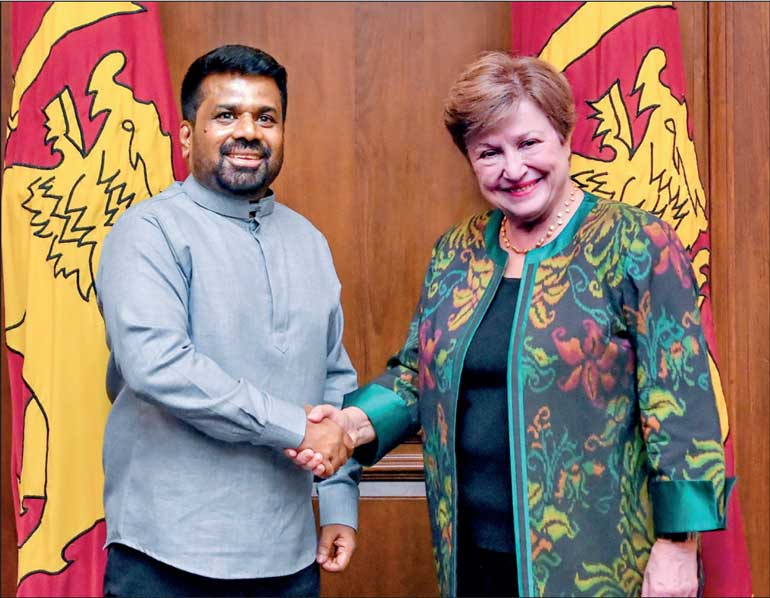
President Anura Kumara Dissanayake with International Monetary Fund Managing Director Kristalina Georgieva during the latter’s historic visit to Sri Lanka in February this year - File photo
 The IMF staff and Sri Lankan authorities have reached a staff-level agreement to conclude the combined Fifth and Sixth Reviews of Sri Lanka’s reform program under the Extended Fund Facility (EFF). If approved by the IMF Executive Board, Sri Lanka will gain access to about US$700 million in financing. While the IMF has acknowledged progress in reserves, growth, and revenue performance, it has also warned that Sri Lanka remains exposed to external shocks, including the Middle East conflict and the aftermath of Cyclone Ditwah.
Recurring dependence
This mixed picture of progress and vulnerability gives added significance to the recent warning by economist Dr. Ganeshan Wignaraja. Speaking on 4 May 2026 at a discussion held at the Regional Centre for Strategic Studies (RCSS) in Colombo, titled “A Global Economy in the Shadow of the Middle East War: Implications for Sri Lanka’s Debt Recovery,” he cautioned that Sri Lanka may once again have to consider the possibility of seeking further IMF assistance if current vulnerabilities are not addressed with urgency.
Dr. Wignaraja pointed out that although Sri Lanka’s current IMF program is scheduled to conclude in 2027, the country will once again face major external debt repayment obligations beginning in 2028. At the same time, global economic instability, Middle Eastern conflicts, rising fuel prices, and climate-related disruptions could place Sri Lanka’s fragile recovery under renewed pressure.
This is not merely an ordinary economic observation. It is a serious warning about the deep structural weaknesses that have shaped Sri Lanka’s economy for decades. In fact, turning to the IMF is not new for Sri Lanka. Since 1965, the country has entered into 17 IMF programs, placing Sri Lanka among the nations that have relied most frequently on IMF assistance.
This recurring dependence is not simply the result of temporary financial shortages. It reflects deeper structural problems: weak productive capacity, insufficient export growth, poor fiscal discipline, and an economic model excessively dependent on borrowing. When a country repeatedly requires IMF support, it raises fundamental questions about the sustainability and resilience of its economic system.
External debt position
 According to Table 1.16, “Outstanding External Debt Position,” in the Central Bank of Sri Lanka’s Annual Economic Review 2025, Sri Lanka’s total external debt position at the end of 2025 was reported at $54.8 billion at market value and $56.2 billion at face value. Of this amount, the Government’s external debt stood at approximately $36.7 billion at face value. In 2022, Sri Lanka suspended external debt repayments for the first time in its history, after which debt restructuring began under the IMF-supported program. Although this provided short-term stability, many of the country’s core economic vulnerabilities remain unresolved.
For example, Sri Lanka’s export earnings remain relatively low compared to GDP. Countries such as Vietnam, Bangladesh, and Thailand have transformed themselves into export-driven manufacturing economies, while Sri Lanka continues to depend heavily on tourism, worker remittances, and external borrowing for foreign exchange earnings.
Although tourism revenues and remittances improved somewhat during 2024 and 2025, these are not sufficiently stable foundations for long-term economic sustainability. External shocks such as Middle Eastern conflicts, fluctuations in global fuel prices, international market downturns, and climate-related disasters could disrupt these income sources at any time.
Dr. Wignaraja also emphasised that climate change itself may become a major factor affecting Sri Lanka’s future debt sustainability. Floods, droughts, and declining agricultural productivity increase food import costs and place further pressure on foreign exchange reserves, thereby worsening the country’s economic vulnerabilities.
Social costs
At the same time, IMF programs carry significant social costs. Since 2023, tax increases, electricity tariff revisions, reductions in Government spending, and State-sector reforms have imposed severe pressures on ordinary citizens. The middle class has weakened considerably, poverty levels have risen, and many small and medium-sized enterprises have struggled to survive rising operational costs. Youth unemployment and migration aspirations have also intensified during this period.
Nevertheless, it must also be acknowledged that recovering from the 2022 crisis without IMF support would have been extremely difficult. The IMF not only provides financial assistance but also offers a framework of credibility that enables countries to secure support from institutions such as the World Bank, the Asian Development Bank, and other international lenders. In Sri Lanka’s case, the IMF program helped restore a degree of investor confidence and international credibility.
Genuine economic transformation
 However, the deeper problem lies elsewhere. Sri Lanka has repeatedly used IMF programs as temporary crisis-management tools rather than as opportunities for genuine economic transformation. The 2024 review of the current IMF-supported Extended Fund Facility again highlighted several specific reform commitments that Sri Lanka was expected to continue. These included strengthening revenue mobilisation and tax administration, advancing public financial management and debt management reforms, maintaining cost-reflective fuel and electricity pricing to reduce fiscal risks from State-owned enterprises, improving governance and restructuring of State-owned enterprises and State-owned banks, and implementing stronger anti-corruption and governance reforms. The IMF also emphasized the need to protect vulnerable groups through better-targeted social safety nets while continuing fiscal consolidation.
More specifically, the 2024 program review required stronger anti-corruption measures in revenue-collecting agencies such as Inland Revenue, Customs, and Excise; greater transparency in public procurement and tax exemptions; publication and implementation of governance reform action plans; stronger oversight of public assets; and reforms to improve the governance of State-owned banks. These were not merely technical conditions. They were meant to address the institutional weaknesses that have repeatedly pushed Sri Lanka back into external financing crises.
Yet Sri Lanka has historically struggled to fully implement such reforms. Tax administration, State-owned enterprise restructuring, public financial management, anti-corruption measures, and cost-reflective pricing have often been delayed, diluted, or weakened due to political resistance, weak institutions, and short-term policy decisions. As a result, IMF programs have brought temporary stability, but not always lasting structural change. After almost every IMF program, the country gradually returned to old habits: excessive Government spending, politically driven populism, inefficient State-owned enterprises, and debt-financed development.
Therefore, the real issue is not simply whether Sri Lanka will enter an 18th IMF program. The more important question is whether the country is capable of building an economy that no longer requires repeated IMF intervention.
Disciplined national economic strategy
Achieving this requires more than slogans or short-term political promises. It demands a clear and disciplined national economic strategy. Government expenditure must be prioritized carefully. Loss-making State-owned enterprises should be freed from political interference and placed under professional management. The tax system must broaden the revenue base fairly while encouraging investment and reducing tax evasion.
At the same time, Sri Lanka must transform itself into an export-oriented productive economy. Agriculture, manufacturing, tourism, information technology, port services, education services, and healthcare services should all be strategically developed as foreign exchange earning sectors. Investors do not seek tax concessions alone; they require policy consistency, legal stability, efficient approval processes, and an environment free from corruption.
True reform does not mean continuously burdening citizens with higher taxes and reduced living standards. Genuine reform means creating a more efficient State, reducing waste and corruption, increasing productivity, and expanding income-generating opportunities for ordinary people. Whether under an IMF program or outside one, Sri Lanka urgently needs this kind of national economic discipline.
Ultimately, the IMF is not a symbol of economic success. It is an emergency support mechanism used during periods of crisis. The national objective should not be to secure yet another IMF program, but to build an economy strong enough to function without repeated external rescue packages.
Otherwise, today’s question — “Will Sri Lanka need an 18th IMF program?” — may eventually become “When will the 19th program begin?”
That is not the future Sri Lanka should aspire to. The country does not need an economy that survives by repeatedly seeking external assistance. It needs a mature national economy that produces, exports, innovates, earns global confidence, and builds its future through its own strength and productivity.




