Wednesday Nov 04, 2026
Wednesday Nov 04, 2026
Wednesday, 4 November 2026 00:00 - - {{hitsCtrl.values.hits}}
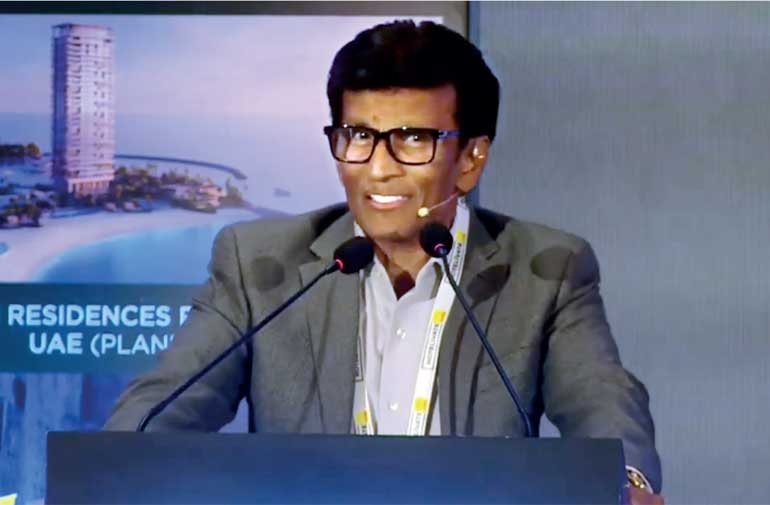
TWC Holdings Chairman Thilan Wijesinghe speaks at the THINC Tourism Conference
Following is the speech by TWC Holdings Chairman Thilan Wijesinghe on the subject ‘Tourism Uncensored’ at the THINC Tourism Conference on 15 October, 2026. Drawing on 20 years in small luxury tourism, starting with Ceylon Tea Trails, Wijesinghe, who is also a Director of Ventive Hospitality (India), Resplendent Ceylon and Tea Trails, sets out what Sri Lanka got right and wrong in tourism. He faults successive governments for arrival targets without strategy, mispriced State land and lax coastal zoning, and calls for a strategic reset through five policy reforms and two ‘moonshot’ projects to move the country up the tourism value chain.
As the subject assigned to me is Tourism Uncensored, I intend to speak candidly about the lessons I have learnt over the past 20 years while pursuing my passion for small luxury tourism in Sri Lanka. I will speak also about what we got right, what we got wrong, and what I believe we must do differently if Sri Lanka is to realise its tourism potential.
In 2004, I undertook a seven-day road trip around Sri Lanka with Robert Hecker, the Managing Director of Horwath, a well-known hotel consultancy firm. During that journey, I realised that Sri Lanka had received what may be one of the greatest destination taglines in history as far back as 1293, when Marco Polo described it as “the finest island of its size in the world”.
My own journey into small luxury tourism began in 2003, during a conversation with my friend and mentor, Nick Clayton, an Englishman whose father had been a tea planter in Malaysia. We had both spent our childhood holidays in plantation bungalows. We then conceived the idea of converting Sri Lanka’s old tea plantation bungalows into a small luxury resort, connected by walking trails. We presented the concept to the founders of Dilmah Tea, who became majority partners in the venture. That was the beginning of Ceylon Tea Trails.
What made the concept unique was that we did not need to build a conventional resort on one large, contiguous piece of land. Instead, we restored five plantation bungalows spread across an area of approximately 50 square kilometres and operate them as one integrated resort. We developed what we called a mothership-and-satellite concept: several individual properties, each with its own identity, brought together under one hospitality operation.
Lesson One: Power of global public relations
When Tea Trails opened in stages in 2006 and 2007, we encountered what I can only describe as a perfect storm. First, through my own naivety and inexperience, I had not estimated a pre-opening and marketing budget. Second, Sri Lanka’s conflict intensified during 2006 and 2007, creating an extremely difficult environment in which to launch a luxury tourism product.
Our saving grace came from an unexpected source. In 2006, the tourist board had entered into a public-relations contract with Batey, the Singapore-based PR agency known for its work on major tourism and the “Singapore Girl” campaigns.
I approached the then Chairman of the Tourist Board and requested permission to invite foreign journalists visiting Sri Lanka through this programme to experience Tea Trails. The resulting articles by these journalists were extraordinarily positive. International publications featured the resort as “The world’s best place to pop the question to your partner”, “Top five colonial holidays in the world”, “Best all-inclusive hotel in the world” and “The top 10 world's greatest trips”.
Through strategic PR, Tea Trails became an aspirational destination overriding the negative country perception at the time. We were subsequently able to command higher room rates and build a profitable business.
The lesson is simple: strategic marketing and public relations are investments in enhancing the economic value of a tourism product or destination. The Government must therefore recognise that there is a substantial cost to not investing in strategic destination marketing.
Lesson Two: Design and storytelling determine what a resort can charge
My second lesson came soon after the end of the conflict. Around 2010, I became a shareholder in a 100-acre property on Sri Lanka’s East Coast.
I asked the CEO of a prominent ground-handling company a straightforward question: “If I were to build a hotel here, what room rate could I expect?” His answer was that we might achieve between $ 80 and $ 100 per night. I then showed him photographs of a resort in Indonesia named Nihi Watu, in a remote location that was difficult to access. The resort’s design and concept offered a very different experience from a conventional beach hotel. When he saw the photographs, his assessment changed immediately. He believed that a resort of this nature could potentially command $ 200 to $ 250 per night.
That was a dramatic increase in the potential room rate, without relying simply on the location or the amount of money spent on construction. This conversation taught me something fundamental: the value of a resort is not determined by its location alone, nor by how much it costs to build. It is determined by the experience it offers, how distinctively it is designed, and how compellingly that experience is communicated to the market.
Lesson Three: Building hotels is not the same as building a destination
My third lesson came from Pasikuda on the East Coast. Following the end of the conflict, the Government invested in infrastructure, including roads, electricity and water, to encourage private investment in hotels.
However, what emerged was a cluster of hotels ranging from five-star to two-star properties, without a coherent approach to destination planning, design, positioning or the overall visitor experience. There was little sense of place and limited coordination between the individual developments. Today, some properties in Pasikuda face serious financial difficulties, and others have reportedly been offered for sale, some at distressed prices.
Pasikuda was another lesson learnt: Sri Lanka has followed the simplistic assumption that if we build enough hotels, the tourists will come without always asking whether the product being built is appropriate for its location, whether it has a clear market position, and whether the destination as a whole will be competitive
Policy mistake: Targets without a credible strategy
In 2009, soon after the conflict ended the then President announced an ambitious target of attracting 3 million tourists by 2015. The Tourist Board then began to calculate the required number of rooms, divide the gap by the number of years remaining, and then approve construction accordingly. Successive governments have made the mistake of announcing arrival targets. This is not a tourism strategy.
Policy mistake: Mispricing scarce land
Another problem was the approach to pricing land for tourism development. In 2012, when my partners were acquiring freehold land on the East Coast at approximately Rs. 5.5 million per acre, the Government was quoting approximately Rs. 20 million per acre for 99-year leases on comparable East Coast lands – an almost 400% premium to the value of freehold land at the time!
This matters particularly in Sri Lanka, where the State owns a substantial share of the land. Beachfront land suitable for tourism is a scarce economic resource. Government owned land should be allocated and priced in a manner that encourages the highest sustainable economic value from its use. When land is priced beyond what a high-quality resort can economically support, investors respond by reducing their development footprint, compromising the concept, or abandoning the investment altogether.
Policy mistake: Doing away with height restriction on beach properties
Another concern was the relaxation of height restrictions that had traditionally limited construction in coastal areas to the height of a coconut tree. Sri Lanka subsequently saw the growth of apartment developments on beachfront properties, marketed for short-term tourist accommodation.
In an island such as Sri Lanka, beachfront land is finite since we have issues with land title, roads and railways hugging the beach preventing tourism development, and in certain areas having inadequate utility infrastructure. If land suitable for a distinctive luxury resort is instead absorbed by developments that do not fit the area’s intended positioning, the opportunity to create a higher-value tourism product would be lost. This is particularly relevant to places such as Tangalle and Talpe, which have developed reputations for distinctive, low-density and high-end hospitality.
The Government’s responsibility is not simply to permit any construction. It is to ensure that development decisions collectively strengthen the destination through proper zoning laws.
The opportunity Sri Lanka has yet to capture
Such poor policy choices help explain why I believe Sri Lanka has not moved up the tourism value chain. More than 20 years ago, the Maldives attracted international luxury resort investments, at times costing USD 1 million per key, capable of commanding very high rates. Properties associated with brands such as One&Only, Cheval Blanc and Four Seasons helped establish the Maldives’ reputation in the luxury market.
Local brands such as Per Aquum evolved by piggy-backing on high-end international brands. While Sri Lanka has well-established local hospitality brands, we should ask why the country has not attracted a larger portfolio of internationally branded resorts, particularly at the upper end of the market.
Only around 6% of Sri Lanka’s graded resort hotel rooms are internationally branded compared to at least 33% in tourism focused countries in Asia such as Maldives, Vietnam and Mauritius.
The value of international brands
International brands can bring distribution networks, loyalty programmes, global marketing, operating systems and access to customers who might otherwise not consider a destination. They can also help local investors benchmark their products against international standards.
Let me illustrate the point with an example. In March this year, before the escalation of the Middle East crisis, I enquired about booking eight rooms at Anantara Peace Haven Tangalle. I was quoted approximately $ 600 per night for a 55-square-metre room and $ 1,300 for a villa. Similarly, properties such as the Marriott Weligama and Hilton Yala outperform most local brands in terms of rates and occupancy.
Sri Lanka’s tourism earnings have not consistently reflected the extraordinary potential of its natural and cultural assets. We need to understand why, and then address the underlying causes. The strategic question remains: are we doing enough to attract investors and operators capable of helping us compete in the world’s most valuable tourism segments?
What should we do differently?
So, where do we go from here? My answer is that we need to reflect, reassess and re-strategise. Let me emphasise that strategy does not mean commissioning yet another master plan, of which there are many. The issue is whether our plans have been translated into coherent policies, investment decisions and measurable results.
Here are five “uncensored” proposals I would like to propose.
(1)Introduce destination-level zoning that determines what we want each tourism area to become. We should not repeat on the East Coast the mistakes that have occurred in many parts of the South Coast.
(2)Introduce viability-gap funding for domestic aviation. I have been advocating this for several years, particularly in relation to facilitating access to the North and East.
(3)Address the underutilisation of scarce beachfront land. This is perhaps my most controversial proposal. We should consider a carefully designed land tax or other fiscal mechanism for suitable beachfront land that remains undeveloped for extended periods. The objective should be to discourage speculative landholding that prevents productive use of a scarce resource.
(4)Restrict high-rise beachfront apartment developments to designated zones. High-rise developments may be appropriate in selected urban zones. It is not necessarily appropriate everywhere along our coastline.
(5)Facilitate the repositioning of ageing hotels. Some of Sri Lanka’s established hotels occupy valuable sites but require substantial reinvestment to remain competitive. They should be encouraged to enter into joint ventures and rebranded, ideally involving international operators. Where aging and underperforming properties occupy State land, they must be encouraged to be repositioned with new investments.
Pursue moonshot projects
Beyond these reforms, I believe Sri Lanka needs to think bigger. We should identify one or two ambitious projects capable of changing how the world perceives the country. I have personally explored two such possibilities.
1.An internationally branded luxury train. Imagine attracting an internationally recognised luxury rail operator, potentially a brand such as Orient Express, to develop a world-class train experience in Sri Lanka. The Colombo-Badulla rail track is possibly one of the world’s most picturesque train journeys rising up to over 6000 feet above sea level and is the highest track in the world in the 5½ foot gauge. We are also probably the only country in the world where in under a day you can take a train to all 8 world heritage sites in Sri Lanka. What is stopping such an investment – safety. While no one has got killed in recent times in Sri Lanka due to train accidents, the railway records show many derailments caused by poor maintenance.
2.My second moonshot is even more ambitious: to explore the possibility of bringing Formula 1 to Colombo following the successful example of Singapore. F1 wants to be in South Asia, but was discontinued in India after 2013 following commercial, tax and regulatory difficulties. We have a perfect track in Colombo stretching from Port City to Galle Face and Baladaksha Mawatha. We also have superior logistics. This would undoubtedly be a complex undertaking, requiring substantial investment, Government coordination and a long-term commercial commitment. But we should at least explore the opportunity, considering there is potential investment interest from India.
Conclusion: Time to realise our potential
Let me conclude by returning to the question of value. A good friend of mine, Navjit Ahluwalia, who is now with Mandarin Oriental, made a statement that has resonated with me: “Before COVID, $1,000 a night was a ceiling for a great resort. Today it is the floor.” He was referring to the growth of the ultra-luxury market and the ability of truly distinctive properties to command extraordinary rates.
The underlying point is that the value of a luxury experience increasingly depends on its rarity. The world’s most discerning travellers are prepared to pay a premium for properties that offer something they cannot easily find elsewhere. This principle has influenced my own work over the past several years, including the investments I pursue, the projects on which my company advises, and the boards on which I serve.
Sri Lanka has a significant opportunity in this segment. It has been 27 years since the Aman brand established a presence in Sri Lanka. We should ask why the country has not attracted more internationally recognised ultra-luxury resorts in the intervening period.
I am however pleased to say that management agreements have recently been signed for a Ritz-Carlton Reserve resort project in Sri Lanka, which is proceeding through its preliminary approvals. There is also interest from other international hospitality brands, supported by investments from India and the Middle East. These developments are encouraging. They suggest that, despite the policy missteps of the past, a new wave of international investments and brands could still reshape Sri Lanka’s resort landscape.
Sri Lanka has been blessed with extraordinary natural and cultural assets. What we have lacked is a consistent strategy for converting our assets into sustainable economic value. We must move beyond the assumption that more hotel rooms and more tourist arrivals will automatically deliver success.




