Thursday Oct 22, 2026
Thursday Oct 22, 2026
Wednesday, 1 April 2026 00:40 - - {{hitsCtrl.values.hits}}
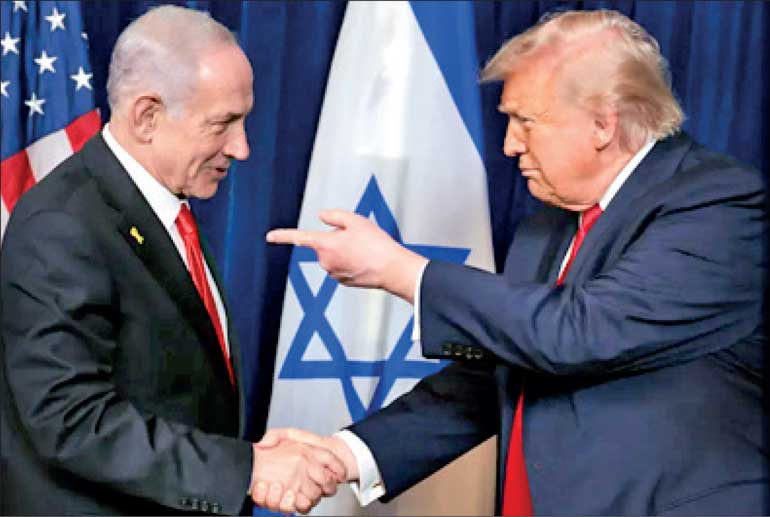
The Bibi-Trump’s illegal war on Iran is likely to do as much harm to the Lankan economy and Lankan living standards as Gota-economics did
By Tisaranee Gunasekara
 The expected has happened. Electricity prices have gone up, with its inevitable effect on cost of production and cost of living. The spectre of stagflation, that dreaded combination of low growth and high inflation, is clearly visible over the economic horizon.
The Bibi-Trump’s illegal war on Iran is likely to do as much harm to the Lankan economy and Lankan living standards as Gota-economics did. Cost of living and the poverty line were inching up before the war began. In January 2026, the monthly income needed for one person to stay out of poverty was Rs. 16,730 (ranging from Rs. 18,044 in Colombo to Rs. 15,997 in Moneragala). This marks a modest increase from the December 2025 figure of Rs. 16,658. The figure for February 2026, when it comes, is likely to mark another modest increase, but the March figure will be exponentially higher.
“As bad as things are now, they are going to get much worse,” Cenk Uygur, a host of the US political talk-show The Young Turks said in a commentary on the economic fallout of the war. Globally, oil prices have increased by 33% in the one month of war, the worst price hike since 1991. If the Houthis manage to close down the Strait of Bab el Mandeb, Suez Canal will become irrelevant, and ships will have to take the older and the much longer routs around the Cape of Good Hope, a trip that would take about 2 weeks more and costs lots extra.
In the meantime, warnings are being sounded about the war’s effect on the AI industry, highly dependent on inputs from the Middle East. According to a 26 March piece in The Atlantic, the all-but-inevitable global energy shock is likely to “grind the AI-build up to a halt. This would be devastating for the tech firms that have issued historic amounts of debt... and it would be devastating for the private lenders and banks that have been buying up that debt in the hope of ever bigger returns... If growth were to stall or the technology were to be seen as failing to deliver on its promise, the (AI) bubble might burst, triggering a chain reaction across the financial system…” (Welcome to a Multidimensional Economic Disaster). The result could be a US/global financial crash worse than 2008.
According to the influential German think-tank, the Kiel Institute for the World Economy, Sri Lanka is second among 20 countries most affected by the war. so far. If the Strait of Hormuz remains closed for a long time, Sri Lanka could experience a welfare change of minus 3.47%. “Global food production depends critically on inputs derived from Gulf hydrocarbons,” and Sri Lanka could experience a food vulnerability rate of 15.33% (https://www.kielinstitut.de/fileadmin/Dateiverwaltung/IfW-Publications/fis-import/01b7c020-27e6-4096-8cc5-e037738d2058-KPB_206.pdf).
 The combined effect will be a huge increase in poverty as those families living just above the poverty line slip below. The first decile immediately above the poverty line would be especially vulnerable, but the risk could spread to the second and third deciles, if the war drags on. These new-poors would have no access to Aswesuma. Therefore, they are likely to experience a massive drop in living standards, pushing them into greater debt and compelling them to adopt such coping measures as missing meals and keeping children away from school. The emotional effect of slipping from lower-middle class into poverty could make them vulnerable to the siren song of extreme ideologies.
The Government was slow to respond to the potential economic fallout of the Iran War, almost as if it believed in the official Israeli-US propaganda of Iran collapsing like a house of cards once its religious leader was no more. The QR system should have been introduced in the first week of the war. That could have prevented or reduced the second price hike. The electricity price hike, coming on the heels of two fuel price hikes, will lead to a mass of disconnections – as happened in 2023. The shortage of cooking gas would impact both households and small businesses, especially the urban poor. Power and water cuts, if they happen, will sour the public mood even further. Unlike in 2022, the problems are not of this Government’s making, but a continued inability to deal with those problems can and will be laid at the Government’s door.
The spectre of a long war?
 Sinking Iranian frigate IRIS Dena was not the only option available to the Americans. In fact, the initial plan was to capture the ship. Then, according to media reports, a general told Donald Trump, “Sir, it’s a lot more fun doing it this way” (sinking). And the leader of the globe’s only superpower agreed. IRIS Dena was sunk not because it was a military necessity but because leaders in Washington found the idea entertaining.
As Frank Herbert, the author of the iconic Dune series, warned many decades ago, “Technology has given us the tools of self-destruction. And if you put those tools in the hands of sick leaders, then we are really in trouble.” (https://www.youtube.com/watch?v=124xCHfVUk4).
Bloodthirstiness is in vogue. Pete Hegseth, who changed his job title from Secretary of Defence to Secretary of War, said that in its strikes, the US would be aiming for “maximum lethality not tepid legality.” The US is as unapologetic as Israel about hitting civilian targets in Iran - from the elementary school in Minab to the Gandhi Hospital in Teheran. In Lebanon, Israel is repeating its Gaza playbook. Tel Aviv has ordered civilians living in 14% of Lebanese territory to evacuate and is bombing civilian infrastructure in Southern Lebanon, especially medical facilities. According to Lebanon’s Health Ministry, Israel has targeted 128 medical facilities and ambulances. The result has been catastrophic. Over three million Iranians and more than a million Lebanese were displaced in the first month of war alone.
As the ward drags on, the Lankan Government needs to develop a comprehensive strategy to withstand the shocks coming our way. If not, the resulting harm could equal or even surpass the ravages of Gota-economics. We get our oil from the Gulf region and send our workers there. Over 50% of our foreign exchange earnings is sourced in remittances from the Middle East. Over 30% of our exports pass through Gulf ports.
 Mass outmigration in peacetime is not a new problem. The number of Lankans leaving the country reached a high of 300,000 in 2014. From 2015, outmigration numbers dropped year-on-year, coming down to 190,000 in 2019. Out-migration began to go up again in 2021, reaching an all-time high of 311,000 in 2022. Stopping/reducing outmigration was a key promise of the NPP/JVP during the 2024 elections, another failed pledge. Lankan outmigration stood over 300,000 in 2025.
Mass outmigration is the result not just of rational calculations but also of emotional considerations, from loss of hope in one’s country of birth to the need to keep up with the Joneses (my neighbour/friend/relation/colleague is migrating, so must I). While a developed occidental nation would be the most desirable journey’s end for those leaving Sri Lanka, in reality Kuwait is the top destination followed by the UAE. On average 862 Lankans depart every day via official channels, 666 of them heading to the Middle East. If the war puts an abrupt end to this outflow, it can create pressure points in society, leading to explosions of public discontent at some point.
One ignitor of such explosions could be prolonged power-cuts. The mass movement which chased away Gotabaya Rajapaksa began with small middle class protests against prolonged power-cuts. That experience should have taught ruling parties the political importance of solar power, and the need to make solar energy accessible to as many Lankans as possible, especially the middle class and the poor. Should have – but didn’t, not even now.
In 2018, Mangala Samaraweera began a project to install solar panels on every rooftop – residential, Government, and commercial. That project died an unnatural death under Gotabaya Rajapaksa. Long before that, in the early 1990’s Ranasinghe Premadasa and Sirisena Cooray began integrating the concept of solar energy into the Housing programme. As career civil servant W.D. Ailapperuma pointed out, a solar village was established as a pilot project in Pansiyagama in Kurunegala with Australian assistance. This provided “a simple photovoltaic solar home lighting system to 500 families, supplying a village family’s minimum power requirements - 4-6 lamps, a radio and a small television. With the experience of the pilot project, the Housing Ministry under Sirisena Cooray, embarked in 1991, on a follow-up solar power project...in the lower Uva region… Solar power was provided to rural hospitals and maternity clinics, doctors’ quarters in rural hospitals, rural schools and school laboratories, teachers’ quarters, vocational training centres and most importantly for community water pumping. In addition, midwives were provided with portable solar lanterns to help in their night rounds and deliveries...” These initiatives were discontinued in 1994 and never revived. Had they continued, we would have been energy-sufficient by now, and much less vulnerable to the shocks of the Iran war.
The NPP/JVP Government can resurrect similar models, as part of a strategic plan to deal with the looming economic disaster. But if they limit themselves to ad-hoc measures, they will not be able to stem the gradual undermining of the economy and of ordinary lives. As American commentators, Tucker Carlson and Saagar Enjeti, warned, when people “feel deep frustration in their lives (and experience) economic precarity to a level that is shameful…” they begin to think “the system is beyond reform, there’s no reasonable step I can take to improve the country or my own life, I have to do something crazy. You are creating true radicalism when you do stuff like this…” This radicalism can be of the left or of the right, it can be economic populist variety or ethno-religious variety. Whatever its nature, it will be motivated by a sense of betrayal and characterised by anger and unreason, an ideal breeding ground for political and civil instability to the point of chaos
Ethno-religious
 fundamentalists in command
In March 2026, the UN General Assembly approved a resolution categorising Trans-Atlantic slave trade as the ‘gravest crime against humanity.’ Just 3 countries voting against it – the US, Israel, and Argentina.
Under a different president, the US (like the UK and EU nations) would have abstained from voting. Donald Trump has done away with such niceties. As American neo-conservative scholar Robert Kagan points out, “Great numbers of Americans, from the time of the Revolution onward, have wished to see America in ethno-religious terms, as fundamentally a white, Protestant nation whose character is an outgrowth of white Christian supremacy…” (Rebellion: How Antiliberalism is Tearing America Apart – Again). In the second Trump term, that wish has come true.
According to media reports, Secretary of War Pete Hegseth has blocked the promotions of four army officers – 2 blacks and 2 women. And his chief of staff Ricky Buria has chastised the Army Secretary for selecting Maj. Gen. Antoinette R Grant, a combat engineer who served in Iraq and Afghanistan, as Commander of the Military District of Washington, saying that “President Trump would not want to stand next to a black female officer at military events.” Secretary Hegseth’s pastor, Douglas Wilson thinks that in the US “Public spaces belong to Christ… Catholic church bells would be ok. But a parade in honour of the Virgin Mary, carrying an image of the Virgin Mary down main street, no.” Another no would be “public display of idolatry… You wouldn’t have a Hindu procession with a Hindu god. You would have to restrict not just Muslim but also Hindu migration…” (https://www.youtube.com/watch?v=icUK_P5GWj8). Incidentally, Buddhism too is considered an idolatrous creed and all Buddhist temples un-permitted in this America on the ground of idol-worshipping.
Israel is already in the fundamentalist territory Donald Trump wants to. Israeli police banned the Latin Patriarch of Jerusalem, Cardinal Pierbattista Pizzaballa, from entering the Church of Holy Sepulchre on Palm Sunday (29 March). The ban was revoked following an international outcry, but is in consonance with Israel’s increasing intolerance of non-Jewish religious presences in Jerusalem. As the former interim president of Israel, Avraham Burg, pointed out, this extremist mindset is based on the belief that “Jews are the only God’s people and Nations of the World (all non-Jewish people) are not… We are the only children of light; everyone else is born of darkness – all of them. Civilisation of light – civilisation of darkness – classic Jewish paranoia” (https://www.youtu be.com/watch?v=myV fnpKtauU).
Mr Burg called the war on Iran the “first religious fundamentalist world war.” Pete Hegseth would agree. At a recent Washington press conference, he quoted from the Old Testament (the Jewish Torah), “Blessed be the Lord, my rock, who trains my hands for war and my fingers for battle.” Obviously in response, Pope Leo XIV, in his Palm Sunday service highlighted Christianity’s commitment to peace. “Brothers and sisters, this is our God, Jesus, King of Peace, who rejects war, who no one can use to justify war. He does not listen to the prayers of those who wage war…saying, your hands are full of blood.”
The world today is in an untested place, a place alien to modernity. But this place would not be alien to our own fundamentalists (especially those Sinhala-Buddhist fundamentalists who back Israel). The Government needs to make sure that these local fanatics are not lifted by the global fundamentalist waves to positions of influence, even power. That means shielding those at the bottom half of the income totem pole from the worst effects of this illegal war, the war Israel and the US chose to impose on the world.




