Sunday Jul 26, 2026
Sunday Jul 26, 2026
Wednesday, 3 December 2025 04:55 - - {{hitsCtrl.values.hits}}
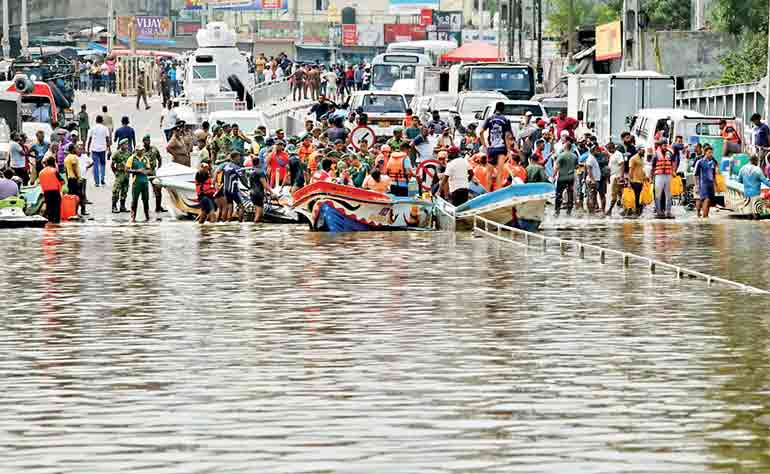
Preventing future tragedies depends on more than restoring water and electricity and rebuilding roads - Pic By Pradeep Dilrukshana
“…economy is embedded in nature and cannot exist apart from it,” - World Bank – Reboot
Development – The Economics of a Liveable Planet
By Tisaranee Gunasekara
In September 2020, a five-storied house in Buwelikada, Kandy, collapsed, killing three people. The victims were neighbours in a house below, a young couple and their infant daughter. Public outcry and demands by the Bar Association (one of the victims was a lawyer) compelled the police to act. The owner of the house, Anura Lewke, a former Basnayake Nilame of the Dodanwala Natha Devalaya, was arrested and remanded.
According to media reports, Lewke’s house had been built over a stream flowing down to the Udawattakale Sanctuary. As the NBRO (National Building Research Organisation) pointed out in its preliminary report, “Existing surface and subsurface drainage systems have been blocked by the construction of the building and the other structures in the vicinity…” (https://www.nbro.gov.lk/images/special_projects/BUWELIKADA/PRELIMINARY-INVESTIGATION-REPORT-ON-BUILDING-COLLAPSE.pdf). Moreover, the initial permission had been for a two-story structure. Three more levels were added in stages, turning the house into a death trap, not for the owners who escaped in time, but for three innocents.
In his recent address to the nation, President Anura Kumara Dissanayake pledged to ‘start from zero’. Doing so would give Sri Lanka an opportunity to rethink its growth path, to avoid and – where possible - undo old mistakes. Such action is bound to be unpopular with voters, and go against the vested interests of powerful groups, both secular and religious. Do the president and his Government possess the courage and the vision to make those difficult decisions and stick to them? Or are we going to continue on an economic path which regards nature at best as a commodity, generally as a nuisance, and at worst as an enemy? If so, whatever recoveries we make in terms of growth and human development might be undermined by the next act of nature
The tragedy brought to limelight a problem which lies at the intersection of economics, environment and the rule of law – illegal and unsafe constructions, by the poor and the rich, from shacks to multi-story apartment complexes, eating into hillsides, wetlands, and river reservations. The NBRO announced it was conducting a survey to identify illegal constructions in Kandy together with the Municipal Council. It subsequently stated that it has identified high risk areas in the Central Province for landslides and was preparing a proposal to deal with buildings in those areas, from tuition classes to residences and hotels. That was that.
In December 2022, heavy rains caused substantial flood and landslide damages in Kandy. 2 were killed, 98 houses damaged, and 1630 families affected. The then Mayor Kesara Senanayake identified illegal constructions as the main reason for the flooding. Immediate steps should be taken to remove constructions blocking waterways irrespective of the nature of the structure or the status of the owner, he said. If not, the city will be destroyed soon, he warned (https://ceylontoday.lk/2022/12/28/illegal-constructions-claim-lives/).
Three years later, his grim warning has become a reality. Three years of more and more illegal and unsafe constructions, three years of public inattention and official indifference.
Even where ample early warnings had been given, tragedies were allowed to happen. The Koslanda landslide of 2014, the worst natural disaster after the 2004 tsunami, was a case in point. The first warnings about the precarious conditions in the Meeriyabedda division of the Koslanda Estate appeared in May 2005; the NBRO issued a second warning in November 2011. The Government and the Maskeliya Plantation Company which owned the estate ignored the warnings. Over 100 people paid for this official apathy and private greed with their lives.
Landslides were mostly minor and uncommon in Sri Lanka until 2002. In 2003, the number of landslides almost doubled (http://www.sundaytimes.lk/141102/news/brace-for-more-landslides-with-climate-change-125882.html). Since then, landslides have grown from occasional mishaps into an existential danger. In 2014, the NBRO warned that one fifth of Sri Lanka’s land mass, housing one third of the country’s population, is landslide-prone: “20% of the country’s land area has been identified as prone to landslides – this includes territory in the districts of Badulla, Galle, Hambantota, Kalutara, Kandy, Kegalle, Matale, Matara, Nuwara Eliya and Ratnapura” (Ibid). When 5,066 square miles in a country of just 25,332 square miles become landslide-prone, none of us can afford to remain bystanders. Yet that is precisely what most of us – rulers and we, the people – did. Today, landslide risk has crept into three more districts, Gampaha, Kurunegala, and Moneragala. Ignoring that 2014 NBRO warning was a key reason for the enormity of harm we are experiencing currently. Further inaction risks turning Sri Lanka into an unlivable land.
Does the Anura Kumara Dissanayake Government possess the courage, and the political will to withstand pressure from vested interests and establish a new culture of responsible land use and management? Or will he do what his predecessors did – speak poetically about the environment and allow its degradation by political, business, and religious interest groups?
Futureless growth
The 1996 Human Development Report by the UNDP began with a seminal statement: “Human Development is the end – economic growth a means.” The report dealt with a contradiction that had been apparent in the real world for decades but remained unacknowledged by orthodox economics – that growth doesn’t automatically lead to development, that the two can move in opposite directions, with high economic growth translating into low human development. “Policymakers are often mesmerised by the quantity of growth,” the Report stated. “They need to be more concerned with its structure and quality” (https://www.un-ilibrary.org/content/books/9789210576857/read).
The report identified five types of negative growth which cause regression in human development. Jobless growth – growth without employment creation; Ruthless growth – growth leading to greater inequality; Voiceless growth – growth without an extension of democracy or empowerment; Rootless growth – growth which undermines cultural identities and minority rights; and Futureless growth – growth that degrades and destroys nature.
The first four types of growth are unsustainable socio-politically because they can lead to violent explosions of human anger. The fifth, Futureless growth, might seem less risky to policymakers, economic actors, and even citizens. After all, mountains have no voices, forests have no votes, and rivers cannot protest. Yet, growth that destroys nature is the most unsustainable, the riskiest, the deadliest of all negative growth types. Years, even decades of economic and other achievements can be wiped out by one natural catastrophe. As we are
experiencing today.
Where we go from here depends on whether – or not - we continue to be possessed by the goal of high growth without bothering to count its socio-political, human, and environmental cost.
Take tourism, for example. Tourism is necessary. But it shouldn’t be a numbers game, a senseless drive to attract more and more tourists in order to ace last year’s (and the previous Government’s) record. In this numbers mania, no cost-benefit analysis is made, from allowing illegal hotels, hostels, and cafes to mushroom in landslide prone areas to permitting IDF tourists to bring Gaza genocide to the East. Political, environmental, and even profit considerations are ignored in the obsession to attract 3 million tourists in 2025. In that myopic pursuit, basic realities are forgotten, that most tourists prize safe destinations, not lands riven by political violence or environmental disasters.
President Ranil Wickremesinghe managed to stabilise the economy but did so by placing most of the burden of recovery on the already bent backs of poor and middle class Lankans. The future of Sri Lanka – not to mention the political fortunes of the NPP/JVP – will depend on how President Anura Kumara Dissanayake approaches the task of post-Ditwah reconstruction
Warnings about the consequences of this heedless promotion of tourism had been around for over a decade. In May 2014, R.M.S. Bandara, the then head of the NBRO’s Landslide Division, said, “…Sri Lanka Tourism Development Authority should look into tourist hotels or inns built on landslide-prone areas. (He) said the recent earth-slip at Ella was a result of lack of retaining structure in nearby tourist hotels and weaknesses in road construction.” (http://www.sundaytimes.lk/140511/news/officials-helpless-as-landslide-danger-grows-98939.html). Professor of Geology of the Peradeniya University, Kapila Dissanayake warned, “There has been a wave of road construction without giving due concern to landslides. Such road constructions trigger the landslide process.” Those warnings were ignored, then, and for the next 11 years.
Take Ambuluwawa for instance. In 2009, the then prime minister D.M. Jayaratne set up the Ambuluwawa Biodiversity Centre including a 157-feet tall observation tower. Whether the project received a proper environment assessment or a Mattala airport type blank cheque is unknown. Minor landslides began to be reported soon after construction began. In 2023, the Government gave approval to a BOI project to build a cable car system in Ambuluwawa, a collaboration between a company called Amber Adventures and China Machine Building International Corporation. Whether a proper investigation was conducted into the reasons for landslides before permission was given is again unknown.
Last year, the residents of the nearby Sinhapitiya village complained to the Grama Niladhari (GN) about massive excavation of soil on the hilltop. The GN relayed the complaint to Gampola Udapalatha divisional secretary Aathma Dilrukshi Jayaratne. D.S. Jayaratne examined the site and put a stop to the cable car project citing environmental harm. Amber Adventures went to Appeal Court. The Court held with Amber Adventures because the project had been approved by the relevant authorities. The verdict mentions that the Divisional Secretary (herself a lawyer) personally tendered a large number of documents to the court which the court was unable to consider since they were not tendered by the AG’s Department. The question is, what were these documents? The question is, why didn’t the AG’s Department tender them to the court?
According to media reports, there has been another minor landslide in Ambuluwawa this time, rendering the hilltop inaccessible, for now. Whether the Government allows the cable car project to go ahead or halts it until a proper environment assessment is made would be a test case. Does the Anura Kumara Dissanayake Government possess the courage, and the political will to withstand pressure from vested interests and establish a new culture of responsible land use and management? Or will he do what his predecessors did – speak poetically about the environment and allow its degradation by political, business, and religious interest groups?
After all, mountains have no voices, forests have no votes, and rivers cannot protest. Yet, growth that destroys nature is the most unsustainable, the riskiest, the deadliest of all negative growth types. Years, even decades of economic and other achievements can be wiped out by one natural catastrophe. As we are experiencing today. Where we go from here depends on whether – or not– we continue to be possessed by the goal of high growth without bothering to count its socio-political, human, and environmental cost
New deals require new visions
The horrific tragedy we are living through is the climatic equivalent of the economic collapse of 2022. The consequences though will be way more extensive both in scale and depth and far-reaching.
In his recent address to the nation, President Anura Kumara Dissanayake pledged to ‘start from zero’. Doing so would give Sri Lanka an opportunity to rethink its growth path, to avoid and – where possible - undo old mistakes. Such action is bound to be unpopular with voters, and go against the vested interests of powerful groups, both secular and religious. Do the President and his Government possess the courage and the vision to make those difficult decisions and stick to them? Or are we going to continue on an economic path which regards nature at best as a commodity, generally as a nuisance, and at worst as an enemy? If so, whatever recoveries we make in terms of growth and human development might be undermined by the next act of nature.
The NBRO has warned that nearly 15,000 families (60,000 men, women, and children) are still living in 230 landslide and 20 rockfall zones in Badulla, Kandy, Nuwara Eliya, Ratnapura, Kegalle, Kalutara, Galle, Matara, Hambantota, Gampaha, Moneragala, and Kurunegala districts. The NBRO can warn, but its warnings lack effect. A bill giving it the necessary powers to prosecute those engaged in illegal constructions has been vegetating with the Legal Draughtsman since 2012. This year, a new National Building Research Institute Act came into force, enabling legal action against local Government authorities who ignore landslide warnings. This is an improvement but it doesn’t obviate the urgent need for a new act enabling the NBRO to take legal action against those who engage in illegal constructions. Another urgent need is to expedite the completion of the National Building Code, so that it becomes effective in 2026 rather than 2028. Once the waters of the floods recede and the debris from landslides are cleared, attention should also be paid to the vital question of whether the high-rises mushrooming across the land contain basic safety measures, especially vis-à-vis fires. The recent inferno in a housing complex in Hong Kong which caused over 150 deaths is a warning of the next disaster waiting round the corner for us. While the original cause of the Hong Kong fire is still unclear, authorities claim that its speedy spreading was caused by Styrofoam placed outside the windows of apartment blocks and substandard building materials brought in for renovation work.
Another urgent need is to expedite the completion of the National Building Code, so that it becomes effective in 2026 rather than 2028. Once the waters of the floods recede and the debris from landslides are cleared, attention should also be paid to the vital question of whether the high-rises mushrooming across the land contain basic safety measures, especially vis-à-vis fires
President Ranil Wickremesinghe managed to stabilise the economy but did so by placing most of the burden of recovery on the already bent backs of poor and middle class Lankans. The future of Sri Lanka – not to mention the political fortunes of the NPP/JVP – will depend on how President Anura Kumara Dissanayake approaches the task of post-Ditwah reconstruction. While foreign assistance is necessary, the bulk of the burden of revival will have to be borne by Lankans. How this burden is distributed among haves and have-nots could be fundamental in deciding the nature and the direction of recovery. If the Government opts to take the indirect taxation route, it will lead to an exponential increase in poverty and inequality, followed by its obvious – and explosive – socio-political consequences.
Preventing future tragedies depends on more than restoring water and electricity and rebuilding roads. Families will have to be evicted from danger zones, after providing them with liveable alternate accommodations. Other constructions in danger zones too will have to be relocated, from hotels and schools to temples and other religious structures. The most vulnerable areas must be allowed to heal, by freeing them of human activity. Which means many of the landslide victims will have to be provided with alternate loci of accommodation. Money will be necessary, political will even more so, the courage to do what is unpopular, with political and business interests, with monks and other clergy, and with ordinary voters, especially those who have been victimised and traumatised already.
It will be a hard path. Yet, not taking it will be tantamount to opening the door wide to the next catastrophe. As Lankan climate scientist Dr. Thasun Amarasinghe said, “Nature had delivered its warning. If Sri Lanka fails to respond with decisive action, the next disaster will not be an accident – it will be a consequence” (https://island.lk/weather-disasters-sri-lanka-flooded-by-policy-blunders-weak-enforcement-and-environmental-crime-climate-expert/).
While foreign assistance is necessary, bulk of the burden of revival will have to be borne by Lankans. How this burden is distributed among haves and have-nots could be fundamental in deciding the nature and the direction of recovery. If the Government opts to take the indirect taxation route, it will lead to an exponential increase in poverty and inequality, followed by its obvious – and explosive – socio-political consequences



