Monday Sep 28, 2026
Monday Sep 28, 2026
Wednesday, 3 June 2026 00:26 - - {{hitsCtrl.values.hits}}
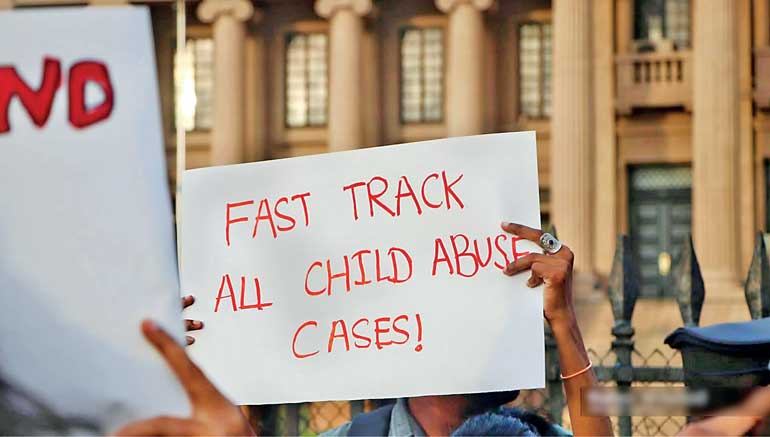
 In recent days, Sri Lankans across the country have taken to the streets demanding justice for a child and calling for long-overdue action on the thousands of child abuse cases moving through our courts. Signs calling to "fast track all child abuse cases" reflect a growing recognition that no child should have to wait years for justice, or spend their childhood navigating the justice system in order to receive it.
But this moment also demands a broader question: not only whether justice is ultimately delivered, but what children endure while waiting for it.
Reports indicate that twenty-eight days passed between the child naming their alleged abuser and an arrest being ordered, during which time no travel ban was reportedly imposed. Bail has since been granted. In court, the accused appeared with approximately twenty lawyers, including a President's Counsel. The child was represented by a small number of volunteers and a lawyer from the NCPA — people who showed up because someone had to.
That asymmetry is not a detail. It is not accidental. It is structural.
Serious sexual offence
To understand why, it helps to know how these cases work. In Sri Lanka, serious sexual offence cases are prosecuted by the State, and children generally participate in the process as witnesses rather than independently represented parties. Navigating the system can involve multiple institutions, with responsibility for support often fragmented across them. No single person is consistently tasked with helping a child understand and navigate the process from beginning to end.
For more than twenty years, through my work with Emerge Lanka Foundation, I have walked alongside teenage survivors of sexual abuse in Sri Lanka. I have watched children removed from their homes, schools, and communities — often because the alleged abuser was a relative or someone close to them, leaving authorities with few safe alternatives. In the name of protection, many were placed into state care while their cases stretched on for years. I have sat with them as they tried to make sense of processes no one had explained, retold their stories to strangers, and walked into courtrooms unprepared and alone.
Delay is not an exception in these cases. It is the norm.
 In October 2025, the Homagama High Court convicted a former police officer for abuse committed sixteen years earlier. The survivor was eight years old when it happened. They were twenty-four by the time the case concluded. In another documented case, a child of thirteen testified at twenty-one — sitting their Advanced Level examination for the third time. "I do not remember any of it anymore," they told the court. These cases, documented in The Morning in February 2026, are not outliers. They are the record.
Over 4,000 cases
As of April 2026, 4,421 child abuse cases were pending before High Courts across Sri Lanka. During the years their cases stretch through the system, children grow up inside legal limbo. Repeated retelling. Uncertainty. Long stretches without information about what is happening in their own case. For those in institutional care throughout this wait, that limbo also means separation from family, community, and the ordinary milestones of development that cannot be reclaimed. A child should not have to keep paying for the courage it took to speak once.
The years spent waiting are years of formation. Justice delayed is not only justice denied. For a child, it is development interrupted.
Important progress
Sri Lanka has made important progress. A child-friendly justice model launched in Kandy last year offers a promising foundation for wider reform. Building on that progress will require ensuring that every child has someone in their corner from disclosure through resolution.
The protesters who took to the streets in recent days have already named many of the reforms that are needed: faster movement of child abuse cases through the courts, legal representation for children, protection for witnesses and advocates, and accountability when systems fail them. These are not abstract proposals from policy papers. They are demands from ordinary Sri Lankans who understand, intuitively, what the system owes a child who speaks.
Some of this can begin without legislation. Magistrates can coordinate timelines across the institutions involved in a child's case. Probation officers can bridge agencies that currently operate in silos. A consistent advocate — someone who stays with a child from first disclosure through final resolution, helping them understand the process, navigate the institutions around them, and prepare for what comes next — can ensure that no child walks into a courtroom having never had anyone explain what is about to happen. These are not radical proposals. They are the minimum a child deserves.
Longer-term reforms
Longer-term reforms require legislative backing but are equally within reach: guaranteed legal representation for children from the point of disclosure, enforceable timelines for case progression, dedicated funding for accompaniment through the justice process, and stronger protections for witnesses and those who advocate on behalf of children. These reforms would directly address the structural imbalance that leaves children facing the full weight of the legal system without adequate support.
As Sri Lanka expands child-friendly justice reforms, children, survivors, and frontline practitioners must have a meaningful seat at the table. They understand where the fear lives. They know what it feels like to wait years without answers, to navigate fragmented systems without consistent support, and to face processes that often make little sense to the people moving through them.
Their experience is not an optional input into reform. It is essential expertise. If we are serious about building systems that work for children, the people who have lived through them and walked alongside them must help design them.
The test of any justice system is not how it treats the powerful. It is how it holds the most vulnerable after they have found the courage to speak.
(The author is the founder of Emerge Lanka Foundation, which has worked with teenage survivors of sexual abuse in Sri Lanka for more than twenty years)