Thursday Oct 22, 2026
Thursday Oct 22, 2026
Wednesday, 25 March 2026 00:20 - - {{hitsCtrl.values.hits}}
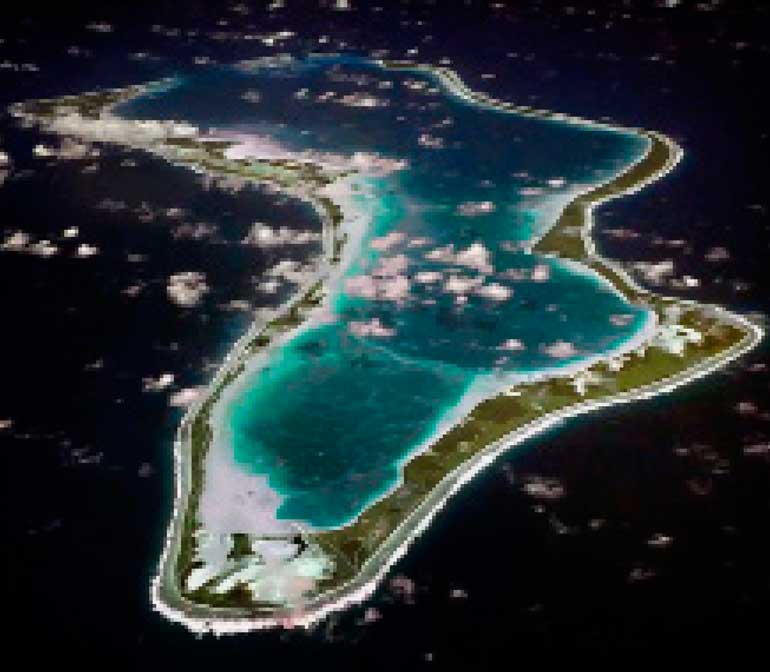
Diego Garcia, part of the Chagos Island group in the Indian Ocean
 There is a particular kind of complacency that thrives in world politics: the belief that war can be geographically contained. It reassures distant capitals, comforts markets and allows policymakers to speak as though violence were a regional inconvenience rather than a systemic force. The reported Iranian missile launch towards Diego Garcia should bury that illusion. What happened was not simply another dramatic episode in an already volatile confrontation. It was a reminder that the boundaries of modern conflict do not hold for long, least of all at sea.
On a map, Diego Garcia looks almost insignificant—a remote speck in the Indian Ocean. Strategically, however, it is one of the most consequential islands on earth. For decades it has functioned as a crucial US-UK military hub, supporting operations across the Gulf, East Africa and South Asia. It is often described as an “unsinkable aircraft carrier”, one of those phrases’ officials favour because it sounds clean, efficient and technical. It also conceals more than it reveals. Aircraft carriers, after all, are built for war. Islands are homes—or were, in this case, before strategic necessity and imperial privilege decided otherwise.
The significance of the reported Iranian strike lies not in whether the missiles hit their target. Reuters, citing the Wall Street Journal, reported that two intermediate-range ballistic missiles were fired at the base, that one failed in flight, and that a US warship launched an SM-3 interceptor at the other, though the outcome of that interception remained unclear. The real point is simpler and more unsettling: a base once treated as a secure rear platform is now understood to be targetable. In military affairs, perception often matters more than damage. Once an asset is seen as vulnerable, the strategic map changes immediately, whether or not the runway is scarred.
That matters well beyond Washington and London. Diego Garcia sits at the intersection of several theatres once discussed as though they were separate: the Gulf, the western Indian Ocean, South Asia and the wider Indo-Pacific. The reported missile launch suggests that this separation is becoming harder to sustain. A conflict that many still describe as “Middle Eastern” is increasingly sending shockwaves across the ocean that carries a significant share of the world’s trade and energy traffic. The Indian Ocean is no longer just a commercial highway. It is becoming a strategic transmission belt.
For smaller states, that is not an abstract shift in military cartography. It is a narrowing of political and economic room for manoeuvre. Sri Lanka illustrates the point with uncomfortable clarity. It did not create the present crisis, nor does it possess the power to shape its military trajectory. Yet it is exposed to its consequences precisely because of where it is. The island’s position is endlessly praised as “strategic”, which is usually a flattering way of saying that it lies where larger powers would like access, leverage and logistical convenience. Geography is marketed as an opportunity when the sea is peaceful. It becomes a liability when the same waters are militarised.
The first sign that a maritime order is deteriorating is rarely a naval battle. It is usually an insurance bill. Shipping costs rise. Energy markets harden. Ports become less predictable. Investors grow cautious. Tourism retreats. Fisheries and coastal livelihoods face disruption from intensified naval activity, possible debris and the wider insecurity that follows strategic escalation. These are the costs small states are expected to absorb while the major powers talk about deterrence, resolve and stability. There is a familiar injustice in that arrangement: the countries least responsible for confrontation often end up paying most of its everyday price.
That is why Sri Lanka’s recent decisions deserve to be read as more than tactical hesitation. Reuters reported that Colombo rejected a US request to allow two combat aircraft to land at Mattala Rajapaksa International Airport and also turned down an Iranian naval request, with President Anura Kumara Dissanayake presenting both decisions as necessary to preserve neutrality. This was not indecision masquerading as principle. It was small-state realism. For countries situated near great-power infrastructure and contested sea lanes, neutrality is not a slogan from a fading non-aligned era. It is one of the
few remaining tools for protecting policy space in a region where the strategic appetite of bigger players is growing faster than the margin for error.
Yet Diego Garcia also raises a more awkward question—one that western strategic discourse has long preferred to keep in the background. What exactly is being defended there? Certainly, a military facility. Certainly, lines of communication. But also, a particular order of power, one shaped by colonial detachment and selective memory. The Chagos Archipelago was emptied of many of its inhabitants in the 1960s and 1970s so that the base could be built. The International Court of Justice and the United Nations have challenged Britain’s continuing administration of the islands, and the sovereignty issue remains entangled in diplomacy, legality and the future of the base itself. There is no way to discuss Diego Garcia honestly without acknowledging that its strategic usefulness was built on dispossession.
That history matters because it reveals the deeper contradiction now on display. Diego Garcia has long symbolised the western promise that order can be secured
from carefully chosen vantage points—remote enough to be safe, powerful enough to shape events from afar. But the reported Iranian launch suggests that even the most insulated platforms are losing their insulation. Missile diffusion, technological improvisation and widening theatres of conflict are eroding the old geography of sanctuary. Oceans no longer guarantee distance. Islands no longer guarantee invulnerability.
The Indian Ocean, then, is becoming the place where several fictions are collapsing at once: that war can be regionally contained; those great powers can indefinitely manage instability from offshore bastions; and those smaller states can remain untouched by rivalries conducted in the name of global order. What looks from afar like strategy often feels, from the shoreline, like exposure. Sri Lanka and others like it are not merely watching a conflict widen. They are being asked to live inside the wider consequences of it.
The reported missiles aimed at Diego Garcia did more than threaten a military base. They punctured a fantasy—that the architecture of great-power security can remain intact while the surrounding region grows steadily less secure. That fantasy was always fragile. It now looks untenable.
(The author is Dean of the Faculty International Liberal Arts and Sciences at Fukuoka Women’s University, Japan. He writes on Indian Ocean geopolitics, small-state diplomacy and strategic change in South Asia)