Friday Sep 04, 2026
Friday Sep 04, 2026
Friday, 4 September 2026 00:25 - - {{hitsCtrl.values.hits}}
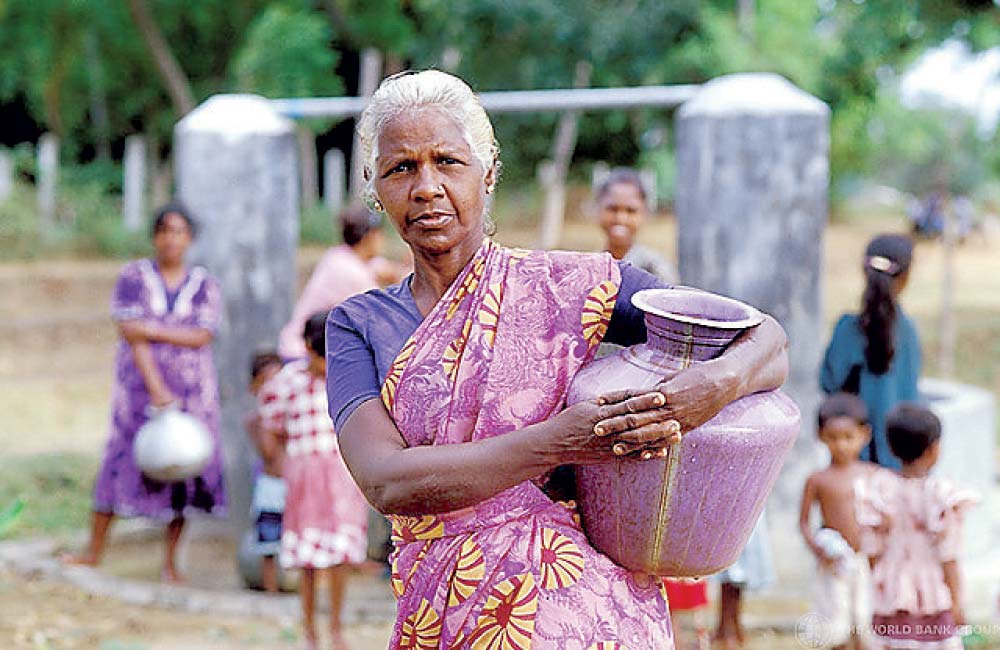
 Sri Lanka’s GDP grew by 5% in 2025. Government revenue increased substantially. The primary surplus reached 5.4% of GDP. Foreign reserves were rebuilt and inflation was brought under control. These are important achievements. But other numbers tell another part of the story. There is no contradiction in acknowledging both sets of numbers. But the distinction matters. The first tells us that the patient has been stabilised. The second asks whether the patient is actually recovering and getting back on his feet—or merely being kept alive on his sickbed
 What is economic growth?
“Economic growth” must be one of the most frequently used phrases in public discourse today. Politicians promise it, economists measure it, the media celebrates or laments it, and the people wait for it.
But what exactly is economic growth?
In simple terms, economic growth is the increase in a country’s output or income from one year to the next, usually measured through the growth of Gross Domestic Product (GDP) or Gross National Income (GNI). At its core, it is a number—the percentage by which the economy has grown compared with the previous year.
We first learned how to calculate the percentage difference between two numbers in primary school. Anyone who attended school can calculate a growth rate once the figures are supplied. One who sits in the Central Bank, as well as one who sits on a river bank, can do it. One who sits in a prestigious think tank, as well as one who sits in a tin tank, can do it. Calculating economic growth is arithmetic. Explaining why it happened—and whether it improved people’s lives—is where economics begins.
Economics is not merely about arithmetic. It is about strategy. Growth itself is morally neutral. It can arise from activities that are productive or unproductive, environmentally friendly or damaging, equal or unequal, socially desirable or undesirable. GDP does not ask whether growth was fair. It does not ask who benefited. It does not ask who was left behind. Nor does the growth figure tell us whether people obtained better jobs, higher real incomes, better public services, improved nutrition, better housing or greater economic security.
That is the first question we need to ask: What does the number actually mean to the person behind the number?
In my view, the central question in Sri Lanka’s economic discussion should not be simply: “Is the economy growing?” But: “Is economic growth improving the lives and opportunities of ordinary Sri Lankans?”
How is growth looked at?
Different institutions look at economic growth from different perspectives.
There is nothing inherently wrong with any of these perspectives. But there is another perspective which is rarely represented adequately in the statistical tables: the perspective of the household. For the household, GDP growth is not something to be framed and hung on the wall. The household asks different questions.
Do I have a job?
Has my real income increased?
Can I afford food, transport, electricity and education?
Can my children find productive employment here rather than having to leave the country?
Can I save anything at the end of the month?
Has my standard of living improved?
These are also economic indicators but rarely receive the same dramatic headlines as GDP growth.
Economics is not merely about arithmetic. It is about strategy
Numbers and what lies behind them
Numbers are indispensable. Without them, economic policy would be little more than guesswork. But numbers are measurements, not explanations. There is a danger in becoming fascinated by numbers alone.
A growth rate can tell us how much the economy grew. It does not necessarily tell us why it grew, where it grew, who benefited from it, or whether it can be sustained. This is where a growth strategy becomes more important than a growth number. Prediction, forecasting, planning, implementation and follow-up are not optional accessories to economic policy. They are the ingredients that should convert growth into development.
Otherwise, we risk becoming very good at conducting economic post-mortems while remaining surprisingly poor at preventing the next economic illness.
The headline may say: “The economy grew.”
The household may quietly ask: “So what grew in my house?”
Economy is growing—Is growth reaching the household?
In my view, the central question in Sri Lanka’s economic discussion should not be simply: “Is the economy growing?” But: “Is economic growth improving the lives and opportunities of ordinary Sri Lankans?”
That question takes us beyond GDP and into employment, wages, poverty, regional inequality, income distribution, taxation, the cost of living and access to public services. The distinction is particularly important today. Sri Lanka has achieved considerable macroeconomic stabilisation. But stabilisation is not the same thing as transformation.
The World Bank’s assessment itself makes an important distinction: macroeconomic recovery has not yet translated into broad household recovery. Household incomes, employment opportunities and non-monetary welfare remain below pre-crisis levels, while poverty and food insecurity remain elevated. That should make us pause. A country can recover on the spreadsheet while a family is still recovering at the dinner table.
Can a country achieve balanced and inclusive growth when so much of its economic activity is concentrated in one province?
What the numbers don’t say
Sri Lanka’s GDP grew by 5% in 2025. Government revenue increased substantially. The primary surplus reached 5.4% of GDP. Foreign reserves were rebuilt and inflation was brought under control.
These are important achievements. But other numbers tell another part of the story. The IMF’s projected growth for 2026 is around 3%. Public debt remains around 100% of GDP. The merchandise trade deficit was $7.9 billion in 2025. And the World Bank’s latest detailed poverty estimates put poverty at 24.5%—roughly twice the 2019 level.
There is no contradiction in acknowledging both sets of numbers. But the distinction matters. The first tells us that the patient has been stabilised. The second asks whether the patient is actually recovering and getting back on his feet—or merely being kept alive on his sickbed.
Economic growth is a means, not the end. And an economy is ultimately not a collection of numbers. It is people
Are we producing—or consuming?
There is another uncomfortable question. In 2025 Sri Lanka exported goods worth about $13.6 billion while importing about $21.5 billion, leaving a merchandise trade deficit of $7.9 billion. At the same time, worker remittances amounted to about $8.1 billion.
Remittances are an invaluable source of foreign exchange. They support millions of families and provide a vital lifeline to the economy. But should we be satisfied with an economic model in which so many Sri Lankans particularly our loved ones—mothers, wives, daughters and sisters—must leave the country to earn the foreign exchange we desperately need to sustain consumption at home? That is not an argument against migration. Foreign exchange is not merely dollars entering the country; it can represent a mother separated from her children, a wife from her husband, or a daughter from her family.
It is an argument for asking a much harder question: That may be foreign exchange earnings. But is it development? Why can’t enough productive opportunities be created at home? If our best export strategy is to export our people, perhaps we should ask whether we are really exporting labour—or exporting the country’s future. And there is an uncomfortable irony here.
A mother working thousands of kilometres away from her children may be sending dollars home to pay for food and education. But dollars cannot substitute for a mother’s love, presence and care—the things a child needs most. And, ironically, the dollars earned through such sacrifice may help finance toys, food and luxury vehicles for the children of those whose parents have never had to leave the country, let alone their families, to earn a dollar abroad.
Where does growth happen?
The geographical distribution of economic activity adds another dimension to the story.
The Western Province alone accounted for 42.4% of Sri Lanka’s GDP, while the other eight provinces together accounted for 57.6%. This concentration is not surprising given Colombo’s dominance in finance, government, corporate headquarters, trade, logistics, manufacturing and services. But it raises a larger development question:
Can a country achieve balanced and inclusive growth when so much of its economic activity is concentrated in one province?
The household income figures make the disparity even more visible. Mean monthly household income in the Western Province was about Rs.109,813 compared with Rs.51,536 in the Eastern Province—roughly a two-fold difference.
The urban-rural-estate divide is even more striking:
Urban household income is about two and a half times estate household income.
So, when we say “Sri Lanka grew by 5%”, we should perhaps ask: Which Sri Lanka are we talking about?
Colombo?
The Western Province?
The urban economy?
The rural economy?
The estate sector?
Or the Sri Lanka that appears in the household budget?
Nobel laureate Amartya Sen famously placed human freedom and opportunity at the centre of development. Economic growth ultimately acquires meaning when it expands people’s opportunities and improves their lives. Interestingly, a similar philosophy was articulated by President Anura Kumara Dissanayake, a political leader without formal training in economics, at the beginning of presidency
Growth for whom?
Income distribution makes the question even more difficult to avoid.
The richest 10% of Sri Lankan households received 36.2% of total household income, while the poorest 10% received only 1.5%. The bottom 20% received 4.6%, while the top 20% received 51.4%.
These numbers do not tell us that growth is necessarily bad. They tell us something more important: Growth is not automatically inclusive. Therefore, the economic question is not merely: “How fast is GDP growing?”
It is: “Where is growth occurring, who is participating in it and benefitting from it, and how much of the additional income reaches households?”
Six numbers that should make us think
Consider just six numbers:
These six numbers tell us far more than the headline “Sri Lanka grew by 5%”.
They force us to ask:
Is the economy growing? Yes.
Where is the growth taking place? That requires another answer.
Who is receiving it? That requires an even harder answer.
And finally: Why can a country grow by 5% while almost one-quarter of its population remains below the World Bank’s poverty line?
That is not a question against growth. It is a question about the quality, composition and distribution of growth.
Growth: What’s it all about?
Nobel laureate Amartya Sen famously placed human freedom and opportunity at the centre of development. Economic growth ultimately acquires meaning when it expands people’s opportunities and improves their lives. Interestingly, a similar philosophy was articulated by President Anura Kumara Dissanayake, a political leader without formal training in economics, at the beginning of presidency.
He argued that citizens should be “participants, not spectators” in the economic process and emphasised inclusive growth and equitable distribution. He also argued that growth for its own sake has little value unless it improves the lives of all members of society.
That is a powerful philosophy. And it leads to perhaps the most important question of all:
Are we building an economy in which people participate in growth—or one in which people are merely informed that growth has occurred? If the former is the objective, GDP cannot be the final examination result. It is only one mark on the report card. The real report card should include jobs, wages, productivity, poverty, regional opportunity, exports, household incomes, access to services and the ability of young people to build a future without having to leave home.
A 5% growth rate can therefore be good news. But it is not the whole news. The ultimate test of economic growth is not whether the economy has become bigger. It is whether people’s economic lives have become better. And perhaps the most uncomfortable question Sri Lanka should now ask is not:
“What is our growth rate?” but: “What is our growth producing?”
If we cannot answer that question, we may know the size of the economy without really knowing the condition of the economy.
Economic growth is a means, not the end. And an economy is ultimately not a collection of numbers. It is people.
(The author is the former Secretary, Plan Implementation Ministry. He can be reached at [email protected])



