Thursday Mar 26, 2026
Thursday Mar 26, 2026
Thursday, 4 December 2025 00:46 - - {{hitsCtrl.values.hits}}
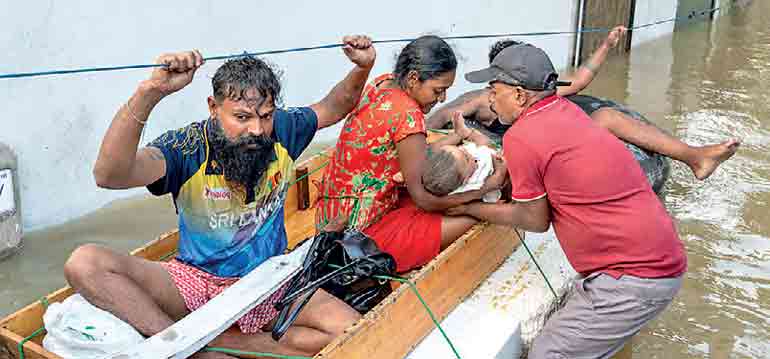
On 30th November 2025 in Kelaniya, Sri Lanka, Sri Lanka Army rescue boats transported villagers stranded near the Kelani River to safer locations. People boarded the boats carrying their essential items, hoping to escape the dangerous flood levels surrounding their homes/UNICEF/UNI908620/InceptChange
 While the institutional architecture for early-warning and preparedness existed, proactive, structured early evacuation did not occur at the scale or speed required to limit loss of life or mitigate the worst outcomes of Cyclone Ditwah. The lack of major pre-emptive action warrants closer investigation.
It is the India Meteorological Department (IMD) that is responsible for early warnings of weather systems in the North Indian Ocean, which includes the Bay of Bengal and the Arabian Sea. Both the IMD and Sri Lanka’s own Meteorological Department identified a strengthening low-pressure system near the island, forecast its intensification, and noted risks of heavy rainfall, rough seas and flooding from as early as 24 November. The IMD bulletin is publicly available on its website.
Statutory framework and bulletins
Sri Lanka’s statutory framework provides mechanisms for anticipatory deployment of resources under the Disaster Management Act. The system includes a national early-warning apparatus centred on the Department of Meteorology and the Disaster Management Centre (DMC), established protocols for inter-agency coordination, pre-identified evacuation centres, and published hazard maps for floods, landslides and storm surges.
Yet these tools did not translate into timely, population-level protective measures during the crucial 24-48 hour window between confirmation of a strengthening weather system and the onset of widespread flooding.
The IMD bulletin of 24 November noted the “likely formation of a low-pressure area over Comorin and adjoining areas of southwest Bay of Bengal and Sri Lanka… around 25 November.” Its “Summary of dynamic and thermodynamic features” likewise concluded that “a low-pressure area is likely to form over Comorin and adjoining Sri Lanka around 25 November.” Under the section on “Probability of cyclogenesis,” the report designated an “Intense Observation Period (IOP)” for the Sri Lanka-Tamil Nadu coasts from 24 to 29 November. Although the bulletin did not yet predict a storm or guarantee a landfall, it formally flagged likely development near the island and placed the Sri Lankan coast under heightened monitoring, an early-warning alert under the regional system.
Flood-risk districts such as Colombo, Gampaha, Puttalam, Kegalle and Badulla, together with the low-lying districts of the Eastern Province such as Batticaloa and Ampara, are well recognised within the disaster-management framework for recurrent flooding and, in central districts, frequent landslides. Local authorities in these areas have standing instructions to monitor hydrological triggers. Yet none of these districts appear to have issued early evacuation orders or begun staged relocation while conditions were still favourable and before rivers, reservoirs or lagoons began to spill.
Bi-lingual public communication
The lag was also evident in public communication. Although national-level warnings were issued, residents in several of the worst-affected localities reported receiving no hyper-local alerts, no loudspeaker announcements, no coordinated SMS warnings and no door to door mobilisation. In predominantly Tamil speaking districts, community accounts and media reporting indicate that early official warnings were either not disseminated in Tamil across all platforms, reducing their effectiveness for at-risk populations. Many households only realised the severity of the situation once water entered their homes or slope failures had already begun. This breakdown in “last-mile” communication is critical because Sri Lanka’s disaster-management model depends on district and divisional authorities activating community-level early-warning chains, particularly during rapid onset flooding.
Structural preparedness was similarly weak. Evacuation centres existed on paper but were inconsistently resourced, and their activation lagged behind the unfolding pattern of destruction. In Puttalam, Badulla and Kegalle, districts that ultimately recorded large numbers of displaced persons, safety centres began receiving significant inflows only after flooding and landslides were already causing casualties. In several locations, subsequent assessments found that communities had never rehearsed evacuation drills despite being situated in repeatedly affected basins. According to post-event reporting, some local officials hesitated to order evacuations until receiving central clearance, reflecting persistent ambiguity over authority and responsibility under the Disaster Management Act.
The critical issue is how early warnings translated into on-the-ground deployment. During the 25-27 November window, technical warnings on rainfall and river levels were issued, but there is no corresponding evidence of large-scale, pre-emptive evacuation from well-known high-risk locations
By the morning of 25 November, IMD’s National Bulletin reported that a low-pressure area had formed over the Comorin region and the southwest Bay, including Sri Lanka, and was “very likely” to become a well-marked low within 24 hours and a depression thereafter. It warned of rough to very rough seas along and off the Sri Lankan coast from 27-30 November and advised fishermen not to venture out. Special Tropical Weather Outlooks issued the same day indicated that most models showed a low or well-marked low near Sri Lanka, predicted intensification to a depression within 24 hours, and stated that the system would skirt the island and strengthen over the next 72 hours.
On 26 November, Tropical Cyclone Advisory No. 1 was formally addressed “TO: STORM WARNING CENTRE, COLOMBO (SRI LANKA).” It identified a “well-marked low-pressure area” near southeast Sri Lanka and assessed that it was very likely to intensify into a depression within 24 hours while moving north-northwestward. An accompanying Tropical Cyclone Forecast Program (TCFP) report kept Sri Lanka within the Intense Observation Period and reiterated high confidence in further intensification. At this point, Sri Lankan authorities had been explicitly informed that a well-marked low was present near the island and was expected to strengthen while moving along or near its coast.
From the night of the 26 into 27 November, the DMC issued flood warnings for key river basins; including Deduru Oya, the Kelani and Badulu Oya; alongside water-level updates. Between 28 and 30 November, Met Department bulletins explicitly referred to “cyclonic storm Ditwah in the vicinity of Sri Lanka,” and DMC situation reports began labelling “affected flood areas: Cyclone Ditwah.” Taken together, these records show that national agencies recognised and communicated the evolution from a low-pressure system to a significant storm affecting the island.
Absence of major pre-emptive action
The critical issue is how early warnings translated into on-the-ground deployment. During the 25-27 November window, technical warnings on rainfall and river levels were issued, but there is no corresponding evidence of large-scale, pre-emptive evacuation from well-known high-risk locations.
Under the Disaster Management Act, the state is required to address “impending disasters” as well as ongoing ones, operate an effective early-warning dissemination system and take preventive steps under the National Disaster Management Plan. Read against IMD’s alerts from 24-26 November and Sri Lanka’s own bulletins, the record suggests that the forecasting and legal architecture was in place and that warnings were issued. What did not occur with comparable speed was the systematic conversion of this warning lead-time into early, pre-impact evacuation and protection for at-risk communities.
This absence of major pre-emptive action warrants close examination. This is not a criticism directed solely at the NPP Government; rather, it reflects long-standing structural weaknesses across many state institutions. Decades of underfunding, institutional inertia, unclear lines of authority and a lack of sustained strategic direction have left critical agencies without the capacity or agility required for rapid anticipatory action. Ditwah exposed these systemic deficiencies, and many of the poorest Sri Lankans paid the price.
(The writer is a political commentator, media presenter, and foreign affairs analyst. He serves as Advisor on Political Economy to the Leader of the Opposition of Sri Lanka, and is a member of the Working Committee of the Samagi Jana Balawegaya (SJB). He is also a former banker. He holds a Master’s in International Relations from the University of Colombo and a Bachelor’s in Accounting and Finance from the University of Kent (UK). He could be reached via email at [email protected])



