Friday Mar 13, 2026
Friday Mar 13, 2026
Friday, 30 January 2026 00:24 - - {{hitsCtrl.values.hits}}
 Confined to home due to a twisted ankle, I nevertheless found myself intermittently attending many events. An unavoidable family wedding and homecoming, the ceremonial induction of the new President of CA Sri Lanka, and even ventured out of Colombo for an enjoyable two-day visit to my ancestral home with my son, daughter-in-law, and granddaughter.
Self-inflicted prolonged recovery and thoughts to publish
Inevitably, these movements prolonged my recovery—a quiet reminder that I had taken for granted the mobility so effortlessly enabled by my anatomy. Yet, on the bright side, those enforced days at home led me, almost unconsciously, to develop several articles. After three weeks of "self regulated care", I then took the advice of a dear friend who introduced be to a physiotherapist/chiropractor, who guided me well through a series of exercises. I think I am now on the road, to recovery.
Beyond economics, politics or governance
From among the many drafts that emerged during this period of enforced stillness, the one I chose to prioritise for publication in this Thought Leadership Forum column, is not about country-level economic policy or strategy, development or trade economics, or corporate restructuring. Nor does it address state-owned enterprise restructuring, privatisation, open markets and regulation, banking and risk management, or the quality and oversight of professional services—areas that typically dominate my writing and public engagement. Instead, it is one which focuses on ageing, (which inter- alia prolongs recovery) —not as a function of time alone, but of what we allow to accumulate when repair and renewal are neglected
Intellectual capital assets
Thus today, I turn to a subject that underpins all of the areas referred to above, but is rarely discussed with the seriousness, the time and space, it deserves. It concerns how we sustain the physical, mental, emotional, and spiritual capacity of those who constitute a nation’s intellectual capital, even within an increasingly artificially intelligent ecosystem. If properly understood and consciously nurtured, these intangible capital assets can remain productive and relevant far longer than is often assumed, extending their contribution well beyond the generally accepted “expiry or best-before” dates.
The trigger
I must say of course, that the thoughts that follow are based on research I did, triggered or inspired by a recent post on Linkedin, by a Dr Gotabhaya Ranasinghe, about ageing, accumulation, and autophagy. I took barely five minutes to absorb the refreshing, scientific insight I gained, which in turn prompted a desire to learn more, more so, since my mind also went to an article I wrote for the Daily News around 2007, titled “Intellectual Capital Flight,” at a time when many skilled professionals and technicians, of many ages, were leaving our shores amidst the daily military conflict. Then, the concern was outward loss. Today, the risk is equally about inward erosion—what happens when accumulated damage quietly shortens the effective life of our most valuable human assets.
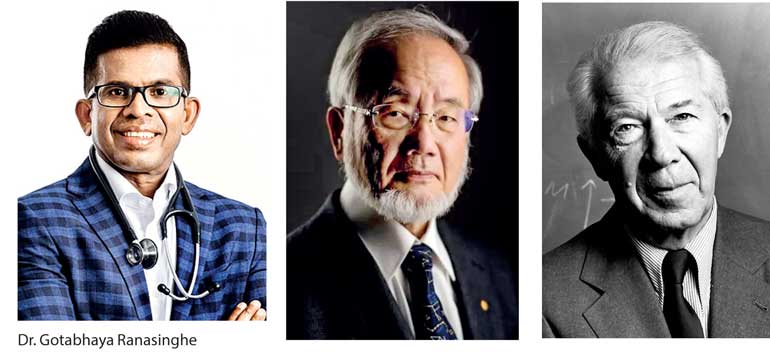
Dr Gotabhaya Ranasinghe
I Google searched Dr Gotabhaya Ranasinghe and learned that he is a Sri Lankan medical professional and academic whose work focuses on preventive health, metabolic well-being, and the biological foundations of ageing. What distinguishes his public engagement is his ability to translate complex medical science into accessible insight, encouraging informed reflection rather than prescription.
From observation to biological insight
Dr Ranasinghe’s brief video on LinkedIn, commences with a conversation he has with a naturalist, that touched on eating patterns- three meals a day, and the idea of accumulation. His observation—that we do not age merely with time, but with accumulation—prompted me to extend my research.
My exploration of his science was not as a clinician but in keeping with the guiding philosophy of my Thought Leadership Forum, of sharing knowledge and enhancing awareness, even beyond one’s professional domain. Particularly the concept of autophagy—proved sufficiently compelling to merit sharing.
Youthfulness, ageing and cellular housekeeping
Modern biology increasingly suggests that ageing is less about the steady passage of time and more about the gradual accumulation of cellular damage. Each day, the body is exposed to metabolic stress, oxidative damage, low-grade inflammation, and microscopic wear and tear.
In youth, these cellular stresses—the everyday wear and tear that accumulates as damage—are efficiently managed and cleared. With advancing age, the challenge is not that damage suddenly appears, but that repair mechanisms gradually lose efficiency. As clearance slows, damaged cells, dysfunctional proteins, and metabolic waste begin to accumulate. Ageing, in this sense, is not a sudden decline—it is a quiet failure of housekeeping.
Autophagy: The body’s natural renewal process
At the centre of this cellular housekeeping is a process called autophagy—literally “self-eating.” In simple terms, it is the body’s natural recycling and renewal mechanism. Autophagy identifies damaged or dysfunctional cellular components and breaks them down so their basic materials can be reused. It is not destructive; it is restorative. By clearing out cellular clutter, autophagy keeps cells efficient, resilient, and functional. When this process slows or falters, damaged components accumulate, contributing to inflammation, organ dysfunction, and the onset of chronic disease.
Healthy autophagy is essential across the body, but it is especially critical for organs and tissues that have limited regenerative capacity. For example, heart muscle cells work continuously and rarely divide, so their internal “quality control” depends heavily on autophagy. When this system functions well, heart cells remain robust. When it falters, damage accumulates, increasing the risk of cardiovascular decline over time. Similarly, in blood vessels, autophagy preserves the lining, reduces oxidative stress, and maintains elasticity. In short, cleaner cells support healthier circulation; cluttered cells accelerate ageing at the tissue level.
Repair requires signals, not automatic
One of Dr Ranasinghe’s most important insights is that autophagy does not run on autopilot. It requires specific biological signals to activate. Modern lifestyles—constant eating, frequent snacking, sugar-rich diets, and prolonged inactivity—send the body a continuous signal of abundance. In this state, the body prioritises growth and storage over repair. Autophagy remains largely suppressed, and cellular clutter quietly accumulates.
From storage and growth to maintenance
Repair and renewal are activated when the body experiences intermittent, manageable stress—signals that resources are scarce or that effort is required. These signals prompt cells to switch from storage and growth into maintenance mode, clearing damaged components and refreshing function. In essence, the body’s cleanup crew works best not under perpetual abundance, but under controlled, intentional challenge.
Healthful practices and maintenance modes
Certain everyday practices naturally signal the body to enter repair and maintenance mode, activating autophagy. Research increasingly highlights a few key approaches:
Fasting or time-restricted eating: Periods without food prompt the body to shift from growth and storage to cellular cleanup, reducing accumulated damage.
High-intensity or challenging exercise: Effortful activity sends a signal of physiological stress, encouraging repair processes at the cellular level.
Sustained movement and long walks: Regular physical activity maintains circulation, oxygen delivery, and metabolic balance, supporting overall cellular renewal.
Balance, not extremes
The goal is not extreme deprivation or exertion, but to provide moderate, consistent signals that awaken the body’s internal housekeeping system. Overdoing it can be counterproductive, while too little allows cellular clutter to build. Balanced, intentional practices give the body the opportunity to refresh itself without tipping into harm.
Autophagy—and cellular repair more broadly—is governed by balance. Moderate fasting, consistent movement, and purposeful physical challenge provide the body the signals it needs to maintain and renew itself, without tipping into stress or injury.
Rethinking ageing through awareness
Autophagy reframes how we understand ageing. While we cannot stop the passage of time, we can influence how much cellular damage we allow to accumulate. Health is shaped not only by what we consume or add, but also by what we allow the body to clear away.
For a non-medical professional like myself, this insight is both humbling and empowering. I am hopeful that I have researched, read, understood and interpreted my learning "technically" appropriately, to the limited extent my layman mind can. I apologise if I have not conveyed this valuable finding correctly and hope this urges medical practitioners to write in. I would like to invite Dr Ranasinghe, in particular, who I have yet to meet and talk with, to provide any correction, or further clarification. Understanding how the body maintains itself allows us to make more thoughtful choices, enhancing longevity, vitality, and our continued contribution to society.
I am grateful to Dr Gotabhaya Ranasinghe for sharing his knowledge and provoking my curiosity, inspiring further research and this writing. On a personal note, two days ago, I switched to two meals a day, and despite mild discomfort introduced into my morning routine, exercises that my physiotherapist recommended. I of course look forward eagerly to restoring my morning walk, which always inspires me.
For those interested, here is the link to Dr Ranasinghe's LinkedIn post, which sparked all of the above.
https://www.linkedin.com/posts/gotabhaya-ranasinghe-1b600a23_we-do-not-age-simply-because-time-passes-activity-7419997206230806528-ktaC?utm_source=share&utm_medium=member_android&rcm=ACoAAAe29xUBmxrRDh62MyaORN9aZSDcN0xIMWY
This article will be incomplete if I do not refer to those who discovered this concept of autophagy and those who took it further.
Pioneers and Nobel Prize winners
Christian de Duve, the Belgian biochemist who coined the term autophagy and discovered lysosomes, laid the conceptual foundations for understanding the cell’s internal recycling system—a breakthrough that earned him the 1974 Nobel Prize in Physiology or Medicine. Decades later, Yoshinori Ohsumi, the Japanese cell biologist, built on this foundation by uncovering the molecular machinery and genes that drive autophagy, work that transformed it from an observed phenomenon into a fully mapped biological process and earned him the 2016 Nobel Prize in Physiology or Medicine. Together, de Duve and Ohsumi’s Nobel-winning contributions established autophagy as a central mechanism of cellular renewal, health, and longevity, with profound implications for ageing and disease.




