Tuesday Aug 25, 2026
Tuesday Aug 25, 2026
Wednesday, 6 May 2026 00:00 - - {{hitsCtrl.values.hits}}
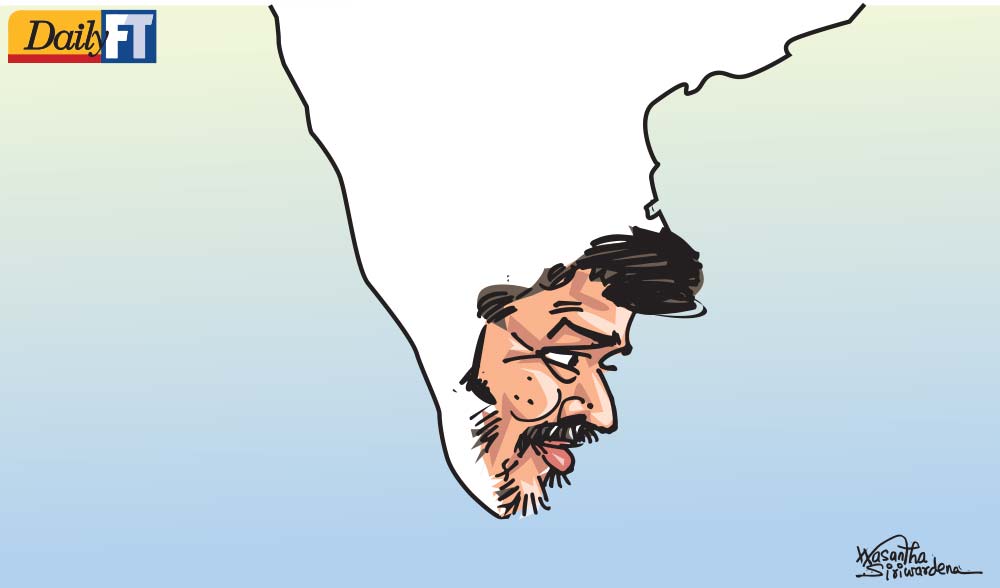
 The rise of Joseph Vijay represents a new phase in Tamil Nadu politics, but the core issues in India–Sri Lanka relations remain familiar. By combining firmness on matters of sovereignty with openness to humanitarian and economic cooperation, Colombo can navigate this evolving landscape with balance and foresight
 The electoral outcome in Tamil Nadu marks a defining moment in its political evolution. Joseph Vijay, popularly known as Thalapathi Vijay among audiences in South India and Sri Lanka, and his party, Tamilaga Vettri Kazhagam (TVK), have emerged as the single largest political force, securing 108 seats—just ten short of the 118 required for a majority. With the DMK-led alliance at 73 seats and the AIADMK-led bloc at 53, TVK is now poised to assume power, either independently with external support or through post-election alignments.
The emergence of a new political force—combining popular legitimacy with a strong regional narrative—has implications that extend beyond state boundaries. Tamil Nadu has long been more than a constituent unit within the Indian Union; it is a politically influential state whose domestic discourse often shapes the contours of India’s engagement with Sri Lanka.
For Colombo, the significance of this electoral outcome lies not in any immediate shift in India’s formal foreign policy, which remains firmly within the domain of New Delhi, but in the potential recalibration of political pressures emanating from Tamil Nadu. Historically, issues such as Katchatheevu, fishermen’s livelihoods, and the status of Sri Lankan Tamil refugees have been deeply intertwined with the state’s political dynamics. Under a Vijay-led administration, these issues may re-emerge with renewed intensity—both in tone and visibility.
At the same time, it would be incomplete to view this development solely through the prism of political sensitivity. Tamil Nadu’s rise as one of India’s most dynamic economic centres offers Sri Lanka an opportunity to reframe its engagement—from managing tensions to building partnerships grounded in shared economic interests.
Katchatheevu: A settled issue reopened
The question of Katchatheevu remains one of the most politically resonant issues in Tamil Nadu. Though legally settled under the 1974 and 1976 maritime boundary agreements between India and Sri Lanka, it continues to surface in electoral discourse with remarkable consistency.
Vijay has taken a clear and assertive position, calling for the ‘retrieval’ of Katchatheevu and proposing interim arrangements such as long-term leasing. These positions, while politically effective, are not new. They reflect a broader pattern in Tamil Nadu politics, where Katchatheevu is often invoked as both a symbol of perceived historical grievance and a practical concern linked to fishermen’s access.
From a legal standpoint, however, the issue remains unequivocal. Successive governments in New Delhi have upheld the validity of the bilateral agreements, recognising them as binding under international law. For Sri Lanka, sovereignty over Katchatheevu is settled and not subject to renegotiation.
What may change under Vijay is not the legal status of the island, but the political energy surrounding it. His ability to mobilise public sentiment—particularly among younger voters—may amplify demands for action, thereby increasing pressure on the Central Government to respond, at least rhetorically.
Sri Lanka’s response must therefore remain steady and consistent. It should continue to affirm its legal position with clarity, while demonstrating flexibility in facilitating long-standing practices such as pilgrimage access to St. Anthony’s Shrine on Katchatheevu. Maintaining a clear distinction between symbolic politics and legal finality will be essential in managing this issue.
Fishermen: Between livelihood and law
If Katchatheevu is symbolic, the fishermen issue is immediate, recurring, and deeply human. The Palk Strait has for decades been a zone of interaction—and at times, confrontation—between Indian fishermen, particularly from Tamil Nadu, and Sri Lankan authorities.
Vijay’s political messaging has emphasised fishermen’s rights and welfare, often framed through the lens of “traditional fishing rights.” This narrative resonates strongly with coastal communities whose livelihoods depend on access to these waters. However, it also raises complex legal and environmental considerations.
The maritime boundary between India and Sri Lanka is clearly demarcated. The concept of unrestricted traditional fishing rights across that boundary does not find support within contemporary international legal frameworks. Moreover, the issue is not simply one of access, but of fishing methods.
The continued use of bottom trawling by segments of the Indian fleet has caused significant ecological damage to marine resources on the Sri Lankan side. This has directly affected the livelihoods of Northern Province fishermen, many of whom rely on sustainable, small-scale fishing practices.
A Vijay-led administration, backed by a strong electoral mandate, may adopt a more assertive posture in advocating for Tamil Nadu fishermen. This, in turn, could translate into increased political pressure on New Delhi in its bilateral engagements with Colombo.
Sri Lanka’s response must remain carefully calibrated. It should continue its established practice of humanitarian handling of fishermen, including prompt release through diplomatic channels, while firmly resisting any attempt to legitimise environmentally destructive practices.
At the same time, this moment offers an opportunity to revive and deepen cooperative mechanisms. Joint fisheries management, phased transition away from bottom trawling, and support for alternative livelihoods represent pathways through which a contentious issue can be gradually transformed into a framework for cooperation.
Sri Lankan Tamil refugees: The missing policy clarity
The presence of Sri Lankan Tamil refugees in Tamil Nadu remains one of the most enduring legacies of the conflict. Decades after the end of the war, a significant number continue to reside in camps, navigating uncertain futures shaped by both policy and circumstance.
While political actors such as the Dravida Munnetra Kazhagam (DMK) have articulated positions advocating pathways to Indian citizenship or long-term integration, Vijay’s stance appears less clearly defined. His rhetoric has strongly invoked emotional and cultural ties with Sri Lankan Tamils, but has yet to translate into a detailed policy framework addressing refugee status. This absence is noteworthy. It suggests that while the issue carries symbolic resonance, it may not yet have been fully integrated into the operational priorities of the new administration.
For Sri Lanka, the refugee question presents both a challenge and an opportunity. The long-term objective remains the voluntary, safe, and dignified return of refugees. However, such return is contingent upon confidence—confidence in economic prospects, social reintegration, and long-term stability.
A new political leadership in Tamil Nadu may reopen debate on refugee status. Colombo should be prepared to engage constructively, while recognising that refugee policy ultimately falls within the jurisdiction of the Government of India.
At the same time, Sri Lanka must take proactive steps to create a conducive environment for return. This includes recognising educational qualifications obtained by refugees during their stay in India, facilitating their integration into domestic education and employment systems, and ensuring access to sustainable livelihood opportunities in their areas of origin.
An economic opportunity: Engaging a rising Tamil Nadu
Amid these political sensitivities, it is equally important to recognise a parallel reality: the sustained economic rise of Tamil Nadu.
The state has emerged as one of India’s most dynamic regional economies, recording strong growth rates in recent years and consolidating its position as a major industrial and services hub. Its economic base spans manufacturing, automobiles, textiles, electronics, and information technology, supported by robust infrastructure and a skilled workforce.
For Sri Lanka, this presents a compelling strategic opportunity.
India is already Sri Lanka’s largest trading partner, with exports to Sri Lanka reaching approximately $4.7 billion in 2024, a level broadly sustained in 2025 according to preliminary trade estimates. Notably, studies by India’s EXIM Bank suggest that around 40% of India–Sri Lanka trade flows through Tamil Nadu, highlighting the depth of regional economic linkages.
Yet, this relationship remains underutilised. Much of Sri Lanka’s engagement with Tamil Nadu continues to be transactional rather than strategic.
A forward-looking approach would involve aligning Sri Lanka’s economic strategy—particularly in the Northern and Eastern Provinces—with Tamil Nadu’s growth trajectory. Enhanced maritime connectivity, development of complementary supply chains, and targeted investment promotion aimed at Tamil Nadu-based industries represent practical avenues for engagement.
Economic interdependence, if nurtured carefully, can serve as a stabilising force. By aligning economic interests, it can gradually reduce the political salience of contentious issues and create a more resilient foundation for bilateral relations.
From conflict to cooperation: Lessons from practice
While the issues of Katchatheevu, fishermen, and refugees are often framed as sources of tension, experience suggests they can be transformed into avenues of cooperation through sustained engagement and pragmatic diplomacy.
During the author’s tenure as Deputy High Commissioner of Sri Lanka in Chennai (2006–2009), several initiatives demonstrated that even sensitive matters could be addressed constructively. Notably, collaboration with the Government of Tamil Nadu enabled Sri Lankan refugee students to sit for the GCE Ordinary Level examinations in 2006 and 2007, reflecting a shared commitment to education beyond political divides.
The refugee question—affecting many who have lived in camps for decades—can likewise be addressed through structured dialogue. In 2008, following a visit to Tamil Nadu by two Members of Parliament—now serving in the Cabinet—a parliamentary process led to the decision to grant Sri Lankan citizenship to 29,489 Sri Lankans remaining in refugee camps.
The fishermen issue, though often the most visible and contentious, also offers scope for cooperative management. Past practice shows that the expeditious release of detained fishermen and their boats, facilitated through diplomatic channels, can prevent escalation and sustain trust.
These examples underscore a broader principle: proximity and shared history, often seen as sources of friction, can equally serve as foundations for cooperation when supported by political will and diplomatic imagination.
Conclusion: Managing continuity, seizing opportunity
The rise of Joseph Vijay represents a new phase in Tamil Nadu politics, but the core issues in India–Sri Lanka relations remain familiar. Katchatheevu, fishermen, and refugees will continue to shape the bilateral agenda.
What is new is the intensity of political mobilisation and the economic context within which it unfolds.
For Sri Lanka, the challenge is not merely to manage these pressures, but to reframe them. By combining firmness on matters of sovereignty with openness to humanitarian and economic cooperation, Colombo can navigate this evolving landscape with balance and foresight.
In doing so, it can transform potential sources of tension into building blocks of a more stable and mutually beneficial relationship—an approach that reflects not only necessity, but strategic vision.
(The author is Sri Lanka’s former Ambassador to EU, Belgium, Turkey, Ukraine and Saudi Arabia and former Additional Secretary , Ministry of Foreign Affairs. He served as Sri Lanka’s Deputy High Commissioner in Chennai from 2006 to 2009)



