By Shanika Sriyananda
Mothers of children with disabilities often endure immense emotional and psychological distress, including stress, depression and anxiety, while facing isolation and marginalisation within their own families and society. Their contribution to their families through household chores and the demanding responsibility of caring for their children with disabilities often goes unnoticed, much like the unpaid work undertaken by millions of other women.
From preparing meals and cleaning homes to caring for children, older persons and family members with disabilities, millions of hours of work sustain Sri Lankan households every day.
Yet much of this labour remains invisible in economic calculations, unrecognised in public policy and disproportionately shouldered by women and girls.
“A mother who comes to our daycare centre for children said she sleeps for a while as her youngest child is safely looked after in the centre. This shows how women sacrifice their time for the betterment of the family by working from dawn to dusk. But her contribution to caregiving responsibilities was not paid or appreciated,” Aneesa Firthous of the Islamic Women’s Association for Research and Empowerment (IWARE), based in Batticaloa, said.
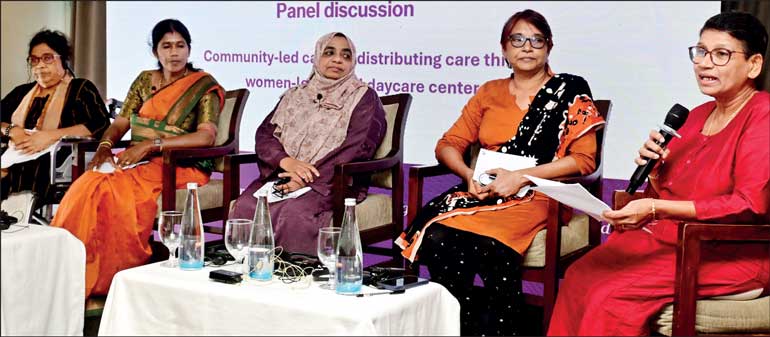
Speaking at a panel discussion on community-led care, she highlighted the need to change attitudes towards women's caregiving responsibilities to enable women and girls to improve their living standards and personal wellbeing.
“It is very difficult to bring about attitude changes in the Muslim community, as it is still a patriarchal society. There are still girls who get married at a young age and, throughout their lives, shoulder all the household unpaid work, as society still believes that looking after children and elders and doing household work belong to women,” she said, stressing the need to make women aware of the importance of sharing responsibilities at home.
Drawing on the findings of their research, community-led women's leaders from Batticaloa, Kandy, Anuradhapura and Jaffna said many young boys and older men still believe that mothers and wives who remain at home are not doing any work.
“They think women are just at home and are not doing any work. We gave them a timetable to make them understand the amount of work those women at home do daily. We also have street dramas and short films to make males and young boys understand the importance of sharing responsibilities at home,” they said.
Women and girls shoulder a disproportionate share of household and caregiving responsibilities, limiting their economic opportunities and wellbeing. As Sri Lanka moves towards a dedicated National Policy on Unpaid Care Work, translating commitments into practical, adequately funded solutions is becoming an urgent priority.
The unequal distribution of unpaid care work continues to place a disproportionate burden on women and girls in Sri Lanka, restricting their access to employment, education, economic independence and personal wellbeing, and prompting renewed calls for a dedicated national policy backed by effective implementation.
According to the Sri Lanka Child Youth Survey 2017, conducted by the Department of Census and Statistics, 87.3% of women and girls aged 10 years and above participated in unpaid domestic and caregiving activities, compared with 59.7% of men and boys.
The figures highlight a persistent gender divide in household responsibilities, reflecting social norms that continue to regard caring for children, older persons, persons with disabilities and other family members as primarily women's work.
The economic consequences are significant. According to the Labour Force Survey 2021, women accounted for 73% of Sri Lanka's economically inactive population, with 59% of these women identifying care responsibilities as the primary reason for remaining outside the labour force.
With women's labour force participation remaining low, women's organisations and development partners are calling for a comprehensive national policy that recognises care as an essential economic and social contribution while establishing mechanisms to reduce and redistribute these responsibilities.
The call was made at the third National Convening on Recognising Unpaid Care Work, organised by The Asia Foundation and Women and Media Collective (WMC), with the support of Global Affairs Canada, in Colombo recently.
Held annually since 2024 to mark the International Day of Care and Support, the convening this year was themed ‘From Policy to Community-driven Solutions: Engaging Communities to Share Unpaid Care Responsibilities’.
The Canadian-funded project, Unpaid Care Work in Sri Lanka, supports national and local efforts to recognise, redistribute and reduce the disproportionate load of unpaid care work carried by women and girls, while representing and responding to their rights and needs.
Bringing together government representatives, development partners, civil society organisations, women's groups and private sector stakeholders, the event highlighted progress towards a draft National Policy on Unpaid Care Work and community-led initiatives addressing care needs across the country.
However, participants stressed that the challenge now lies in ensuring that policy commitments translate into tangible improvements in the lives of women and girls.
Economic implications
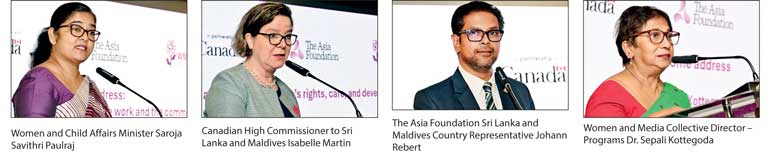
Canadian High Commissioner to Sri Lanka and the Maldives Isabelle Martin highlighted the economic implications of the unequal distribution of unpaid care work, noting that women continue to undertake a disproportionate share of responsibilities for caring for children, older persons and households.
“Across Sri Lanka, women continue to carry a disproportionate share of unpaid care responsibilities, caring for children, elderly persons and households. Yet, this work remains largely unrecognised and undervalued,” she said, adding that the consequences were significant: unpaid care responsibilities limit women's access to employment, reduce economic opportunities and contribute to persistent gender inequalities.
Martin highlighted that nearly 60% of unemployed women in Sri Lanka identify care responsibilities as the main reason they remain outside the labour force.
“Research shows that recognising and valuing unpaid care work could make a substantial contribution to Sri Lanka’s economic growth and social wellbeing. Reducing the unequal burden of care will enable more women to participate in the labour force and contribute to the inclusive economy,” she said.
Martin said the initiative was guided by the five Rs framework – Recognise, Reduce, Redistribute, Represent and Respond – and worked at both policy and community levels.
Commending the progress made towards the National Policy and Action Plan for Unpaid Care Work, she said it was an important step towards ensuring that care work was recognised not only as a private responsibility but also as a public policy responsibility and priority.
“It is equally important that the project strengthens the voices and leadership of women's rights organisations and women advocates who are driving change in their communities,” the High Commissioner said, adding that Canada remains firmly committed to supporting women's empowerment, gender equality and inclusive governance in Sri Lanka.
Call for coordinated policy implementation
Women and Child Affairs Minister Saroja Savithri Paulraj said women's labour force participation currently stands at only 32%, highlighting the need to address the unequal distribution of unpaid care responsibilities.
Citing the 2017 survey findings, she emphasised that 87.3% of women and girls aged 10 and above participated in unpaid domestic and caregiving activities, compared with 59.7% of men and boys.
“These figures highlight the unequal distribution of care responsibilities and the need for meaningful action,” the Minister said.
She noted that Sri Lanka had already introduced several policies and initiatives relevant to care and social protection, including the National Policy on Gender Equality and Women Empowerment, the Women Empowerment Act 2024, the National Policy on Child Day Care Facilities in Sri Lanka 2024, the National Social Protection Policy 2024, the National Action Plan on Social Care and the National Policy for Elders.
While these frameworks provide important foundations, Paulraj stressed that they must be complemented by a dedicated policy addressing the structural causes of the unequal distribution of unpaid care work.
“While these frameworks strengthen services and support for people who need care, we must also address the everyday realities of women who spend countless hours caring for children, older persons, persons with disabilities and other family members, often without any provision of support,” she said.
Paulraj noted that unpaid care work was connected to several areas of public policy, including labour rights, social protection, early childhood development, health, disability inclusion and support for older persons.
“Instead, care must be recognised and shared systematically among families, communities, the state and the private sector,” she said.
The Minister added that policy implementation would require coordinated action across government institutions, development partners, women's organisations, service providers, trade unions, researchers and the private sector.
Paulraj acknowledged the contribution of grassroots women's organisations in raising awareness, conducting community discussions, undertaking research and advocating for change.
“Through awareness-raising, community discussions, research and advocacy, they are bringing unpaid care work into public discussion and helping ensure that women's experiences and voices are reflected in the policy process,” she said.
However, the Minister cautioned that women's organisations could not be expected to fill gaps in public services indefinitely.
“Often with limited funding and by relying on women's unpaid labour, these organisations need appropriate recognition, resources and support to sustain their work,” she said.
Paulraj emphasised that the ultimate objective was to ensure that women had greater opportunities to participate in education, employment and public life while having time for rest and their own aspirations.
“Policy is only as meaningful as the difference it makes in people's lives,” she said, emphasising the need to have a society where care is valued, shared and supported, and where no woman or girl is held back from realising her full potential because of unequal care responsibilities.
Need for structural reform
WMC Director - Programs for Gender and Political Economy Dr. Sepali Kottegoda said the organisation's work on unpaid care had evolved through more than a decade of research, advocacy and engagement with communities.
“The research and advocacy that WMC has been carrying out for more than a decade have been exciting and challenging,” she said. “With the Asia Foundation’s support, awareness-raising on social norms change and shared responsibility for unpaid care work at the community level by women's organisations is a significant marker in this journey.”
Kottegoda stressed that unpaid care work should be addressed as a structural issue affecting gender equality, labour force participation, poverty and human development, rather than being treated solely as a welfare concern.
“Challenges still remain. The category of labour remains confined to activities that are deemed to directly produce income, which contributes to the country’s GDP. But we need to strengthen awareness and policy acceptance that unpaid care work does contribute economic value within the household as well as to the larger economy,” she emphasised.
According to Dr. Kottegoda, unpaid care work reflects a broader reality: women's labour is both essential and invisible, while women are expected to perform those tasks without recognition or compensation.
“This reinforces the structural devaluation of care work in economic and policy frameworks,” she said.
Dr. Kottegoda, stressing the need to integrate unpaid care work into government budgeting, planning and monitoring, and to ensure that recognition is accompanied by concrete institutional action, said that the draft policy seeks to recognise care work as an essential contribution to families, communities and the national economy.
The draft National Policy on Unpaid Care Work, developed by WMC in collaboration with the Ministry of Women and Child Affairs, with support from The Asia Foundation and Global Affairs Canada, is currently under review and is expected to be submitted for Cabinet approval in 2026.
“Women's labour is both essential and invisible, but the expectation is that women will perform these tasks, regardless of recognition or compensation, reinforces the structural devaluation of care work in economic and policy frameworks,” she noted.
Dr. Kottegoda said that the draft labour reforms were considering extending paternity leave from three days to five days. “Still, we need to ask: how would this manifest in terms of sharing childcare or household chores?” she questioned.
The policy is aligned with Sri Lanka's constitutional principles and international commitments, including the Convention on the Elimination of All Forms of Discrimination against Women, the International Covenant on Economic, Social and Cultural Rights, the Beijing Declaration and Platform for Action, and Sustainable Development Goal 5 on gender equality.
Call for shared responsibility
The Asia Foundation's Country Representative for Sri Lanka and the Maldives, Johann Rebert, said the initiative had been driven by a commitment to place the experiences, needs and rights of women and girls at the centre of efforts to address unpaid care work.
“When we started this journey, we shared one important priority,” he said, adding that the priority was to challenge the perception that caring for families and communities was primarily women's work.
He said that care was a shared responsibility, with men and other family members, communities, the state and the private sector all having a role to play.
Rebert said the initiative had sought to generate evidence on how women from different communities experienced care responsibilities and to support solutions that responded to their realities.
Community-led solutions
While national policy development continues, women's organisations across Sri Lanka are already working to address unpaid care responsibilities through community-led initiatives.
The convening highlighted women-led, community-based daycare models for older persons, children and persons with disabilities in Jaffna, Batticaloa and Anuradhapura.
Community-led initiatives in Kurunegala, Nuwara Eliya, Hambantota and Batticaloa are also raising awareness about unpaid care work and advocating for a more equitable distribution of responsibilities.
These initiatives demonstrate how local organisations can respond to care needs while challenging the social norms that place the responsibility primarily on women.
At the panel discussions, women community leaders highlighted that access to affordable and accessible care services remains a major challenge. They explained that, for women who cannot afford private daycare or eldercare services, caring for family members can become a full-time responsibility, limiting their ability to seek employment or pursue other opportunities.
However, the growing demand for eldercare is adding to the pressure, as Sri Lanka is among the fastest-ageing countries in South Asia, and the increasing number of older persons is expected to intensify the demand for care services.
Women who frequently provide care for both children and older family members face growing demands on their time and energy.
The panellists highlighted that this situation had affected women's rights to education, paid employment, professional development and rest, as well as their physical and mental wellbeing. It affects women across all social and economic backgrounds.
It was also said that care was connected to several areas of public policy, including labour rights, social protection, early childhood development, health, disability inclusion and support for older persons.
At the discussions, the community-led women's organisations in Jaffna, Batticaloa and Anuradhapura emphasised the importance of developing women-led, community-based daycare models for older persons, children and persons with disabilities. They also highlighted community-led solutions in Kurunegala, Nuwara Eliya, Hambantota and Batticaloa that raise awareness and promote the need to share unpaid care work responsibilities among men and boys.
“Over 80% of men and boys in the estate sector still say that women are just staying at home. The work that women do from 4 am to 11 pm is not being recognised and valued. This change in thinking should start from the pre-school, giving importance to the sharing of care responsibilities,” the participants said.



