Friday Mar 13, 2026
Friday Mar 13, 2026
Friday, 27 February 2026 00:20 - - {{hitsCtrl.values.hits}}
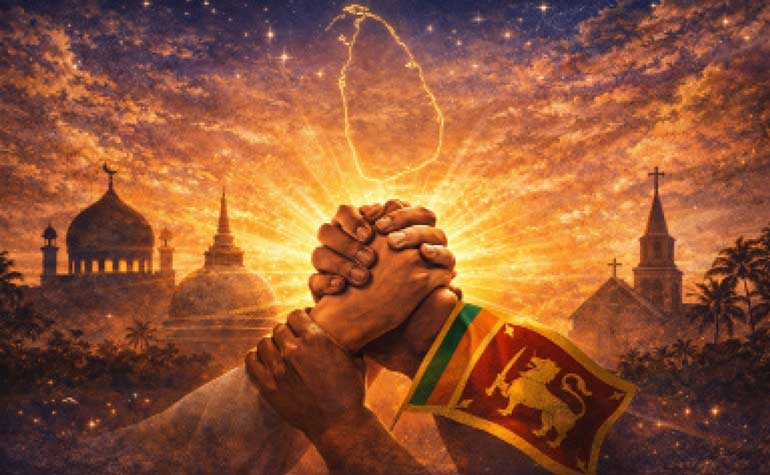
 Ramadan is often described as a month of spiritual discipline. But discipline is not only a personal virtue. It is also a national necessity.
In times of polarisation, uncertainty, and institutional fragility, societies fracture not merely because of diversity, but because diversity becomes unmanaged, manipulated, and weaponised. Sri Lanka’s recent history particularly in the aftermath of the Easter Sunday attacks demonstrates how quickly mistrust can metastasise into collective suspicion, and how swiftly identity can become a fault line.
Two verses from the Qur’an, revealed over fourteen centuries ago, offer a governance ethic remarkably relevant to our current national moment.
The first warns against fragmenting religion into hostile sects. The second establishes a principle of proportional justice: good deeds are multiplied, while wrongdoing is punished only in equal measure never excessively.
Together, they articulate two pillars essential for national stability: unity without coercive uniformity, and justice without excess.
These are not theological abstractions. They are policy imperatives.
Fragmentation as a security risk
Sectarian fragmentation is not merely a religious concern. It is a national security vulnerability.
When communities retreat into hardened identity silos, three dynamics typically follow: isolation, grievance, and radicalisation. Isolation fosters echo chambers. Grievance narratives deepen mistrust. Radical actors exploit both.
Sri Lanka’s multi-ethnic and multi-religious composition has always been a source of richness. Yet when political rhetoric, social media algorithms, and transnational ideological currents amplify difference over common citizenship, diversity becomes combustible.
Unity, therefore, must be understood not as enforced sameness, but as structured pluralism a system where multiple identities coexist under shared constitutional loyalty.
This requires institutional design.
District-level interfaith councils with formal mediation mandates.
Early-warning mechanisms against hate speech and digital incitement.
Shared national commemorations that reinforce common civic belonging.
Structured engagement between religious leaders and security institutions.
These are not symbolic gestures. They are preventive security measures.
Fragmentation precedes instability. Proactive unity-building interrupts that trajectory.
Justice as a stabilising force
The second Qur’anic principle is equally powerful: whoever does good will receive multiplied reward; whoever commits wrongdoing will face only proportional consequence.
Translated into governance language, this is a doctrine of calibrated accountability.
Post-conflict or post-terror environments often oscillate between two extremes: overreach or paralysis. Excessive securitisation breeds alienation. Insufficient enforcement erodes public confidence. Both undermine legitimacy.
Measured justice, however, builds trust. Rejecting collective suspicion of entire communities. Ensuring due process even in emotionally charged cases. Strengthening independent oversight in counter-terrorism enforcement. Separating orthodoxy from extremism with intellectual clarity.
When the state demonstrates that accountability is precise rather than sweeping, it reinforces its moral authority. Justice must be firm. But it must never be indiscriminate. In deeply plural societies, legitimacy is not maintained through dominance. It is maintained through fairness.
Incentivising good citizenship
 The multiplication of good deeds, as articulated in the Qur’anic ethic, offers another governance insight: nations must reward positive civic behavior.
Too often, public discourse is dominated by the language of punishment. But stability also depends on the encouragement of virtue.
Recognition frameworks for interfaith collaboration.
Youth leadership programs promoting shared civic identity.
National awards for community reconciliation initiatives.
Institutional support for cross-cultural service projects.
If destructive behavior captures headlines, constructive behavior must capture policy attention.
States that only punish without incentivising good inadvertently create moral asymmetry. The social contract strengthens when citizens see virtue publicly acknowledged.
Managing diversity, not suppressing it
Sri Lanka’s challenge is not diversity itself. It is unmanaged diversity.
History demonstrates that forced uniformity is neither sustainable nor desirable. Attempts to flatten cultural distinctions often deepen resentment and erode democratic credibility.
Conversely, unregulated pluralism without shared norms can create fragmentation.
The middle path is disciplined pluralism:
This is unity without uniformity.
In this context, religious literacy becomes a matter of national interest. Misinterpretation of doctrine whether Islamic, Buddhist, Christian, or Hindu can generate narratives of exclusion or supremacy. Encouraging intra-faith reform and theological clarity reduces the risk of ideological distortion.
Security policy must therefore intersect with intellectual responsibility.
The digital dimension
Modern fragmentation is algorithmically accelerated.
Social media ecosystems reward outrage. Digital misinformation crosses borders faster than traditional community mediation structures can respond.
A national reconciliation strategy must include digital governance:
Rapid-response fact-checking coalitions.
Stronger enforcement against incitement.
Cross-platform cooperation to monitor extremist amplification.
Digital literacy curricula embedded in education systems.
Radicalisation today is as much a technological phenomenon as an ideological one.
Ignoring this dimension leaves reconciliation efforts structurally incomplete.
Security sector legitimacy
No reconciliation framework can succeed without public trust in institutions.
Professionalism in intelligence and law enforcement is indispensable. But professionalism must be visible, not merely asserted.
Transparent investigative standards.
Clear communication strategies during crises.
Independent complaint review mechanisms.
Community liaison units embedded within security structures.
Security without legitimacy breeds fear.
Security with legitimacy builds resilience.
Having observed the pathways through which individuals descend into violent extremism, one pattern recurs consistently: alienation thrives where institutions are perceived as unjust or indifferent.
Legitimacy is the strongest counter-radicalisation tool available to the state.
Mercy as strategic wisdom
The Qur’anic ethic’s most subtle lesson may be its asymmetry: good is multiplied; evil is not. This tilts the moral balance toward mercy. In governance, mercy does not mean impunity. It means calibrated response, rehabilitation pathways, and reintegration frameworks where appropriate.
Deradicalisation programs. Community-based restorative initiatives. Second-chance policies for non-violent offenders. Such mechanisms signal that the state distinguishes between hardened extremism and vulnerable susceptibility.
Mercy, when disciplined by justice, strengthens stability.
A Ramadan ethic for the nation
Ramadan disciplines appetite. It restrains impulse. It cultivates self-accountability.
Nations, too, require restraint.
Political rhetoric must resist exploiting religious identity for short-term gain. Media must avoid sensationalism that deepens communal fault lines. Religious leaders must guard against theological fragmentation. Civil servants must uphold impartiality even under pressure.
If individuals fast to purify the soul, institutions must restrain excess to purify power. The lesson is neither exclusively Islamic nor exclusively religious. It is civilisational.
Reject division.
Reward good.
Ensure proportional justice.
Leave ultimate judgment beyond human arrogance.
These principles are not merely spiritual aspirations. They are governance necessities.
Toward a structured future
Sri Lanka stands at a strategic inflection point.
Economic recovery, constitutional reform debates, geopolitical recalibrations —all unfold within a fragile social fabric. Without reconciliation, progress remains brittle.
A structured national framework grounded in disciplined pluralism can anchor long-term stability:
*Unity without coercion.
*Justice without excess.
*Security without discrimination.
*Citizenship without hierarchy.
The question is not whether we possess diversity. We do.
The question is whether we possess the discipline to manage it wisely.
Ramadan reminds believers that transformation begins with intention, but is sustained through structure.
Nations are no different. If we can institutionalise unity while preserving diversity, calibrate justice while rejecting excess, and reward civic virtue as vigorously as we punish wrongdoing, Sri Lanka can move from reactive coexistence to resilient cohesion.
The choice is strategic. The time is now.
(The author is a Sri Lankan policy analyst and advocate for national reconciliation whose work focuses on interfaith understanding, institutional reform, and social cohesion. He believes Sri Lanka’s strength lies in disciplined pluralism and shared citizenship, and remains committed to contributing to a future where diversity is a foundation for unity rather than division)




