Sunday Oct 25, 2026
Sunday Oct 25, 2026
Friday, 19 June 2026 00:25 - - {{hitsCtrl.values.hits}}
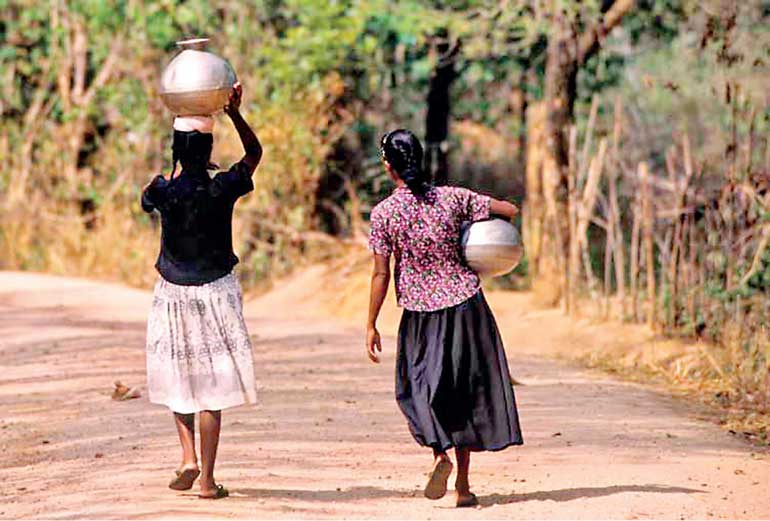

In November 2025, Cyclone Ditwah swept across Sri Lanka, bringing nearly 10% of annual rainfall in a single day, triggering floods and landslides, affecting nearly every region, and causing damage worth billions of dollars. Within weeks, the island swung to the opposite extreme: prolonged dry spells strained domestic water supplies, before a depression in the Bay of Bengal brought fresh flooding to several districts.
This violent swing between too much water and too little is no longer the exception. The outlook is sobering. Forecasters point to the likelihood of a strong El Niño in 2026–2027. Past strong El Niño events, such as in 2015-2016, have brought severe floods followed by widespread drought, and devastated livelihoods across the country.
These recurring shocks expose an uncomfortable truth. Traditional coping mechanisms and small, incremental adaptation adjustments are no longer enough. Sri Lanka needs transformational climate adaptation — and water sits at its centre. Whether it arrives as floods, landslides, drought, water shortages or coastal erosion, water has become the defining feature of the country’s climate crisis. That is why water governance must become a central pillar of its adaptation strategy.
Researchers from the International Water Management Institute (IWMI) released a book titled: Water Governance and Climate Change Adaptation in Sri Lanka (Springer, 2026), which sets out the reforms and institutional changes needed to get there.
What water governance really means
Water governance is often assumed to be the job of the agencies that run dams, reservoirs and irrigation schemes. In reality it is far broader. It encompasses how information is generated and shared, how agencies coordinate and make decisions, and how laws, institutions, communities and the private sector work together to protect society from water-related disasters.
Because these disasters threaten not only water security but also food and livelihoods, breaking the cycle requires governance that reaches well beyond water infrastructure — extending across land, agriculture, markets, finance, policy and the social systems that shape how people use resources. In “Water Governance for Climate Change Adaptation in Sri Lanka,” we map these interconnected components and use them to pinpoint where Sri Lanka’s governance must improve.
From forecasts to action
Reliable early warning and decision-support systems are the backbone of good water governance, guiding the controlled release of water from reservoirs and tanks and giving communities time to prepare. They depend on accurate, spatially detailed rainfall forecasts — which makes strengthening the Department of Meteorology and allied agencies a national priority.
But forecasts and risk maps are only tools. What ultimately matters is whether institutions act on them together. Today, more than 40 institutions share responsibility for water in Sri Lanka, often with overlapping mandates and weak coordination. The absence of a national water policy has weakened institutional coordination, led to fragmented decisions and blurred accountability.
Two remedial measures are urgent: a strong national water policy with a clear action plan, and a powerful national coordination body to guide, monitor and hold water institutions accountable. Sri Lanka need not start from scratch. The National Disaster Management and Response Committee, chaired by the President, already carries a strong mandate. It’s responsibilities could be expanded to convene regularly to review forecasts, disseminate localised risk information and direct timely action with regional stakeholders.
Storage, sectors and systems in between
Major reservoirs and minor tanks have rightly drawn decades of investment for their role in food security. But resilience also depends on managing them as one system alongside soil moisture, groundwater, ponds, lakes and wetlands — supported by sound infrastructure, efficient water conveyance facilities and skilled staff.
Equally, water-use efficiency cannot improve through better coordination among water agencies alone. It requires collaboration with the land, agriculture, livestock, fisheries, forestry, marketing and private sectors. Without it, climate-smart innovations like micro-irrigation, higher-value cropping, and community-run tank cascade committees, cannot deliver their full gains in yields, water productivity and incomes.
Some of the deepest constraints are structural. Archaic land-use policies, fragmented landholdings and unclear tenure arrangements can discourage the long-term investments that improved efficiency and crop diversification require. Strengthening collective governance of traditional water management systems is essential to sustaining community water and food supplies, especially during droughts.
Sri Lanka offers many examples of traditional tank cascade systems and agricultural practices designed to mitigate water stress during dry periods. The Kulu wewa, a small tank within a catchment system, was designed to trap sediments, while the Olgam wewa was a tank built in a forest used for cultivation during the Maha harvest season and left to support wildlife during the Yala season.
Time-tested land management practices include bethma, the equitable sharing of irrigated land and water during periods of scarcity; puranawela, a traditional system for allocating agricultural land; and akkarawela, a customary community-based cultivation practice. 
The bottom line
Each of these governance elements shapes how well adaptation works and ultimately, whether Sri Lanka can secure its water, food and livelihoods in a more volatile climate. The message of our book is clear: the country already has much of the institutional architecture it needs. The task now is to connect it, empower it and point it toward transformational change — before the next climate extreme tests it.
(Giriraj Amarnath is a research group leader in Water Data for Climate Resilience and principal researcher in Disaster Risk Management and Climate Resilience at IWMI, and Upali Amarasinghe is an emeritus scientist at IWMI)
Reference
Amarasinghe, U.A.; Amarnath, G.; Wickremasinghe, H. (Eds.) 2026. Water Governance and Climate Change Adaptation in Sri Lanka: Status, Challenges, and Policy Options. Global Issues in Water Policy, Volume 13. Springer Nature, Switzerland. https://doi.org/10.1007/978-3-032-04950-6