Tuesday Sep 15, 2026
Tuesday Sep 15, 2026
Wednesday, 10 December 2025 00:00 - - {{hitsCtrl.values.hits}}
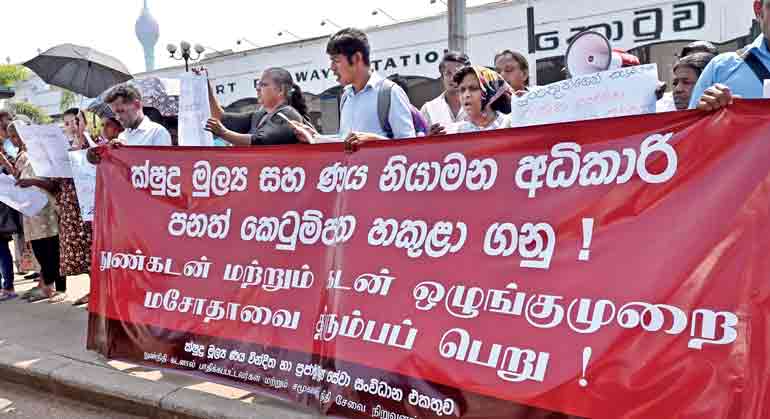
The microfinance crisis is a manifestation of a chronic problem afflicting people’s economies at the level of livelihoods
By Suneth Aruna Kumara, Renuka Gunawardena and Amali Wedagedara
The Microfinance and Credit Regulatory Authority Bill that was defeated by communities affected by microfinance, women victims and community credit providers in April 2024, has reincarnated. The one gazetted in October 2023, with zero community consultations, was a joke. Instead of regulating big finance companies at the heart of the microfinance crisis in Sri Lanka, the Bill proposed regulating community credit providers. People protesting succeeded in stopping the Bill from moving forward. The amended version gazetted on 17 November 2025, is a tragedy, repeating the old Bill and missing an incredible opportunity to learn from community practices to formulate a pro-people regulatory framework, strengthen community financing, protect the rights of credit consumers, and curb profit-driven lending.
Even though ensuring the protection of microfinance consumers is a core function of the Regulatory Authority, the responsibility is delegated to the licensed moneylenders and microfinance providers
From a flawed interpretation to a flawed policy
The Bill that saw the light of day after five years of labour in 2023 was useless to begin with. Not only did it lack a clear vision for regulating the most necessary to be regulated and protecting credit consumers, but it also risked conflating community credit providers with illegal and usurious money lenders. Despite the prolonged struggle by women victimised by microfinance (since 2017), the drafters of the Bill had shown no sign of understanding the depth and breadth of the microfinance crisis, nor any inclination to propose the necessary regulations to safeguard people from predatory lending. The Annual Report 2019 of the Central Bank (CBSL), which the Supreme Court quoted in framing its determination (Box 13, p. 311-312), blames informal and undocumented moneylenders for multiple loans and over-indebtedness. While the problem of money lenders has been a perennial problem for low-income people, the modern microfinance problem is far from the creation of moneylenders. Both the Annual Report 2019 and the Supreme Court’s determination on the Bill failed to capture the reality faced by low-income women trapped in multiple loans with big finance companies.
On the part of the CBSL, defining the microfinance crisis as the making of the money lenders serves to rescue it from neglecting to regulate the Licensed Finance Companies (LFCs) engaged in microfinance businesses. According to the CBSL, the microfinance loan portfolio of the LFCs by 2024 was only Rs. 0.0228 trillion, equivalent to 1.9% of their gross loan portfolio. It is a small portion, not significant to regulate, CBSL opines. However, data on the volume of microfinance loans shows that LFCs have disbursed far more money than smaller microfinance institutions combined. LOLC, one of the biggest microfinance providers in Sri Lanka, acknowledges that “personal finance, previously known as ‘microfinance”, accounts for a “significant segment under lending umbrella” (p. 16, 2024/25 Annual Report). According to the company, ‘personal finance’ follows “strategi[c] rebrand[ing] to better reflect its evolving scope and broader appeal cater[ing] primarily to grassroots-level customers” (p. 16). LOLC’s personal loan portfolio by 31 March 2025, accounted for Rs. 24 billion. In 2024/25 year alone, LOLC disbursed Rs. 17 billion as microfinance loans.
We recommended that Sri Lanka also adopt a tier system to regulate microfinance, like that in India, exempting smaller community-based initiatives from more burdensome regulations
LFCs have better access to funds, for example, foreign finance capital provided by international investment funds such as the Asian Development Bank (ADB), FMO, International Finance Corporation (IFC), Swedfund, and the World Bank, which enhances their ability to give out more loans than smaller microfinance institutions or money lenders. For lack of other official evidence, money recovery cases in the Small Claims Courts at District Courts are also a good illustration of the sources of the microfinance crisis. About 95% of the pending cases are filed by the LFCs.
The CBSL’s aversion to regulate LFCs to safeguard finance consumer protection is not limited to microfinance victims. Various incidents, including violent incidents such as killings and seizures of property related to leasing services, are examples of how LFCs violate the rights of the finance consumers. The refusal of the CBSL to regulate illegal debt recovery activities culminated recently when a group of vehicle seizers held a press conference, demanding legal recognition for the services they render to safeguard the stability of the financial system.
Community proposals to amend the Microfinance and Credit Regulatory Authority Bill 2023
After the Legal Division of the Ministry of Finance withdrew the 2023 version of the Bill in April 2024, the Development Finance Division of the Ministry invited three community representatives to provide their input on amending the Bill. There was no public call for community consultations. The Director General of the NGO Secretariat, through a personal connection, reached out to a collective that represents us, the writers of this article. Over a few meetings held from 18 September 2024 until the submission of the Working Committee report to Finance Ministry Legal Division Additional Director General A.K.D.D.D. Arandara on 9 January 2025, intervened to deepen bureaucrats’ understanding of the microfinance crisis and call for a fresh approach to imagine regulations from the point of view of microfinance consumers and community credit providers.
Despite the prolonged struggle by women victimised by microfinance (since 2017), the drafters of the Bill had shown no sign of understanding the depth and breadth of the microfinance crisis
The microfinance crisis
The microfinance crisis that erupted after 2017 in the form of suicides, financial violence and protests is an outcome of the unbridled release of ‘quick and easy’ loans at high interest rates. Debt issued to initiate income-generating activities but not structured with a grace period to ensure that debt is serviced through income generated, compels borrowers to take new loans to meet swift repayment obligations in the form of weekly or monthly instalments. Borrowers turn to other microfinance companies eager to lend and meet their lending targets. Eventually, borrowers get trapped in a vicious cycle of debt, including formal LFCs, MFIs, moneylenders, cooperatives, community credit providers, friends and family. Experiences of the microfinance borrowers reveal that multiple loans are built into the business model of the LFCs. Some big LFCs have graduated microfinance borrowers to personal loans while holding land grants as collateral.
The microfinance debt bubble is a product of profit-driven lending and a good example of the commercialisation of the microfinance business. Apart from predatory lending, LFCs have also poached social security transfers and cash grants from the borrowers who cannot repay their debts. In addition, unpayable debt issued by LFCs has given money lenders a lifeline. The distressed borrowers, without other means, resort to money lenders to obtain funds to meet debt service obligations. Profit-driven microfinance has created a conducive ecosystem for predatory lending, whether formal or informal, to coexist.
We pointed out that microfinance has excluded low-income women from the formal financial markets instead of promoting financial inclusion
We pointed out to the Working Committee that containing pro-profit lending should be at the heart of regulating microfinance businesses. Scaling down microfinance businesses from a commercial enterprise while strengthening community credit initiatives and cooperatives as alternatives is also essential to soften the debt crisis. We proposed that the Bill adopt a tight definition of microfinance business as small loans issued to low-income women for income-generating purposes, without collateral or securities. After studying microfinance regulations in the neighbouring countries such as India, Nepal, and Bangladesh, we recommended that the regulators adopt strict legally enforceable prohibitions against garnishing social security provisions such as debt payments, multiple loans, loan caps for vulnerable communities, and designate permissible debt payments as a ratio of monthly household income, to ensure microfinance consumer protection while discouraging pro-profit lenders, either formal or informal, from remaining in the microfinance business.
Community credit providers
The Bill reduced credit providers into two categories: 1) moneylenders, 2) microfinance providers and eliminated the identity and existence of community-credit providers. A significant component of the community credit providers represented by community-based organisations (CBOs) is the creation of State-centric, UN-aided rural development programs from the late 1980s. Others include grassroots community organisations such as Death Donation societies and mutual aid societies, which represent collective initiatives from below to respond to emergencies at the village level. While the latter illustrates more voluntary and communal initiatives by the people and for the people, the former stand for State-mediated and externally supported organised attempts to empower women, alleviate poverty, and regenerate livelihoods. Both versions rely on the principles of solidarity and mutual aid rather than on profit, unlike money lenders or microfinance providers. Without recognising such a qualifying difference, the Bill attempted to subsume community-credit providers as money lenders and microfinance providers.
The microfinance debt bubble is a product of profit-driven lending and a good example of the commercialisation of the microfinance business
Our efforts in the Working Committee where to place the identity, functions, and interests of community credit providers, both formal and informal, on the regulatory agenda. We contested the erasure of community-credit providers and opposed the imposition of an overarching regulation by a Regulatory Authority, which is antithetical to autonomous community-owned initiatives to address rural credit. We recommended that Sri Lanka also adopt a tier system to regulate microfinance, like that in India, exempting smaller community-based initiatives from more burdensome regulations. Given the distinct nature of community-credit organisations, we proposed the representation of community-based credit practitioners on the Board of the Regulatory Authority.
The expansion of the Credit Information Bureau (CRIB)
According to both the CBSL and the Supreme Court determinations, the illegibility of low-income borrowers for creditworthiness is a major reason for multiple loans and over-indebtedness. According to them, the answer is to expand the Credit Information Bureau (CRIB) to include
moneylenders.
As profiting from poverty, as in the case of microfinance, became a popular practice over the last 20 years in Sri Lanka, CRIB has conferred greater power to creditors. Banks and finance companies manipulate their customers’ debt to refinance loans, thereby denying debt relief and artificially lowering Non-Performing Loans (NPLs). In many cases, banks and finance companies have also used CRIB to transfer the risk of lending to the low-income customers by demanding higher interest rates. With the deluge of unpayable debt consolidating and propelling mass defaults, a vast majority of low-income people have been shut out of accessing safe, cheap and subsidised credit from formal banks and finance companies. The level of financial disenfranchisement that CRIB has brought about to low-income people is already creating a massive socio-economic problem at the community level. However, the CBSL, without cognisance of peoples lived experiences, pushes for the CRIB to be expanded.
During the few interactions within the Working Committee, we raised awareness among officials of the CBSL and the Development Finance Division of the Finance Ministry about how CRIB actually works for low-income borrowers. We pointed out that microfinance has excluded low-income women from the formal financial markets instead of promoting financial inclusion. We also opposed initiatives to expand the web of CRIB to include community-based organisations that serve as alternatives for low-income people to source agricultural and other urgent credit needs.
The CBSL’s aversion to regulate LFCs to safeguard finance consumer protection is not limited to microfinance victims
Community consultations on the Bill and preaching to deaf ears
The amended version of the Bill, gazetted on 17 November, reveals that our efforts to bring community interests to the table have been an attempt to cast pearls before swine. The Bill has reappeared essentially unchanged with LFCs exempted from regulations of the Credit Regulatory Authority, community-credit providers wiped out from the nomenclatures, grassroots community credit providers reduced to moneylenders, and CRIB expanding to the level of mutual aid societies. Even though ensuring the protection of microfinance consumers is a core function of the Regulatory Authority, the responsibility is delegated to the licensed moneylenders and microfinance providers. The Authority also overlooks the imbalance of power between creditors and debtors. It imposes on credit consumers the burden of saving themselves as a form of legal liability.
As there is no national study on the microfinance crisis to inform policy making, we did our best to bring in on-the-ground experiences to update policymakers. We underscored the importance of systematic studies and data to guide policy making rather than misinformation, the whims and fancies of policymakers or funders. We pointed to India’s experiences, for example, the Malegam Committee established by the Reserve Bank of India after the microfinance crisis in Andhra Pradesh in 2010, to study the causes and culprits of the crisis and to recommend regulations. When the policymakers in the Working Committee seemed oblivious, we brought in comparable examples from other countries to inform policy making. However, Bill 2025 shows that our efforts have been a wasteful exercise. Community consultations initiated by the Ministry of Finance have been nothing more than a symbolic gesture. A box to tick.
Finally, the Asian Development Bank’s loan condition prevailed over our efforts to establish a regulatory framework that addresses the concerns of microfinance victims and community credit providers.
The Microfinance and Credit Regulatory Authority Bill 2025 sets a dangerous precedent of how misinformation, stereotypes, personal biases and funding interests can sidetrack research, data and people’s needs in policymaking. The microfinance crisis is a manifestation of a chronic problem afflicting people’s economies at the level of livelihoods. A regulatory response to the crisis could have been the beginning of correcting deep-seated structural issues, notably by repurposing the banking and financial system with developmental goals rather than speculation and profit. Policymakers, however, consciously disregarded this opportunity. The task of rectifying this failure and achieving justice now falls to those most affected, the women victimised by microfinance, community credit providers, and their allies in solidarity.
(About the authors: Suneth Aruna Kumara is a representative of the Collective of Women Affected by Microfinance. Renuka Gunawardena is the Executive Director of the Ekabadha Praja Sanwardhana Kantha Maha Sangamaya, Weligepola. Amali Wedagedara represented Uva Wellassa Kantha Sangamaya.)




