Monday Jul 06, 2026
Monday Jul 06, 2026
Wednesday, 29 April 2026 00:26 - - {{hitsCtrl.values.hits}}

In the 1980s, IBM recruited graduates from any discipline. My intake included graduates in entomology, neuroscience, mathematics, theology, law (me), and linguistics. What we had in common was not a coding language or STEM training. It was a high level of linguistic and analytical literacy. Decades later, with the rise of AI, we have come full circle: language is once again the primary programming interface. Technology multiplies advantage for those with the literacy to command it — and as I look at the landscape in 2026, the very tools that should be closing the global opportunity gap are placing students in struggling education systems further behind.
Somewhere in Sri Lanka tomorrow morning, two students will open the same generative AI application on their phones. One will type a precise prompt setting out context, question, and the output required. They will read the response critically, refine the question in response to AI's own follow-up questions, and walk away with something useful. The other will type a few keywords, accept the first answer, and move on.
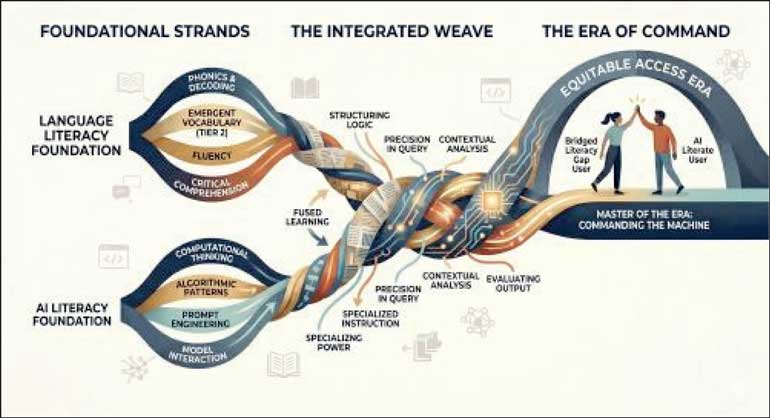
The difference between them is not the technology. It is the language and cognitive skills they bring to the task. AI fluency — the ability to collaborate with AI to accomplish a task — is tightly interwoven with language fluency, which depends in turn on foundational literacy. As I outlined in my earlier article in February (https://www.ft.lk/columns/The-Silent-Bottleneck-in-2026-education-reforms/4-788577), the ability to decode print to speech and encode speech to print using phonics, combined with vocabulary, sentence structure and inferential processing, determines language fluency for reading and writing. Regional neighbours have understood this. Both India and China embed AI competencies from Grade 3, leveraging mother-tongue instruction to build the cognitive and linguistic foundation first.
Language and AI Literacy Rope adapted from Scarborough's Reading Rope
That brings us to the canary in the coal mine: the new Grade 6 English syllabus. Partners In Micro-development has just released a detailed analysis of the 2025 Grade 6 English Teachers' Guide and Modules (https://doi.org/10.13140/RG.2.2.19638.87365). Three findings are consequential not only for English teaching but for every curriculum reform now in development across all grades, and for any AI-specific curriculum that follows.
First, the new curriculum assumes Grade 6 students have already secured the foundational literacy skills — decoding, fluency, spelling — that reading depends on. They have not. The curriculum offers no explicit instruction to remedy the gap.
Second, prompt engineering is not "talking to a computer." It is a high-level linguistic exercise that depends on what educationalists call Tier 2 vocabulary — the general academic register: analyse, evaluate, compare, infer, justify, significant. Without it, a student cannot construct a precise prompt, evaluate what the AI returns, or iterate toward a better answer. They can use AI as a search engine. They cannot use it as a thinking tool.
 There is a policy contradiction here. The 2022 Proposed English Curriculum for General Education mapped a clear lexical acceleration from Tier 2 at Grade 3. The 2025 Grade 6 syllabus stalls at Tier 1 — simple, everyday vocabulary — at exactly the point the trajectory should accelerate.
Third, and this is where the Grade 6 syllabus becomes a very loud canary, the instructional design is not aligned with the Science of Learning. The Science of Learning is the cognitive science of how students actually learn. A core component is cognitive load theory, which shows that novice learners acquire knowledge most reliably through explicit instruction; that instruction must precede discovery rather than follow it; that the teacher's role begins as instructor and becomes facilitator only as student competence grows; and that foundational skills must be deliberately taught and practised at spaced intervals to consolidate in long-term memory. The Grade 6 syllabus embodies the opposite assumptions: that students acquire new knowledge incidentally from exposure, that discovery precedes explicit instruction, that foundational skills emerge from engagement.
Constructivism is the learning theory that informs the current curriculum reforms — the proposition that learners actively construct knowledge through engagement and experience. That foundation is not being challenged here. What is being challenged is the assumption that constructivism, as a learning theory, dictates a particular pedagogy. It does not. Pedagogy and instructional design are empirical questions, not philosophical ones, and they must be answered from the evidence.
If the same pedagogical assumptions are being carried into the Grade 6 mathematics and science syllabi now in development — and into the subsequent grade-level reforms — the consequence is not a weak English cohort. It is a weak academic cohort, in every subject, at the exact moment Sri Lanka is trying to build an AI-capable workforce.
The 2027 deferral of the Grade 6 English rollout is a strategic opportunity. Three things should happen in the window. First, the Teachers' Guide should be retrofitted to align with the science — explicit foundational literacy instruction, deliberate Tier 2 vocabulary, and a retrieval architecture that converts thematic modules into cumulative learning. Our report sets out how AI-assisted instructional design can deliver this in a fortnight, not months. Second, the new Grades 3–5 and 7–11 English syllabi should be checked against the 2022 Curriculum's vocabulary tier progression, since a Grade 6 retrofit assumes the earlier years are delivering what the curriculum specifies. Third, every other subject syllabus currently in development should be evaluated against the Science of Learning before it is finalised. The cost of doing this now is trivial compared with discovering at the end of the curriculum cycle that none of the new syllabi actually teach.
Somewhere in Sri Lanka tomorrow morning, two students will open the same AI application. The Grade 6 syllabus, as it stands, is deciding which of them walks away with something useful. The student with English-medium instruction at school, private tuition, or daily exposure to English outside school may thrive regardless. For the student reliant only on a cognitively under-engineered curriculum, the gap is not just widening. It is becoming a permanent lockout.
The ultimate irony is that a rewrite of the Grade 6 Teachers' Guide — which would once have taken a large team months — can now be completed in a fortnight using the very technology Sri Lanka is stalling on, to fix the bottleneck that is stalling it.
The full report is available on ResearchGate at https://doi.org/10.13140/RG.2.2.19638.87365.
(The author is the President of Partners In Micro-development (https://microdevpartners.org/), an international NGO with over 20 years of experience in educational development in Sri Lanka. Based in Sydney, she works extensively with Sri Lankan state universities providing online training for English teachers in literacy instruction based on the Science of Reading and the Science of Learning. PIMD was founded by Dr Vaughan's late husband, Dr Mahesan Kandaiya)



