Thursday Oct 22, 2026
Thursday Oct 22, 2026
Wednesday, 29 April 2026 00:22 - - {{hitsCtrl.values.hits}}
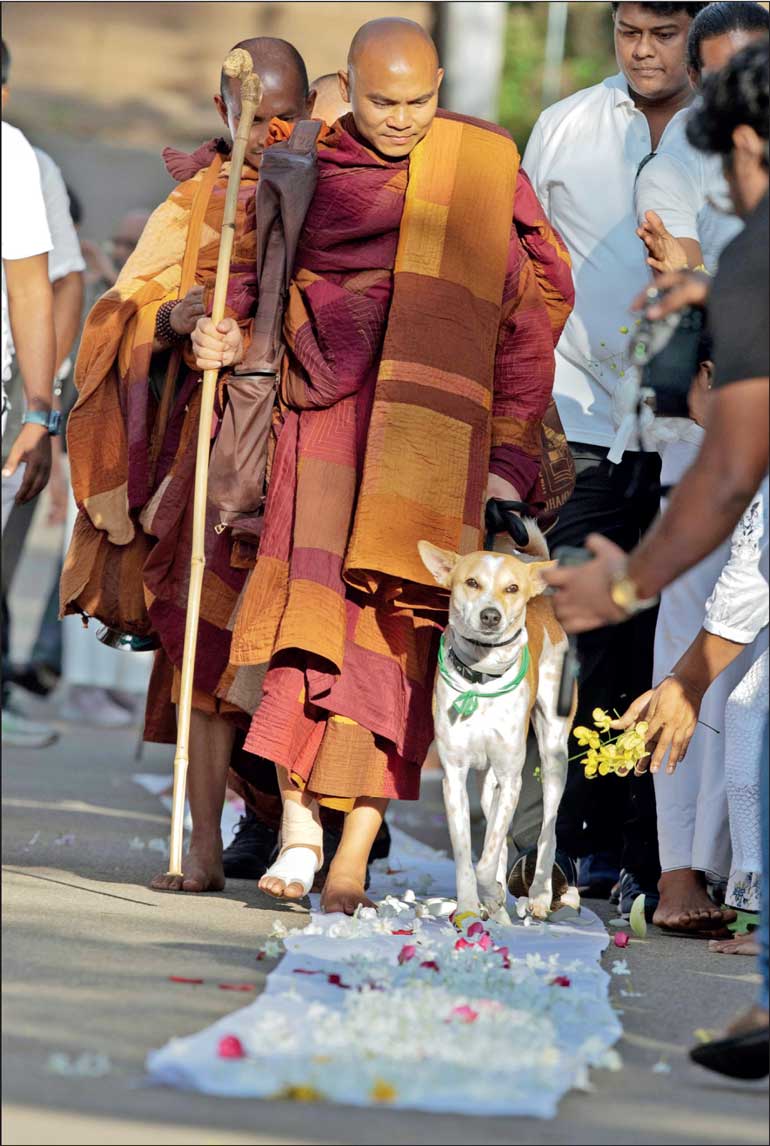
While Aloka the peace dog was resting, a local dog joined the walk for peace on his own initiative
 The woman venerates the dog, or does she? This was the minor controversy unfolding at the beginning of the ‘Walk for Peace’ that had reached Sri Lanka, following its remarkably successful conclusion in the USA (even though the whole exercise seems to have had little direct and immediate effect on the imperial war machinery there).
The group of monks on the peace walk are from the Huong Dao Vipassana Bhavana Center in Texas, led by the Vietnamese monk Ven. Paññākara. One of the main objectives of their visit was to obtain a sapling of the sacred Bodhi tree in Anuradhapura, initially a branch of the very tree under which Siddhartha became the Buddha. Their plan was to walk along a path that connected the country’s most sacred Buddhist sites, starting at the ancient Mahāvihāra complex with the Bodhi tree and the Great Stupa, and extending to the Temple of the Tooth Relic in Kandy, before reaching the capital, Colombo.
The entire route of the peace walk became a site of impromptu religious encounter, drawing thousands of devotees to the wayside to witness the procession. The state was no less engaged in the walk and this veritable site of ritual and devotion: in Kandy, the monks met with the Prime Minister Harini Amarasuriya, and the journey concluded yesterday in a final celebratory meeting with the President Anura Kumara Dissanayake at the Independence Square in Colombo.
Almost as popular as the monks (or by some accounts, even more so) was Aloka, a sand-coloured street dog who had become a ‘peace dog’ known around the world from the initial enactment of the peace walk in the US. It was as if Aloka was born for this task, with a white, heart-shaped patch on his forehead. According to some of the faithful, this was no mere biological coincidence but a karmic sign (lakṣaṇa).
On this particular day we talk about, the movement was met with a wave of controversy, especially from the so-called ‘progressive, scientific atheists,’ over a photograph that made the rounds on social media: an elderly woman in traditional white lay Buddhist attire, captured in what appeared to be a gesture of bowing in reverence before the dog. According to these critics, the piety of this elderly woman is a byproduct of ‘ignorance,’ lack of formal education, or both. What such claims fail to acknowledge are the peculiar cosmic principles our society operates under; principles that are inherently Buddhist and embedded in our collective consciousness.
Co-travelers in Samsāra
While this image appears to be a photographic illusion (the woman was probably venerating the monks and the dog happened to pass by), we—in our dual role as scholars of Buddhism and practicing Buddhists—are not here to pass judgement even if the lady were actually venerating the dog. To attempt to go down that analytical path would be to view the dog through a modern, human-centric lens that reduces the animal to a ‘lesser’ being: one that can only fill utilitarian roles such as one of a hunter, a protector, or a pet.
In the Sri Lankan Buddhist imagination, however, animals are not mere domestic accessories. They are integral members of a shared and collective, more-than-human world, one in which we are connected to each other by ancient karmic threads. We are all co-travelers in the cycle of saṁsāra, having met one another across countless lifetimes and in an infinite variety of forms. In this Buddhist imagination, the boundary between the human and the animal is not easily demarcated. It is one in fluid transition: the stray dog at our feet may once have been the mother who carried us, or a daughter who once sought our protection.
From the streets to the cosmos
 To view Aloka through this lens of karmic continuity is to believe that our paths do not cross by accident. Whether in the garb of a monk, a woman in white, or a wandering dog, we are entangled in an ancient web of suffering and seeking. This is the Buddhist imagination. Here, there is no need of ‘reimagining’ animals or nature as something we must seek engagement with (as we often hear in the Buddhist academia, with good reason). The Buddhists are not merely on the earth, but in it, with all that entails. When the woman in white encountered Aloka in that religious setting, she was not seeing just a dog or a mere pet. Instead, she was meeting a primordial relative who, evidently, was endowed with much merit (puñña/pin).
In this, she would have only been reflecting the prevailing sentiment across the general Buddhist populace in the island, which saw the dog as possessing an extraordinary store of merit from past lives simply to ‘qualify’ for such a journey in the first place. Surely, to walk alongside such impressive monks in a mission for peace is a spiritual privilege that can only be earned through previous practice? In this view, Aloka is recognised as a meritorious traveler, a being whose animal form is a temporary station in a long, sacred journey that has finally led him back to the Sangha.
As Aloka travelled from the USA to Sri Lanka, it was as if he, too, had undergone a profound transmutation, crossing a threshold where the labels of the modern world started to dissolve. In the West he was framed through the human-centric view of utility: the rescue dog or the support animal, whose value was decided by his relationship to the human masters. If the monks’ walking provided the embodied spirituality, Aloka the dog provided the ‘domesticity.’
This happens to be the case in the US primarily because the dog is the ultimate symbol of the ‘every day.’ The dog is often the only friend of people who are atomised by the relentless consumerism of capitalism. Thus, for many Americans, a group of foreign monks in saffron robes might feel ‘other’ or culturally distant, but a group of monks walking with a dog would be instantly recognisable and relatable. During the peace walk there, Aloka functioned as a ‘cultural translator.’ The dog stripped the ‘exoticism’ away from the monks, making them appear not as distant icons, but as ‘pet owners’ and ‘dog walkers,’ roles that are deeply embedded in American everyday life. In that world, the monks were the heroes of the narrative, and Aloka was the domestic accessory that humanised their presence to the Western world. However, upon touching the Sri Lanka soil, Aloka was transformed from a ‘pet’ to a ''samsaric relative'.
In a human-centric world, we categorise dogs as ‘support animals’ for our anxieties, ‘protectors’ for our property and livestock, ‘hunters’ to find food (or tragically, for ‘sport’), or ‘pets’ for our emotional consumption. Even when we call them ‘family,’ they are often treated as permanent children, beings who exist to provide comfort to us but lack their own spiritual agency. Seen through this human-centric lens, the hierarchy remains fixed: it is the human that has superiority and agency.
Spending some time in Sri Lanka, however, and one will see farmers bowing down before the buffaloes that pull the plough, people venerating the elephants that carry the relic caskets, cobras being kindly invited to leave human abodes, and cats and dogs being given religious last rites when they die. In the Sinhala language, the shared honorific suffix ‘rāla’ is used for both the farmer (govirāla) and the dog (balurāla), preserving a linguistic memory of a world where animals co-existed in a state of dignity. Yes, there is animal abuse too, but can one say this is worse than the abuse we have heaped upon our fellow humans? Is this not, after all, the very reason for a peace walk?
Jātaka unfolding on the roads
In a human-centric world, the story often ends with the human as the hero––the one who rescues, conquers, and possesses. But in the Buddhist imagination (as manifest in the Kukkura Jātaka), the Bodhisattva himself walked in the skin of a dog, not as a ‘stray’ to be rescued, but as one to be heard.
In this Buddhist fable, the royal chariot gets damaged by the dogs of the palace, and the blame inevitably lands on the dogs of the street. Then ensued a massacre of stray, or should we say free, dogs. The Bodhisattva, who was the leader of a large pack of free dogs, realised that no companion of his would have broken through the heavily guarded gates of the castle. Through the power of merits he had accumulated over the saṁsāra, he was able to reach the royal court without being harmed, and make the case on behalf of his oppressed (but untethered) kindred. Eventually he was able to prove that it was, indeed, the dogs of the palace that were the culprits. The King was impressed, and not only did he venerate the Bodhisattva dog but also handed over the kingdom to him! The dog, of course, had better things to do, and after exhorting the king, returned the kingdom to him as well.
For Buddhists who grew up in this tradition, the sight of a woman venerating Aloka would not appear alien. Here is a modern-day kukkura (dog), walking alongside monks on land ravaged by war and still suffering its consequences. In such a world, a walk for peace can only be enriched by the presence of a venerable dog saint.
(Anushka is a postdoctoral fellow at Harvard University and her research interests are in the evolution of Buddhism and contemporary Buddhist movements. Prabhath is a social anthropologist specialising in Theravada Buddhist theory and practice, based in Amsterdam)



