Thursday Mar 12, 2026
Thursday Mar 12, 2026
Wednesday, 4 March 2026 00:22 - - {{hitsCtrl.values.hits}}
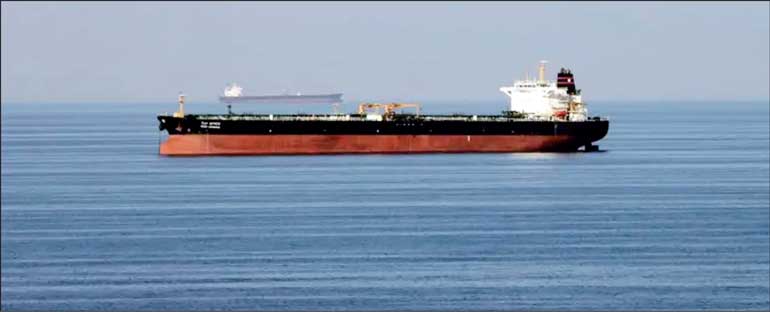
Oil tankers passing through the Strait of Hormuz/File photo

“Anti-Americanism is in the process of being consecrated into an ideology. Once
someone is branded
anti-American, the chances are that he or she will be judged before they are heard.”
— Arundhati Roy, Come September (2002)
This is not a conspiracy theory. It is a series of documented facts, verified data, and observable patterns — assembled in the spirit of open analytical inquiry. The questions raised here do not come with definitive answers. They come with evidence, sources, and an invitation to think. What the reader does with that is their own affair.
I. The language of power: Who gets to name the enemy
In September 2002, Indian author and activist Arundhati Roy delivered a speech at the Lensic Performing Arts Center in Santa Fe, New Mexico — later published as Come September. In it, she articulated something that has only grown more relevant in the two decades since: that the label “anti-American” functions not as a description but as a weapon. It is deployed, she argued, to pre-emptively discredit any critic of US foreign policy — to ensure that the argument is lost before it is heard.
The mechanism she described is precise and worth dwelling on. Criticise the actions of the US Government, and you are branded anti-American — which is then conflated, as if by magic, with being opposed to jazz, to free speech, to Toni Morrison, to the beauty of the American landscape. The sly conflation of a Government’s foreign policy with the entirety of a nation’s culture, she wrote, is a deliberate and extremely effective strategy.
This framing matters to everything that follows in this analysis. Because every Government discussed in these pages — from Mossadegh in Iran to Allende in Chile to Imran Khan in Pakistan — was removed not for being “anti-American” in any meaningful sense, but for being pro-their-own-country. For daring to suggest that their 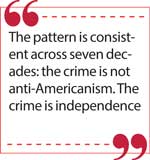 nation’s resources, sovereignty, or foreign policy alignment belonged to their own people rather than to Washington’s strategic calculus.
Roy also noted, with characteristic precision, what had happened to Latin America: “Guatemala, Costa Rica, Ecuador, Brazil, Peru, the Dominican Republic, Bolivia, Nicaragua, Honduras, Panama, El Salvador, Mexico and Colombia — they have all been the playground for covert and overt operations by the CIA. Hundreds of thousands of Latin Americans have been killed, tortured or have simply disappeared... If this were not humiliation enough, the people of South America have had to bear the cross of being branded as people who are incapable of democracy — as if coups and massacres are somehow encrypted in their genes.”
That last line deserves to be read twice. The narrative constructed to justify intervention — that these peoples are simply not ready for self-governance — is itself a product of the intervention. You undermine democracy, then point to the instability as evidence that democracy cannot work there. It is a circular logic that has served empire for centuries, and it is as operational today as it was in 1973.
II. A history the record confirms
 Before examining current events, intellectual honesty demands acknowledgment of what the historical record already confirms. The CIA has engaged in the active destabilisation and overthrow of foreign Governments — not as allegation but as declassified fact.
The 1953 coup in Iran (Operation Ajax/Boot) removed democratically elected Prime Minister Mohammad Mossadegh after he nationalised the Anglo-Iranian Oil Company. The 1954 overthrow of Jacobo Arbenz in Guatemala followed his land reform policies that threatened United Fruit Company interests. The 1973 Chilean coup against Salvador Allende — September 11, a date the rest of the world also remembers — came after Allende’s nationalisation of copper mines. Henry Kissinger, asked to justify US support for the coup, reportedly said that he saw no reason why Chile should be allowed to go communist due to the irresponsibility of its own people. The condescension is breathtaking. The people of Chile had democratically elected Allende. Their irresponsibility, it turned out, was choosing the wrong man.
Vietnam, Cambodia, Laos, Indonesia — the pattern extends across Southeast Asia. The 1965 coup in Indonesia, which brought General Suharto to power and was followed by the massacre of somewhere between 500,000 and one million suspected communists, had documented CIA involvement in providing lists of names to military death squads. This is not contested history. It is documented in declassified US Government files.
In each case, the public justification was ideological — the Cold War, the communist threat, the protection of freedom. In each case, the economic motive was present and documentable. Oil. Copper. Rubber. Land. The resources of other nations, redirected toward American strategic and corporate interests under the cover of liberation.
III. The Petrodollar: The architecture of everything
To understand why certain leaders are tolerated and others are removed, one must first understand the petrodollar system — the invisible architecture underpinning the global financial order and, by extension, US power.
Following the collapse of Bretton Woods in the early 1970s and the oil crisis of 1973, the United States and Saudi Arabia reached a series of agreements that established a foundational principle: oil would be priced and traded globally in US dollars. In exchange, Washington offered Riyadh military protection and security guarantees. The effect was profound and structural — it created permanent global demand for dollars regardless of US economic performance, enabling Washington to run large deficits, project military power worldwide, and maintain reserve currency status.
 Any serious challenge to this system — any move by a significant oil producer to price their exports in an alternative currency — represents not merely an economic inconvenience but an existential threat to the financial architecture that sustains American hegemony. This is not speculation. It is the explicit concern of multiple US administrations, and the pattern of responses to such challenges is now long enough to constitute a demonstrable record.
Iraq, 2000: The Euro experiment
In November 2000, Saddam Hussein switched Iraq’s oil-for-food programme transactions from dollars to euros — a move dismissed at the time as symbolic. When the US-led coalition invaded in 2003, no weapons of mass destruction were found. One of the first documented actions of the US-backed interim Iraqi Government was the reversal of oil pricing back to dollars. The reversal happened within weeks of Baghdad falling.
Libya, 2009-2011: The Gold Dinar
In 2009, Muammar Gaddafi, serving as chair of the African Union, proposed a pan-African gold-backed currency — the gold dinar — designed to give African oil-producing nations an alternative to the US dollar and the French CFA franc for oil transactions. Nigeria, Angola, Tunisia, and Egypt were among the nations reportedly open to the proposal.
In April 2011, a private intelligence email to then-Secretary of State Hillary Clinton — later released as part of the State Department document dump — stated that the gold plan was designed to provide Francophone African countries with an alternative to the French franc, and that this intelligence had influenced France’s decision to participate in the NATO attack on Libya. Fact-checkers have rightly noted this email came from a private intelligence source, not an official US Government assessment, and the gold dinar plan was never formally implemented. The claim cannot be confirmed with absolute certainty.
What can be confirmed is this: one of the first acts of Libya’s rebel Transitional National Council — even before Gaddafi’s death — was to establish a new central bank recognised by Western institutions. The gold dinar died before Gaddafi did. And the youth uprising that provided the visible face of the Libyan revolution followed a pattern we will see repeated: genuine grievance, rapidly escalating momentum, and outcomes that served interests far beyond those of the young Libyans in the streets.
IV. Venezuela and Iran: The supply chain nobody mentions
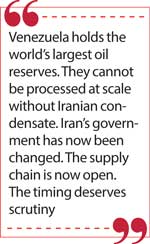
Venezuela holds the world’s largest proven oil reserves — approximately 300 billion barrels, primarily concentrated in the Orinoco Belt. This extraordinary resource has one extraordinary technical problem: the oil is extra-heavy crude with an API gravity of 8 to 10 degrees, so viscous that it cannot be transported by pipeline or ship without being blended with a lighter diluent or condensate.
For years, a significant source of that diluent was Iranian condensate. According to data from S&P Global Commodities at Sea, Iran was a regular supplier of condensates to Venezuela for blending purposes until US sanctions effectively ended those shipments around 2023. Venezuela subsequently pivoted to Russian naphtha (a light, flammable liquid hydrocarbon mixture, it functions as a diluent — a thinning agent.) as an alternative — at greater cost and logistical complexity. RBN Energy, in a January 2026 analysis, confirmed that a 460,000-barrel shipment of US-sourced naphtha to Venezuela underscored a critically important fact: production of Venezuelan heavy crude requires steady inflows of imported diluent.
BloombergNEF reported in January 2026 that US energy companies were positioned to invest billions in rebuilding Venezuela’s oil industry. The infrastructure logic is straightforward: the world’s largest oil reserves, controlled by or accessible to US energy interests, require a reliable diluent supplier. Iranian condensate — historically the most established and geographically logical source — becomes commercially available only if the sanctions framework collapses, or if the Government that imposed those sanctions is changed.
 We are not asserting that this supply chain dependency caused the attack on Iran. We are asserting that the connection exists, that it is technically verified, and that it has received almost no mainstream analytical attention. In a world where decisions of this magnitude are never made on a single basis, this economic logic would be one thread among several. The question this analysis poses is simply: why is no one pulling it?
V. The neutrality crime: From Imran Khan to the broader pattern
Perhaps the most forensically documented recent case of externally pressured regime change is that of Pakistan’s Imran Khan — and it matters here because of what it reveals about the specific trigger that draws Washington’s intervention.
Khan visited Moscow on February 24, 2022 — the same day Russia launched its invasion of Ukraine. The timing was coincidental; the visit had been scheduled in advance. But Washington’s response was immediate and blunt. One day after Khan held a large rally in northern Pakistan in which he declared Pakistan’s neutrality — stating publicly that his country was “friends with Russia, friends with America, friends with China and with Europe” and was not in any camp — Assistant Secretary of State Donald Lu met with Pakistan’s ambassador to the United States.
What followed was documented in a classified Pakistani diplomatic cable — known internally as a “cypher” — later obtained and published by The Intercept in August 2023. The cable, provided by a Pakistani military source, records Lu telling the Pakistani ambassador: “People here and in Europe are quite concerned about why Pakistan is taking such an aggressively neutral position on Ukraine, if such a position is even possible. It does not seem such a neutral stand to us.” Lu then delivered the bottom line: “I think if the no-confidence vote against the Prime Minister succeeds, all will be forgiven in Washington... Otherwise, I think it will be tough going ahead.”
Khan was removed by a parliamentary no-confidence vote five weeks later, on April 10, 2022. He has subsequently been imprisoned on charges his supporters describe as politically motivated. The economist Jeffrey Sachs, writing in February 2024, stated plainly: “There are strong reasons to believe that US actions led to the removal from power of Pakistan’s Prime Minister Imran Khan.” The US State Department has denied involvement on multiple occasions.
The evidentiary picture is contested — the Pakistani Government that replaced Khan confirmed the cipher existed but denied it constituted a conspiracy. The full truth may never be publicly confirmed. But the pattern it fits is unmistakable: a leader who declared neutrality — who said he was pro-Pakistan rather than pro-Washington — found Washington pressing for his removal the following day.
 This is precisely the dynamic Arundhati Roy described in Come September. Neutrality, in Washington’s framework, is not a recognised position. It is, in Lu’s own recorded words, a form of aggression. The implication — that small and medium nations are obligated to align with the United States or face consequences — is the operating logic of empire, stated plainly in a secret cable.
VI. The youth uprising pattern: Genuine rage, exploitable moment
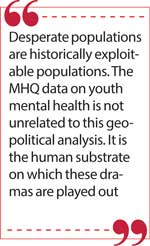
A recurring feature of 21st-century regime change is the prominent role of youth and student movements as the visible face of popular uprising. This is not a new observation — but it deserves careful and non-reductive examination. The question is not whether youth discontent is real. It invariably is. The question is whether, in some cases, that discontent is identified, amplified, and directed by external actors who position themselves to benefit from its outcomes.
Consider the pattern: the Arab Spring across North Africa and the Middle East (2010-2012); the youth uprising in Libya that preceded NATO intervention; the student movement in Bangladesh in 2024 that removed Prime Minister Sheikh Hasina; the youth protests in Iran that accelerated through 2024-2025 and preceded the political transition. In each case, the grievances were genuine. Economic frustration, corruption, authoritarianism — these are real conditions that require no manufacture. But genuine grievances are not sufficient explanation for the specific timing, escalation, and political outcomes of these movements.
The National Endowment for Democracy — established by the US Congress in 1983 — openly funds civil society organisations in countries of strategic interest. This is public record, not allegation. Its stated mission is to promote democracy. Its critics argue, with some documentation, that the line between supporting civil society and shaping political outcomes is thinner than its mandate suggests. In 2004, the NED’s own president, Carl Gershman, described certain countries as targets of “democratic” transition.
What is more sophisticated than manufacturing a revolution is identifying a population ready to revolt and providing the logistical, financial, and communications infrastructure to ensure the outcome serves your interests. You do not start the fire. You position yourself near the kindling and carry a match. And you ensure that whoever emerges from the chaos is already favourably disposed toward your priorities.
The Global Mind Health 2025 report, examined in a companion article, provides relevant quantitative context: youth across South Asia and the Middle East are in a measurable mental health crisis driven by economic precarity, fractured social bonds, and pervasive hopelessness. A generation that is economically desperate and psychologically distressed is structurally vulnerable to mobilisation — from any direction, for any purpose.
VII. Why Sri Lanka? The answer is under your feet
The question is a reasonable one. Sri Lanka is a small island nation of 22 million people. Its GDP is modest by global standards. It has just emerged from one of the most severe economic crises in its post-independence history. Why would the world’s great powers — the United States, India, China — invest such sustained strategic attention in so small a place?
The answer has multiple dimensions, and each one is significant.
The harbour that history cannot forget
Trincomalee, on Sri Lanka’s northeastern coast, is one of the world’s finest natural deep-water harbours — the fourth largest globally by some measures, capable of accommodating the largest naval and commercial vessels. Napoleon Bonaparte observed that whoever controlled Trincomalee controlled the Indian Ocean. British Prime Minister William Pitt called it the most valuable colonial possession on the globe. These assessments are as strategically valid in 2026 as they were two centuries ago.
 Approximately 80% of the world’s traded oil passes through the Indian Ocean. The shipping lanes connecting the Persian Gulf to East Asian manufacturing centres pass directly through the waters around Sri Lanka. Any power that exerts influence over key nodes in this maritime corridor holds leverage over global energy flows and, by extension, over the economic security of every nation that depends on those flows — which is to say, virtually every nation on earth.
As of April 2025, a trilateral agreement between India, Sri Lanka, and the United Arab Emirates formalised plans to develop Trincomalee as a strategic energy hub — explicitly described by the East Asia Forum as a strategic counterweight to China’s expanding Indian Ocean influence. China, meanwhile, holds a 99-year lease on Hambantota port in Sri Lanka’s south, and Sinopec signed a US$3.7 billion oil refinery agreement for the Hambantota region in early 2025. Sri Lanka is simultaneously being developed by India and the UAE in the north, and by China in the south. This is not economic partnership. It is competitive colonisation of a strategically irreplaceable geography.
The minerals under the sand
What receives almost no attention in the geopolitical discourse about Sri Lanka is the mineral wealth concentrated along its coastlines — and its strategic significance in the 21st-century global economy.
Sri Lanka’s beach sand deposits contain substantial concentrations of ilmenite, rutile, zircon, monazite, and garnet. The primary deposits run along the northeast coast — Pulmoddai, Mulativu, Nayaru, Vakarei — and the southern coastline: Dondra, Dikwella, Ambalantota, Godawaya, Kirinda. The Pulmoddai deposit alone is estimated to contain approximately six million tonnes of heavy mineral sands, with ilmenite content of 70-72%, rutile at 8%, zircon at 8-10%, and monazite at 0.3%.
These are not obscure industrial minerals. Ilmenite and rutile are the primary sources of titanium dioxide — used in aircraft manufacture, paint, plastics, and paper. Titanium metal is as strong as steel but half the weight, resistant to corrosion and extreme temperatures. Zircon is essential for ceramics, refractory materials, and nuclear applications. And monazite — the mineral that quietly sits at 0.3% of the deposit composition — is the principal mineral source of rare earth elements in Sri Lanka. Sri Lanka is reportedly among only nine countries in the world with monazite deposits, considered second only to China in certain rare earth element concentrations.
According to the Daily FT, in 2016, the president of a Chinese holding group arrived in Sri Lanka specifically to discuss acquiring mineral sands and graphite production — stating bluntly that China believed Sri Lanka was not getting the best international prices for its minerals. Sri Lanka’s own Government manifesto (2024) acknowledged the strategic importance of these resources, pledging to research and develop them. An AIM-listed mining company, Capital Metals, began production of the Eastern Minerals project on Sri Lanka’s east coast in early 2026 — described by analysts as one of the highest-grade mineral sand resources globally, at over 17% heavy minerals.
These minerals are beneath Sri Lankan soil and sand. They belong, in any meaningful sense, to the Sri Lankan people. Whether Sri Lanka is in a position to ensure they remain so — given the country’s debt obligations, the IMF conditions attached to its bailout, and the strategic competition between great powers for influence over the island — is a question that has not been adequately asked in the national conversation.
The secret agreements
In 2025, Sri Lanka signed agreements with India relating to the development of Trincomalee and other strategic assets. According to opposition voices in parliament and widespread reporting in Sri Lankan social media and alternative media, the full terms of these agreements have not been disclosed to Parliament. If accurate, this raises a question of fundamental democratic accountability: how can a legislature provide oversight of agreements it has not seen? And what, precisely, requires the secrecy?
This is not an allegation of wrongdoing. It is an observation that in a country whose sovereignty has historically been contested, whose port infrastructure is now being developed simultaneously by competing great powers, and whose mineral wealth is attracting international commercial interest — the terms of strategic agreements with foreign Governments are matters of urgent public interest, not administrative detail.
VIII. The de-Dollarisation moment and the urgency of now
The broader context for all of these patterns is a historic structural shift now well underway: the gradual erosion of the dollar’s exclusive status as the global reserve currency. China and Russia have been trading in local currencies. The BRICS bloc has actively discussed alternative payment mechanisms. Saudi Arabia has entertained yuan-denominated oil transactions. The share of global foreign exchange reserves held in dollars has declined from approximately 71% in 2001 to around 57% in 2024.
For a nation whose capacity to sustain over $33 trillion in national debt depends on permanent global dollar demand — driven by petrodollar recycling — this trend is existential. The strategic response, if the historical pattern holds, is to reassert control over the key nodes of global energy infrastructure: the producers, the transit routes, the processing supply chains, and the strategic ports through which energy flows.
Venezuela’s oil reserves, Iran’s condensate, Libya’s proposed gold currency, Iraq’s dollar-pricing reversal, Pakistan’s neutrality, and Trincomalee’s harbour are not unrelated data points. They are nodes in the same network — the network of mechanisms by which global energy is produced, priced, transported, and paid for. Whether they are being managed as such — consciously, strategically, at the highest levels — or whether the connections represent coincidental patterns that analytical minds are overlaying onto unrelated events is the central question this piece invites readers to sit with.
IX. What Sri Lanka must ask — Before someone else answers
For Sri Lankans — and particularly for those in education, policy, and public life — these patterns raise specific and urgent questions that go beyond geopolitical abstraction.
First: Is Sri Lanka’s decision-making genuinely sovereign? The IMF conditions attached to Sri Lanka’s bailout program have shaped fiscal policy, energy pricing, and privatisation agendas. These conditions reflect not only economic logic but the strategic interests of the major shareholders of the IMF — primarily the United States. This is not a conspiracy; it is the documented governance structure of the institution. The question is not whether the IMF is helpful. The question is helpful to whom, and at what cost to sovereign decision-making.
Second: Who benefits from Sri Lanka’s mineral wealth, and on what terms? Sri Lanka has been exporting raw ilmenite, rutile, and zircon for decades — largely without the value-added processing that would generate significantly greater national revenue. The technology to process ilmenite into titanium dioxide exists. The domestic demand exists. What has been absent is the political will and the structural conditions to keep the value of these resources within the country. As international interest in Sri Lanka’s minerals intensifies — from Chinese, British, and other foreign mining interests — the terms on which those resources are extracted and who captures the value become questions of national importance.
Third: What does the documented pattern of youth-uprising-to-regime-change mean for Sri Lanka’s own generation in crisis? The 2022 Aragalaya was the most organic and broadly supported mass movement in Sri Lanka’s post-independence history — driven by genuine desperation over fuel, food, and economic collapse. Its outcome — the departure of Gotabaya Rajapaksa and the installation of Ranil Wickremesinghe, followed by a rapid IMF agreement — raises questions that have not been fully examined. This is not to delegitimise the Aragalaya. It is to ask whether its outcome was shaped, in part, by interests that positioned themselves to benefit from the crisis.
Fourth: Why is none of this in the national conversation? Sri Lanka’s political class — across all parties — remains focused almost entirely on economic stabilisation metrics defined by external institutions, while deeper questions of sovereignty, strategic positioning, and long-term national interest go largely unexamined in public discourse. A Government perpetually managing the present crisis cannot see the future being negotiated around it.
And the fifth question — the most important one — was posed by Arundhati Roy more than two decades ago, and remains unanswered: when disagreement is labelled anti-national, when asking who benefits is dismissed as conspiracy theory, when the terms of agreements affecting a nation’s strategic assets are hidden from its legislature — what, precisely, is left of democracy?
Conclusion: The obligation to ask
This analysis does not claim to know whether a unified strategic hand is directing the events described above. The connections between Venezuelan oil reserves, Iranian condensate supply chains, Libyan gold currency proposals, the removal of leaders who declared neutrality, youth uprisings in strategically situated nations, and the contest for Indian Ocean ports may be the product of deliberate coordination — or the emergent result of multiple actors pursuing separate interests that happen to align — or partially coincidental patterns that analytical minds are inclined to connect.
What this analysis does claim is that the patterns are real, the data is verifiable, the historical record is documented, and the questions are legitimate. A world in which the most powerful intelligence apparatus in human history has a confirmed record of regime change — in which petrodollar protection is a documented strategic priority — in which youth populations in strategically inconvenient countries reach boiling point at politically convenient moments — deserves more scrutiny than it typically receives.
The obligation of informed citizens — and especially of those in education, policy, journalism, and public life — is not to accept these patterns as proof of conspiracy, but equally not to dismiss them as paranoia. The obligation is to ask, rigorously and persistently: who benefits, who decides, and whether the country they live in is navigating these forces with open eyes or closed ones.
(The author with MBA Sri J; FIB; is a former senior banker, educationist, transformation strategist, and certified coach with extensive experience in both public and private sector leadership. He has served on the boards of state and private institutions and was formerly Chief Operating Officer of a Public-Private Partnership unit, bringing a unique perspective on governance, institutional reform, and economic development in Sri Lanka)




