Thursday Oct 22, 2026
Thursday Oct 22, 2026
Wednesday, 29 April 2026 00:20 - - {{hitsCtrl.values.hits}}
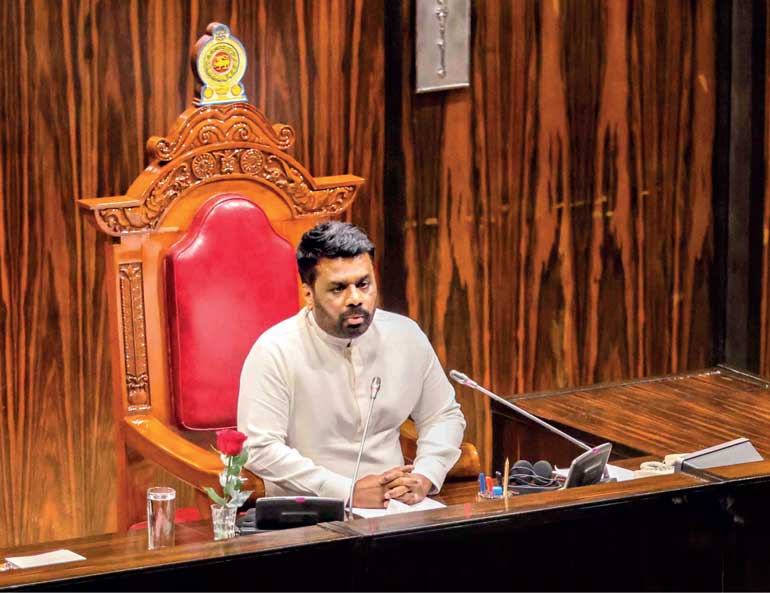
President Anura Kumara Dissanayake

When multimillion-dollar losses emerge from within the public treasury, it is not just money that disappears. It is trust. And trust, once fractured at the level of the state, does not self-repair through press releases, ministerial reshuffles, or the procedural comfort of a parliamentary majority. It deepens. It spreads like cancer. And eventually, it becomes the defining story of an era.
The most dangerous risk facing any Government is not an Opposition with sharp questions. It is the widening gap between proclaimed values and lived practice. When a Government that came to power on a platform of purity and accountability begins to accumulate its own cloud of unanswered questions, it faces a choice that no majority can make for it: the choice between the performance of virtue and its practice.
This is a call to conscience. Not to any party, not to any faction. To the institution of governance itself — and to the citizens, including the innocent majority of this country and the generations yet unborn, who will ultimately carry the cost of decisions made today behind closed doors.
The anatomy of the cover-up
There is a particular species of institutional failure more dangerous than the original wrongdoing: the organised silence. It works predictably. An allegation surfaces — a credential that does not survive scrutiny, a consignment that clears without inspection, a connection between politics and the narcotics trade, a road accident absorbed without consequence, an agreement with a foreign nation kept from the people it affects, a medicine of doubtful quality in a public ward, a corruption in the energy supply chain, public funds missing from places they should have been most sacred. Instead of an ‘independent’ inquiry, the parliamentary majority is mobilised. Questions are ruled out of order. The matter is managed rather than resolved.
 Each of these, taken alone, might be explained. Taken together, they form a pattern. And patterns, in governance, are never accidental. They are structural. They tell us something not about individual lapses but about institutional culture — about what a Government believes it can absorb, deflect, and outlast.
The people of this country are watching. They are not naive. They have seen this script before, performed by different actors on the same stage. What makes the present moment uniquely painful is that this Government was elected on the explicit promise that the script would change. That promise is the standard by which every unanswered question now carries double weight. This turns out be the highest form of public betrayal.
And then, within the past week, the news that the Finance Ministry’s processes compromised with questionable competency in due diligence and $ 2.5 million — funds earmarked as a sovereign debt repayment to Australia — were stolen claimed to be by cybercriminals, who quietly rerouted the transfer. The question of due diligence is not limited to ministry officials up to the highest level who authorised the transfer, but also to the Central Bank. Four senior officers suspended which is the easiest thing to do also seems to be the pattern. The IMF, which holds the lifeline this country depends upon, is now monitoring the situation. The funds were destined not for discretionary spending, but for the discharge of a national obligation on behalf of a people already carrying a debt burden that will outlast this generation.
This is not a moment for political point-scoring. It is a moment for institutional seriousness. The question the country is entitled to ask is not who is to blame in the narrowest sense. The question is: what does it say about the state of our governance systems that such a breach was possible, that it went undetected until a foreign creditor flagged the missing payment, and that the response has been administrative competence rather than political?
What 2022 taught us — and what it cost
Sri Lanka proved something to the world in 2022 that few small nations ever demonstrate so starkly: that the power of the people is greater than the people in power. The Aragalaya — was not merely a protest movement. It was a reckoning. Ordinary men and women, students and clergy, farmers and professionals, united across every line that normally divides this island, and they brought down a presidency and a political dynasty that had seemed immovable.
 It was a moment of extraordinary moral clarity. And it came at an extraordinary cost. The economy did not merely stumble. It collapsed. Foreign reserves ran dry. Medicine disappeared from pharmacy shelves. Cooking gas queues stretched for miles. Families made impossible choices. An entire generation of young people looked at their country and concluded that their futures lay elsewhere resulting in about 600,000 families migrating.
Sri Lanka cannot afford another such reckoning. This is not a political observation. It is an economic one. The country’s economy is hanging on a shoestring — bound to an IMF program whose conditions are unforgiving, carrying a debt restructuring whose terms were hard-won, dependent on a fragile return of investor confidence that evaporates faster than it accumulates. The people are tired. Not the fatigue of comfort, but the fatigue of repeated betrayal. The fatigue of people who gave everything to a moment of change and are watching, with a quiet and growing dread, whether that change was real or merely a change of cast. A Government that came to power on the back of the people’s sacrifice owes those people something that no parliamentary majority can substitute: the unambiguous demonstration that it is different. Not in rhetoric. In conduct.
What Singapore understood
Lee Kuan Yew built Singapore on a premise that Governments across Asia have admired in public and quietly abandoned in practice: that institutional integrity is a non-renewable resource. Once spent, it cannot be bought back.
Singapore’s Corrupt Practices Investigation Bureau was given true independence and real teeth — powers to investigate bank accounts, tax returns, and the families of suspected persons, regardless of rank or political proximity. The philosophy was explicit and unsparing: make wrongdoing a high-risk, low-reward activity, and enforce that standard without exception.
The test came in 1986. Teh Cheang Wan, a senior cabinet minister and trusted member of Lee’s own inner circle, was alleged to have accepted bribes in connection with state land deals. Lee Kuan Yew authorised the CPIB to investigate. There was no parliamentary maneuver. No majority deployed to shield the accused. No suggestion that the investigation was premature or politically motivated. His position was stated without qualification: “There is no way a Minister can avoid investigations, and a trial if there is evidence to support one.”
 Teh Cheang Wan took his own life before charges could be filed. Lee Kuan Yew read his suicide note to parliament. The investigation continued. The principle held. That is the model — not perfection, but a governing class that understood, from its founding, that the legitimacy of the state is its most precious and most fragile possession.
South Korea: When the streets become the majority
Governments that mistake their parliamentary arithmetic for their greatest asset tend to forget a more powerful force: a citizenry that has stopped believing them.
President Park Geun-hye governed South Korea with a parliamentary majority. When the scandal emerged — allegations that she had allowed an unelected private associate to influence state appointments, coerce conglomerates, and access classified presidential documents — the initial response was containment. Aides were dismissed. The narrative was managed.
The public responded with weeks of candlelight protests, in temperatures below freezing, in numbers reaching into the millions. Her approval rating did not merely fall. It collapsed to 4% — the lowest recorded in South Korean presidential history. The parliamentary majority became irrelevant against the weight of what the streets were saying. The Constitutional Court upheld her impeachment in a unanimous 8-0 ruling. She was arrested, tried, and sentenced to 24 years in prison for corruption and abuse of power.
South Korea has repeated this lesson. In January 2025, President Yoon Suk-yeol — who had briefly declared martial law before being impeached — became the first sitting South Korean president to be physically arrested. Investigators scaled the walls of his residential compound, pushed past his security detail, and brought him into custody. No parliamentary majority protected him from that moment.
Malaysia: When 61 years of majority run out
 Malaysia’s ruling coalition held power for 61 years without interruption. Six decades of parliamentary dominance. Through all of that time, the apparatus of majority politics functioned as such systems always do: inconvenient investigations were slowed, questions deflected, and the arithmetic of loyalty preserved.
Then came 1MDB. The United States Department of Justice described it as the largest kleptocracy case it had ever pursued. More than USD 4.5 billion was diverted from a sovereign wealth fund established, with deep irony, in the name of national development. The parliamentary majority held — until the 2018 election, when public fury over the scandal ended six decades of unbroken rule in a single night.
Former Prime Minister Najib Razak was subsequently convicted, jailed, and in December 2025 found guilty on all 21 counts of money laundering and four counts of abuse of power. The judge, whose reading of the verdict took five hours, offered a conclusion that deserves to be quoted in full: “The accused was no country bumpkin. Any attempt to paint the accused as an ignoramus who was hopelessly unaware of the misdeeds going around him must therefore fail miserably.”
The parliamentary majority that had protected him for years could not protect him from that sentence.
The pattern that keeps repeating
The same story, in varying registers, has played out across the region and beyond. What the international evidence establishes, with a consistency that should be sobering, is that the strategy of managed silence always fails. It merely determines the timing and the scale of the eventual reckoning.
Research by Transparency International has shown that corruption costs governing parties roughly double what incompetence does at the ballot box. Citizens punish cover-ups not merely because they disapprove of the underlying conduct, but because they understand, at an intuitive level, that a Government willing to be silent about one thing is a Government willing to be silent about everything. The silence itself becomes the verdict.
And the scholarship on parliamentary governance is equally unambiguous: greater parliamentary oversight translates directly to less corruption. When a majority uses its numbers to suppress that oversight rather than exercise it, it is not strengthening governance. It is creating the conditions for a larger and more destabilising reckoning down the road.
The question this Government must answer
A Government that inherited the moral authority of the Aragalaya carries a burden that governments which came to power by ordinary means do not. The people who voted for this administration in 2024 were not merely voting against the old order. They were voting for the proposition that governance could be different. That public office was public trust, not public privilege. That the standards applied to predecessors when in opposition would, with equal rigor, if not more, be applied to themselves.
That proposition is now being tested. Not by the Opposition. Not by commentators. By the accumulation of questions that a Government serious about accountability would be racing to answer, rather than managing with the arithmetic of its majority.
 The concern here is not for those who hold power. It is for the innocent and betrayed majority of this country — the schoolteacher in Kurunegala, the farmer in Anuradhapura, the toddy tapper in Jaffna, the fisherman in Negombo, the small trader in Pettah, the house wife/mother who is anguish, the young graduate weighing whether to stay or go — who cannot afford the cost of another institutional failure. And it is for the unborn, who will inherit whatever we leave behind in the public accounts, the public institutions, and the public trust we either maintain or squander in this moment.
Sri Lanka’s economy is recovering on borrowed time and borrowed money. The IMF’s program is not charity. It is a conditional lifeline, and its conditions include not merely fiscal targets but governance standards — transparency, anti-corruption frameworks, and the kind of institutional credibility that cannot be manufactured by a communications team. It is built, slowly and painfully, through demonstrated conduct. And it is destroyed, quickly and comprehensively, by exactly the kind of questions that are now accumulating without adequate answers.
The hollow within
There is a philosophical problem at the heart of institutional cover-up that no majority can solve. Legitimacy is not a legal category. It is not conferred by the number of seats a Government holds or the procedural correctness of its parliamentary maneuvers. It is earned, continuously, through the demonstrated alignment between what a Government claims to stand for and how it behaves when the stakes are highest.
A Government that proclaimed purity and is accumulating unanswered questions does not have a political problem. It has an integrity problem. And integrity problems do not respond to communications strategies. They respond only to one thing: the unambiguous, institutional demonstration that no question is too inconvenient to answer, no inquiry too uncomfortable to permit, and no interest — political, personal, or partisan — too important to protect.
Lee Kuan Yew understood this not as political philosophy but as national survival. He built an entire system on the premise that the moment the state’s integrity becomes negotiable, the state begins to decay from within.
The mask is always the problem. Not because it is ugly, but because it is hollow. And hollowness, in governance, has a way of becoming audible — in the quiet conclusions of international partners, in the reluctance of investors, in the deepening cynicism of citizens who have already paid too high a price for the last performance of virtue that turned out to be exactly that: a performance.
The question every Government in this position must answer is not whether accountability is politically convenient. That question has already been answered — across decades and jurisdictions, in courts and at ballot boxes, in the streets of Seoul and Kuala Lumpur, and on the Galle Face Green in July 2022.
The question is whether those in power are willing to hear the answer before the mask breaks — or only after. Integrity is not optional. It is the only shield left when the mask breaks. This article is written as a call to conscience — not as an accusation, but as a concern for the country, its people, and those yet to inherit it.
(The author, DBA Scholar, MBA Sri J; FIB, is a former senior banker, educationist, transformation strategist, and certified coach with extensive experience in both public and private sector leadership. He has served on the boards of state and private institutions and was formerly Chief Operating Officer of a Public-Private Partnership unit, bringing a unique perspective on governance, institutional reform, and economic development in
Sri Lanka)




