Saturday Jul 11, 2026
Saturday Jul 11, 2026
Monday, 30 March 2026 04:00 - - {{hitsCtrl.values.hits}}
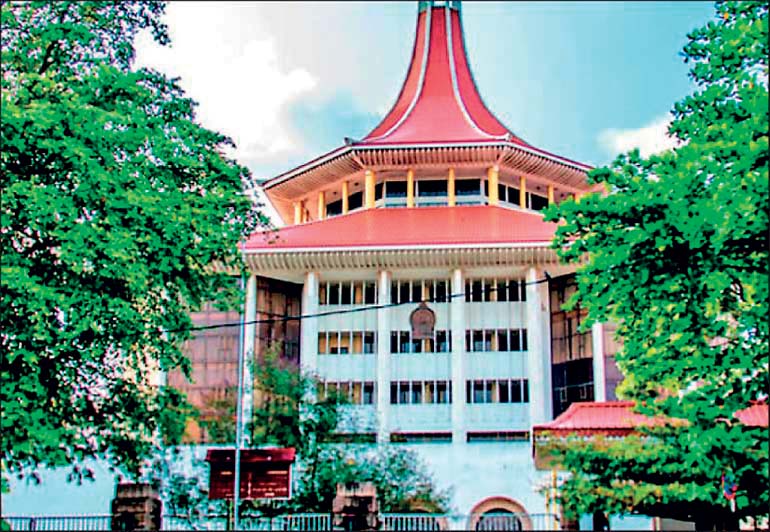
Supreme Court of Sri Lanka

President and Finance Minister nura Kumara Dissanayake
 The Court’s mandate is constitutional, not economic. Does any provision of the Bill infringe the Fundamental Rights guaranteed by Chapter III of the Constitution? Does it undermine the separation of powers? Does it bypass the special Constitutional procedures reserved for the most foundational laws of the land? That distinction between Constitutional scrutiny and economic second-guessing is not merely procedural. It is the very foundation of the separation of powers that makes democracy work
 With the deadline for petitions against the Inland Revenue (Amendment) Bill 2026 closing on 30 Monday March, and hearings likely to follow this week, Sri Lankans have an opportunity to watch constitutional democracy in action. But what exactly is the Supreme Court’s scope and where does its authority properly end?
A Bill on the Order Paper, the clock is ticking
When a tax bill is placed on the Order Paper of Parliament, it is not yet law. It is a proposal, a statement of legislative intent waiting to run a constitutional gauntlet. And under the Sri Lankan Constitution, the most significant checkpoint on
that journey is not a parliamentary vote, but a window of precisely 14 days during which any citizen may walk into the Supreme Court and say: “this bill is unconstitutional.”
That is exactly what is happening right now. The Inland Revenue (Amendment) Bill 2026, published in the Gazette on 24 February, has been placed on the Order Paper since 17 March.
Many constitutional petitions have already been filed challenging the Bill.
The deadline for any further petitions is Monday, 30 March 2026. Hearings before the Supreme Court are expected to follow during the course of this week.
This is democracy working as designed. But it raises a question that many Sri Lankans are asking: what, precisely, is the Supreme Court entitled to examine and where does its authority end?
The Constitution’s architecture: Article 121 and the 14 day window
The answer lies in the Constitution itself. Under Article 121(1), any citizen may petition the Supreme Court within 14 days of a bill appearing on the Order Paper, challenging its consistency with the Constitution. The Parliament is constitutionally barred from proceeding until the Court delivers its determination or until three weeks have elapsed from the date of the petition. (whichever is earlier)
The Court’s task under Article 123 is equally defined: it must issue a reasoned determination stating whether the bill or any specific clause is inconsistent with the Constitution. If so, it must state whether that inconsistency requires a two-thirds majority under Article 84, or something even more formidable , a national referendum under Article 83.
Article 83 is one of the Constitution’s most powerful provisions. It shields the most foundational aspects of Sri Lankan statehood, the sovereignty of the People, the unitary character of the Republic, fundamental freedoms from torture and enslavement, from being altered by Parliament alone, no matter how large its majority. Any bill touching those provisions must go not just to Parliament but to the People themselves.
Once a bill clears this process and the Speaker certifies its enactment under Articles 79 and 80, the door slams shut. Article 124 is unambiguous: no court, tribunal or institution may thereafter question the validity of the enacted law. The window is narrow. It is pre-enactment. And it is the only one.
What the Court is not doing and why that matters ?
Here is the single most important fact about this week’s proceedings: the Supreme Court is not being asked whether Sri Lanka’s taxes are too high.
It is not sitting in judgment of the Government’s fiscal targets. It is not evaluating whether the IMF’s revenue benchmarks are sound, whether Capital Gains Tax should be 10% or 15%, or whether the doctors should be given a lower rate of income tax to prevent migration ?. Those are policy questions and they belong exclusively to Parliament under Article 148, which vests “full control over public finance “ in the elected legislature.
The Court’s mandate is constitutional, not economic. Does any provision of the Bill infringe the Fundamental Rights guaranteed by Chapter III of the Constitution? Does it undermine the separation of powers? Does it bypass the special Constitutional procedures reserved for the most foundational laws of the land?
That distinction between Constitutional scrutiny and economic second-guessing is not merely procedural. It is the very foundation of the separation of powers that makes democracy work.
The Judiciary speaks: Landmark cases that drew the line
Courts across the democratic world have repeatedly been called upon to articulate this boundary and they have done so with striking clarity.
The most celebrated statement in South Asian jurisprudence comes from the Supreme Court of India in the landmark case of R.K. Garg v. Union of India (1981) 4 SCC 675.
Delivering the majority judgment(along with Chief Justice Y.V. Chandrachud, Fazal Ali, and A.N. Sen) that has guided constitutional courts for four decades, Justice Bhagwati wrote that “laws relating to economic activities should be viewed with greater latitude than laws touching civil rights such as freedom of speech, religion etc.”
The Court went further, quoting with approval the celebrated words of Justice Frankfurter (minority judgement) of the United States Supreme Court: “In the utilities, tax and economic regulation cases, there are good reasons for judicial self-restraint if not judicial deference to legislative judgment. The legislature after all has the affirmative responsibility. The courts have only the power to destroy, not to reconstruct. When these are added to the complexity of economic regulation, the uncertainty, the liability to error, the bewildering conflict of the experts, and the number of times the judges have been overruled by events, self-limitation can be seen to be the path to judicial wisdom and institutional prestige and stability.”
That passage deserves to be carved above the entrance of every court that has been tempted to redesign a budget. Judges are not economists. They are not elected. And they are, as the Court noted, operating with meagre and uninterpreted experience in a field where even trained economists routinely disagree.
The R.K. Garg principle have never been reversed and continue to guide judicial approaches to economic legislation in India to this day. India’s Supreme Court has consistently held that economic policies must be reviewed under a highly deferential standard, and will only be struck down if shown to be “absolutely capricious, arbitrary and unreasonable, or violative of constitutional or statutory provisions.”
Sri Lanka’s Supreme Court has followed the same disciplined approach. The court’s own jurisprudence acknowledges that it can intervene where a policy was manifestly unreasonable or arbitrary, or implicated an issue of constitutionality. But it is not setting policy: it is not making a policy prescription. The line isclearly drawn between the legality of how a law was made and the wisdom of what it contains.
Sri Lanka’s own track record: Three Tax Bills, the economic crisis case and four lessons
Sri Lanka’s constitutional history with tax legislation provides exactly the roadmap needed to understand what lies ahead.
Lesson One: 2017 — When a clause goes too far
The IMF-assisted Inland Revenue Act of 2017, designed to raise Sri Lanka’s tax revenue from 12.4% to 15% of GDP as a condition of a $501.5 million loan facility, was challenged before the Supreme Court. The Court found clauses 97, 98, 100(1)(e), 167, and 200 of the bill inconsistent with various articles of the Constitution.
The most dramatic finding was that Clause 167, which would have allowed tax authorities to prevent individuals suspected of tax fraud from leaving the country raised serious constitutional concerns.
Even more strikingly, Clause 200 relating to the interpretation of the Act, was found to require not a simple majority, not a two-thirds majority, but approval at a national referendum.
The Court said nothing about whether Sri Lanka needed higher revenue. It said nothing about the IMF’s fiscal targets. It confined itself entirely to constitutional principle. That was its job, and it did it.
Lesson Two: 2022 — The Special GST test
When the Special Goods and Services Tax Bill was challenged by the Bar Association of Sri Lanka, the Inland Revenue Commissioners’ Association, and the main opposition, the Court once again drew a sharp line. The Supreme Court determined that some clauses of the Special GST Bill were inconsistent with the Constitution and that the bill needed a two-thirds majority and approved by the people in a referendum under Article 83 to be enacted. The determination was about constitutional structure, the proper legislative threshold, not about whether consolidating taxes on liquor, cigarettes, telecommunications, and gambling was sound fiscal policy.
Lesson Three: 2023 — A clean bill of health
In September 2023, when the Inland Revenue (Amendment) Bill was challenged amid widespread protests from professionals over steep income tax increases, the outcome was instructive in the opposite direction. The Supreme Court held that neither the bill nor any of its provisions was inconsistent with Article 12 or any provision of the Constitution, and that it could be passed by a simple majority. Tax rates that caused nationwide strikes were upheld without comment on their economic merit, because the Court’s role was never to adjudicate the fairness of a tax rate, only its constitutional validity.
Lesson Four: Sri Lanka’s economic crisis case, the exception that proves the rule
The most dramatic recent intersection of Sri Lankan constitutional law and economic governance came with the November 2023 ruling against former President Gotabaya Rajapaksa and other senior officials over the 2021–2022 economic crisis.
The respondents were found guilty of violating public trust and breaching Article 12(1) of the Constitution and critically, the Court held that they “cannot evade responsibility by labeling their decisions as policy choices.”
This might appear to contradict the principle of judicial non-interference in economic matters. In fact it reinforces it. The majority was clear that it was not setting policy or making a policy prescription, but engaging in a post-mortem. It was only reviewing whether the relevant actors had exercised their discretion improperly, in a manifestly unreasonable, irrational, or arbitrary manner, in failing to take remedial measures once the original policy had failed.
The Court did not tell the Government what tax rates to set or what foreign exchange policy to adopt. It found that officials had been warned repeatedly of impending catastrophe and done nothing , that inaction in the face of clear evidence crossed from policy disagreement into constitutional violation. The ruling stated that “this situation brought in a total breakdown of economic and social life of the entire society” , framing its jurisdiction in terms of fundamental rights and public trust, not economic management.
What is certain is what the Court will not decide: it will not pronounce on whether Capital Gains Tax should be higher or lower, whether the IRD needs more powers, or whether Sri Lanka’s revenue targets satisfy the IMF. That, as courts from Colombo to New Delhi have consistently affirmed, is a question for the people’s elected representatives, answerable at the ballot box, not the courtroom
The 2026 Challenge: Constitutional substance, not fiscal complaint
Against this backdrop, it becomes clear why the current petitions against the Inland Revenue (Amendment) Bill 2026 deserve serious attention , and equally clear why they are not a challenge to tax policy.
At the heart of petitions is Clause 31 of the IRA Bill, which introduces provisions allowing the Commissioner General of Inland Revenue to issue certificates confirming tax defaults. These certificates would be treated as conclusive evidence in court, effectively preventing Magistrates from questioning their accuracy. The petitioner contends that this framework undermines the role of the judiciary by reducing Magistrates to a “mere conduit.”
Sri Lanka’s Constitution clearly vests judicial power in courts and institutions established by law, ensuring that disputes , especially those involving financial liabilities , are subject to impartial review. Critics argue that Clause 31 disrupts this structure by placing decisive authority in the hands of a tax administrator.
Then there is Clause 4. The petition alleges that the proposed changes effectively introduce new tax burdens without prior disclosure in the national Budget. The a petitioner points out that the 2026 Budget speech and related fiscal reports did not mention any intention to redefine reserves in a manner that would increase corporate tax liabilities. This omission, it is argued, amounts to a form of “stealth taxation,” bypassing the constitutionally mandated budgetary process and undermining Parliament’s exclusive control over public finance under Article 148.
In addition to the above, it is highly likely that challenges will arise against the Bill, particularly with respect to the provisions empowering the Commissioner-General of Inland Revenue (CGIR) to issue tax rules for the implementation of IFRS 17, as well as the evidentiary lock-out provisions introduced through the new section 122(8A) of the principal Act. Further concerns are expected regarding the criminalisation of administrative defaults via the introduction of a new Chapter XVIIA.
These are not gripes about tax rates. They are substantive constitutional arguments about judicial independence and parliamentary procedure , exactly the kind of questions the Supreme Court exists to answer.
The final lock: After Monday
There is one more constitutional fact that every citizen reading this article should understand clearly: after Monday, 30th March, it will be too late.
Sri Lanka’s constitutional design, unlike India’s, does not permit post-enactment judicial review of legislation. Sri Lanka does not have judicial review but rather only a limited pre-enactment review of legislation. Citizens have the opportunity to petition the Court only before the bill is debated in Parliament, amendments are passed at the committee stage, and the bill is eventually passed.
Once the Speaker issues the certificate of enactment under Article 124, the constitutionality of the law is beyond the reach of any court forever. No petition, no fundamental rights application, no appeal can reopen the question. This is the only opportunity and it closes on Monday.
India operates differently. Under the Basic Structure Doctrine established in the landmark Kesavananda Bharati v. State of Kerala (1973), enacted legislation in India remains subject to challenge throughout its life, if it violates the basic structure of the Constitution. Sri Lanka made a different constitutional choice , one that demands citizens and lawyers act swiftly, in the precise window that the Constitution has provided.
The week ahead
This Monday morning, as this article reaches readers, the 14 day window is drawing to a close. Any petition must be in the hands of the Supreme Court Registry by Monday, 30 March. Hearings on the petitions already filed, and any new ones received, are expected to follow during the week. Parliament cannot proceed with the Bill until the Court has spoken.
What the Court will decide is, appropriately, unknown. It may find challenged Clauses constitutionally sound. It may find them inconsistent with the Constitution and requiring a two-thirds majority or even a referendum. What is certain is what the Court will not decide: it will not pronounce on whether Capital Gains Tax should be higher or lower, whether the IRD needs more powers, or whether Sri Lanka’s revenue targets satisfy the IMF.
That, as courts from Colombo to New Delhi have consistently affirmed, is a question for the people’s elected representatives, answerable at the ballot box, not the courtroom.
The Supreme Court is a guardian at the gate , powerful, principled, and precisely bounded. The weeks to follow, the Supreme Court will decide the fate of the Bill. The rest is to be decided by the Parliament.
(The author is Attorney-at-Law, LLB,FCMA(UK),CGMA, FCMA. He was the Tax Practice Leader of the Year 2024 for the ASPAC region - International Tax Review (ITR) and was amongst the top four for the Tax Litigation and Disputes Practice Leader of the Year (ASPAC region) - International Tax Review)

