Monday Sep 28, 2026
Monday Sep 28, 2026
Friday, 24 April 2026 04:06 - - {{hitsCtrl.values.hits}}
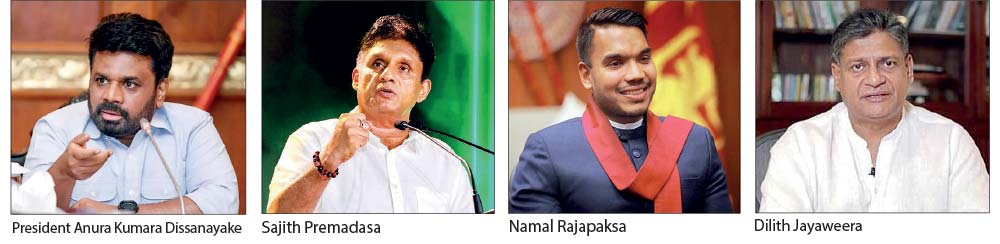
 Hypocrisy is an inescapable and necessary fact of political life. It is cynical to pretend politics can be completely sincere. Instead of searching for "authentic" politicians, voters should learn to distinguish between different types of hypocrisy
 This is about Political Hypocrisy. It is also about our ‘Leftist’ President who has made a turn to the ‘Right’. His ‘Opponents’ claim “they know better and could perform better’.
The ‘Global Economy’ is where the ‘Left’ and ‘Right’ finally meet. Adam Smith’s invisible hand is best used for reaching into someone else's pocket or as the War in West Asia has shown, a global hegemon's ability to confiscate some sovereign nation’s natural resources.
AKD has chosen pragmatism over ideology. Once a vocal critic of the IMF and its "painful" austerity, his administration has largely maintained the existing IMF deal to ensure economic stability.
His opponents - parties such as the SJB now criticise current austerity and tax hikes while their own economic blueprints once promoted similar IMF-backed reforms.
AKD running to be President focused on ethical governance. Despite his anti-corruption platform, his Government is now being accused of delaying reports on probes completed and irregularities on high level appointments. The Opposition has discovered new moral high ground. Port irregularities are regularly highlighted. The Prevention of Terrorism law continues to be applied.
Some Opposition leaders who were integral parties of ousted administrations blamed for our 2022 collapse now preach good governance and integrity while attacking AKD's policy missteps. AKD too has made a few policy errors.
First a brief explanation.
Recently, I had an appointment with my very genial Consultant Physician. Apart from being a very good Physician He is a ‘Royalist’ and very much anti-JVP. At the last Presidential he voted for RW while I voted for AKD.
We had many debates then. While performing his meticulous examination he asked me, “Now don’t you regret your vote?
It is this patronising sophistry in the upper echelons of the middle class that prompts this essay. My Physician insisted that AKD was a hypocrite!
I conceded that there was some truth to it. My response was that perhaps AKD is a hypocrite, but he is a good hypocrite! To justify my claim, I relied on Cambridge Political Science professor David Runciman’s treatise on “Political Hypocrisy”. His thesis on hypocrisy in politics is disarmingly precise and accurate.
Truth and power
Confined to my home, I find revisiting books on my shelves sheds much light on current complexities in both our domestic politics and beyond our shores. Following my encounter with the good doctor I picked up my copy of David Runciman’s seminal work on Political Hypocrisy. The subtitle of this definitive study of Political Hypocrisy sets indicates its ample scope: “The Mask of Power, from Hobbes to Orwell and Beyond.”
Runciman has chosen Hobbs and Orwell to cover his subject of hypocrisy for a purpose. Hobbs defined power. Orwell defined truth. Philosopher Thomas Hobbes believed that maintaining public order called for a strong, absolute Government. Otherwise, our lives would be “solitary, poor, nasty, brutish, and short". Politics therefore was a kind of perpetual war.
Orwell was essentially a writer and commentator. He made political commentary into a timeless art. The word ‘Orwellian’ attests to his impact. Orwell insisted that “True freedom is the right to tell people what they do not want to hear.”
Revisiting this book offered deep, sharp insights into the current landscape of Sri Lanka’s present leadership and wannabe leaders.
Hypocrisy is an inescapable and necessary fact of political life. It is cynical to pretend politics can be completely sincere. Instead of searching for "authentic" politicians, voters should learn to distinguish between different types of hypocrisy.
There are Harmless Hypocrites and Harmful Hypocrites. Instead of wasting time trying to pontificate double standards, we must identify the good and better hypocrites of them all. We must assess which hypocrisies are harmless and which are truly damaging to our so-called ‘liberal democracy.
Technology has changed today's political landscape. YouTubers and social media influencers using a variety of platforms have transitioned from innocuous commentators to powerful political actors. They run the race faster than traditional media both in reach and engagement.
They are also used by our main political actors to bypass the learned and not so learned journalistic gatekeepers to reach out to the ‘Aragalaya’ generation.
The ‘Gal Anguru’ controversy where the Minister has now decided to step down is the clearest and immediate example. The constant attempt by rivals to expose each other’s inevitable double standards makes effective governance a highwire circus act.
Let us have a closer look. We are ultimately left with a choice between different kinds of lies and different kinds of truth, often requiring "principled pragmatism" over rigid honesty.
For a democracy to function, leaders must often use "masks" to manage conflicting interests, making some level of hypocritical deception embedded in political language and survival.
I used Professor David Runciman’s lens of Political Hypocrisy to understand AKD the Leftist who pivoted to the right as elected Executive President.
The adoption of the IMF roadmap by President AKD is a textbook example of what David Runciman defines as principled pragmatism.
In his book – ‘Political Hypocrisy: The Mask of Power, from Hobbes to Orwell and Beyond’, Runciman argues that "the most dangerous form of political hypocrisy is to claim to have a politics without hypocrisy".
He amplifies principled hypocrisy! It is principled pragmatism. For a leader to be effective in a liberal democracy, he must often adopt a "mask" that balances ideological commitments with the "brute facts about power" and the immediate needs of the State.
AKD’s core political identity is rooted in a left-leaning, anti-neoliberal platform that historically viewed IMF interventions as "corrupt" or "harmful" to national sovereignty.
As President he has made a ‘Pragmatic Pivot’. On assuming office AKD acknowledged that "deviating from the current path would be irresponsible" and that Sri Lanka "cannot seek options outside the IMF basket" without risking total economic collapse.
So, he resorted to Karl Marx’s teacher Hegel. The thesis and the antitheses resulted in a Synthesis that made him abandon his ideological principles! Now, AKD is attempting to implement the IMF objectives through "alternative means" that prioritise social welfare and "relieve the burden off the people".
This is also the essence of Runciman's "principled pragmatism “a form of ‘benign self-deception’ where the leader maintains his moral authority (his perch in Pelawatte) while doing what is necessary to keep the nation functioning- his “pragmatism."
AKD’s IMF “mask" will remain “virtuous" as long as his pragmatic cooperation with the IMF is used as a tool to achieve his broader social goals, rather than becoming an end that betrays his original mandate.
Now we turn to AKD’s opposition or more precisely his opponents who claim to possess the requisites to replace him.
Sajith’s ‘Insignificant Language ploy’
Lost in verbose forays, Sajith Premadasa offers a chaotic contrast. His frequent excursions into ‘Strategic Planning’, ‘Scenario Planning’ are best described as learned non-essentials. They appear to be a desperate bid to remain relevant in a post-Aragalaya world that has moved on. Runciman quotes the thinker Jeremy Bentham on Insignificant Language of hypocrisy.
Bentham despised ‘Insignificant Language’ that concealed glaringly demonstrable social facts. Facts are not mere babbles. Meaningless jabber of professional jargon as Bentham points out qualifies as ‘verbose forays’ into learned non-essentials! Now, the SJB has turned in to a ‘Sing Song” consolations party that has disenchanted its own ranks.
Dilith Jayaweera’s entrepreneurial mask
Dilith Jayaweera is the quintessential marketer. Runciman in his study of political hypocrisy cites the Dutch Philosopher and Satirist Bernard Mandeville. Mandeville has famously observed that in a commercial society, people must "sham" and present their motives in a "more favorable light" to succeed.
Precisely for that purpose Dilith Jayaweera the master craftsman in "manufacturing of consent” has resorted to a mix of nationalism and cosmopolitan marketing to produce a classic ‘Sham Mask’.
He is the Master of Manufacturing with his consent. He brews a hotchpotch of Sinhala-Buddhist supremacy and urbane marketing sophistry to create his “entrepreneurial State."
Namal Rajapaksa – inheritor of systemic misrule
More than such being inherited, he is the dynastic successor and scion of the Rajapakse misrule. He is shackled by the legacy of a family dynasty burdened by the allegation of untold riches his family has supposedly siphoned away. Namal Rajapakse has displayed remarkable dexterity in portraying his sincerity of purpose - rehabilitating the family halo. He now denounces political patronage and suppression of dissent. His hypocrisy is of the most damaging type. He seems to have narrowed the gap between his party’s past performance and current rhetoric sizable percentage. The Rajapaksas have since the end of the civil conflict crafted a distinctive confidence trap for the electorate. By accusing NPP of hypocrisy, Rajapaksa uses the "anti-hypocrisy" card, which Runciman notes is a classic tool used by politicians to delegitimise rivals, even if the user themselves is perceived as hypocritical.
The most dangerous form of political hypocrisy is to claim politics without it. We should stop searching for "authentic" leaders. Instead, we must distinguish between "harmless and harmful hypocrisies".
To me, President AKD’s hypocrisy appears to be principled pragmatism. He may have kept it in reserve while making his bid for the Presidency. It was a mask of power as David Ranciman defines it.
But AKD must be careful. His principled pragmatism can turn into self-deception. With two years into the Presidency his principled hypocrisy has begun to lose its virtue and there are signs of it turning ‘Toxic’.
Our "Orwellian" reality
What Aragalaya did was to expose the Orwellian concept of “benign self-deception." We close liquor shops on full moon days and the regime uses liquor shop permits and distilleries as means of fattening party coffers. Orwell in his ‘Animal Farm’ novel says ‘no animal shall drink alcohol to excesses. The collective "trapeze act" of the opposition contenders demonstrates the depth, width, and breadth of the “messy and murky compromises of domestic politics" that Orwell tellingly described in his novel ‘Animal Farm.’ Orwell’s advice was that we must not seek non-existent "sincerity".
In this assessment Anura Kumara Dissanayake our current President emerges as the "Good Hypocrite" truly and rightly aligning with Runciman's core thesis: that the most effective and least dangerous leaders are those who recognise the necessity of the "mask" for the sake of stability.




