Sunday Sep 27, 2026
Sunday Sep 27, 2026
Wednesday, 12 August 2026 03:33 - - {{hitsCtrl.values.hits}}
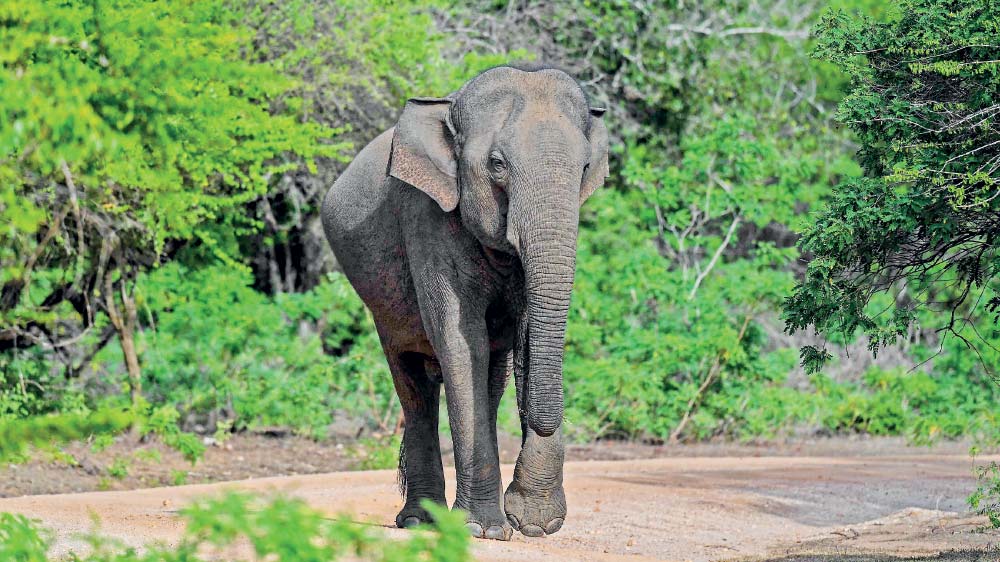
Sri Lanka possesses one of the world's greatest opportunities to secure the future of the endangered Sri Lankan elephant (Elephas maximus maximus). Achieving this will require visionary leadership, science-based conservation and a Presidential Initiative to transform human-elephant coexistence into a national priority.
 Before the first rays of sunlight illuminate Sri Lanka's ancient reservoirs, another civilisation is already awake.
Across Sri Lanka's dry zone forests, elephant herds move silently through the morning mist, pausing only briefly before disappearing into a mosaic of scrub forest, abandoned chena and grassland. As birdsong gathers with the dawn, the landscape comes alive in a rhythm that has changed little since long before the first kingdoms rose at Anuradhapura.
For more than two millennia, elephants have shared this island with its people. They walked beside the architects of Sri Lanka's hydraulic civilisation, whose vast irrigation systems transformed a dry landscape into one of the ancient world's greatest agricultural societies. They became symbols of kingship and statecraft, guardians of sacred processions and enduring icons of Buddhist compassion towards all living beings. Few countries possess such a deep historical, cultural and spiritual relationship with a wild animal.
Sri Lanka's ancient hydraulic civilisation was founded on an intricate network of reservoirs, canals and forested catchments that sustained both people and wildlife. The forests surrounding these irrigation systems protected water supplies, while elephants continued to move through extensive dry-zone landscapes with relatively little conflict.
This enduring relationship reminds us that coexistence is not a modern aspiration but a principle deeply embedded in the island's environmental history.
The challenge before us is not to invent a new relationship with elephants, but to reimagine an ancient one for the twenty-first century.
Yet today this remarkable relationship stands at a crossroads.
Across Sri Lanka, Human-Elephant Conflict (HEC) has become one of the nation's most complex environmental and development challenges. Every year, rural families suffer crop losses, damaged property and tragic fatalities. Hundreds of elephants are killed through gunfire, electrocution, explosive bait and other human-induced causes. Despite decades of investment, conflict continues to escalate in many parts of the country, imposing immense social, ecological and economic costs.
These realities are often portrayed as an unavoidable confrontation between people and wildlife. They are not.
They are the consequence of how landscapes have been planned, managed and shared.
As the world marks World Elephant Day on 12 August, Sri Lanka has an opportunity to ask a far more important question than how to reduce annual conflict statistics.
Can this island become the world's leading example of long-term human-elephant coexistence?
Increasingly, science suggests that the answer may be yes.
The urgency could scarcely be greater. Sri Lanka supports one of the highest densities of wild Asian elephants anywhere in the world, yet an estimated 70% of these animals live outside formally protected areas, sharing landscapes with rural communities. In 2023, the country recorded 488 elephant deaths and 154 human fatalities arising from Human-Elephant Conflict, one of the highest annual tolls recorded anywhere in the world. These figures illustrate not only the scale of the challenge, but also the urgency of replacing reactive conflict management with long-term coexistence.
Beyond conflict: Understanding the real challenge
Public debate frequently frames Human-Elephant Conflict as a contest between farmers and elephants.
The evidence tells a different story.
Research over the past two decades has demonstrated that approximately 70% of Sri Lanka's wild elephants live outside formally protected areas. Rather than inhabiting remote forests alone, they occupy a complex mosaic of secondary forests, scrublands, traditional chena cultivation, village commons and agricultural landscapes.
This is not an ecological anomaly.
It is the natural ecology of the Sri Lankan elephant.
Unlike many mainland populations that depend heavily on extensive forests, Sri Lankan elephants thrive in dynamic landscapes where seasonal disturbance encourages the growth of grasses, shrubs and young vegetation. For centuries, traditional farming systems inadvertently created habitats that elephants utilised outside cultivation seasons.
The challenge emerged as land use changed.
Large-scale irrigation schemes, permanent settlements, expanding agriculture, highways and other infrastructure gradually fragmented traditional elephant ranges. Landscapes that once accommodated seasonal movement became increasingly divided, bringing elephants and people into direct competition for space and resources.
Seen from this perspective, Human-Elephant Conflict is not primarily a wildlife problem.
It is a landscape planning challenge.
Ultimately, the future of the Sri Lankan elephant will be determined not by the strength of our fences, but by the wisdom of our landscapes.
It is equally a governance challenge, requiring coordination between agencies responsible for wildlife, forests, agriculture, irrigation, transport, regional development and local government.
Above all, it is a sustainable development challenge.
No nation has succeeded by attempting to conserve elephants in isolation from broader land-use planning. Nor has any country eliminated conflict simply by building more fences or relocating animals.
The future depends upon designing landscapes where people and elephants can coexist safely.
That requires a fundamentally different way of thinking.
Sri Lanka's extraordinary opportunity
Paradoxically, the very factors that make Sri Lanka one of the world's most challenging places for elephant conservation may also make it one of the most promising.
Demography is central to this story.
While much of Asia continues to experience intense population pressure, Sri Lanka is entering a new demographic phase. Population growth has slowed significantly and is projected to stabilise before gradually declining later this century. Unlike many neighbouring countries, Sri Lanka is unlikely to experience continuing expansion of its overall human footprint.
This seemingly simple demographic trend has profound implications.
A stable population creates the possibility of establishing permanent coexistence landscapes without the relentless outward expansion of settlements into remaining elephant habitats.
By contrast, India, home to around 60% of the world's wild Asian elephants, faces the immense challenge of accommodating hundreds of millions of additional people before its population eventually stabilises. Expanding infrastructure, agriculture and urbanisation continue to place extraordinary pressure on wildlife corridors essential for maintaining genetically connected elephant populations.
Thailand presents almost the opposite scenario. Its ageing population and rural depopulation offer opportunities for ecological restoration, yet its comparatively small and fragmented elephant populations remain largely confined to isolated forest complexes.
Sri Lanka occupies a unique middle ground.
Its human population is stabilising.
Its elephants have already demonstrated exceptional adaptability to shared landscapes.
Its conservation challenge is therefore not whether coexistence is possible.
It is whether the nation possesses the vision to organise that coexistence scientifically.
A national vision for coexistence
The future of the Sri Lankan elephant will not be secured by protecting isolated pockets of wilderness. It will be secured by protecting living landscapes.
This represents perhaps the most important shift in conservation thinking of the twenty-first century.
For generations, conservation was largely based on a simple assumption: wildlife belongs inside protected areas, while people belong outside them.
Although national parks remain indispensable, experience throughout Asia has demonstrated that this approach alone cannot guarantee the survival of wide-ranging species such as elephants, whose ecological requirements extend far beyond the boundaries marked on official maps.
Sri Lanka illustrates this reality more clearly than almost any other country.
Scientific studies have consistently shown that around seventy percent of the island's wild elephants live outside the formal protected-area network. Far from being ecological refugees, they inhabit landscapes that have long combined forests, scrublands, village commons and traditional chena cultivation. These are not marginal habitats but functioning ecosystems that have sustained both people and elephants for centuries.
Recognising this reality changes the conservation question entirely.
Instead of asking how elephants can be confined within protected areas, the more important question becomes how shared landscapes can be managed so that people and elephants can coexist safely and productively.
That shift in perspective transforms conservation from a wildlife issue into a national development strategy.
From conflict management to landscape stewardship
For more than six decades, Sri Lanka's response to Human-Elephant Conflict has relied heavily upon reactive interventions, elephant drives, translocations, forest-boundary electric fencing and emergency responses after conflict has already occurred.
Although intended to protect both people and wildlife, experience has repeatedly demonstrated their limitations.
Elephants possess remarkable intelligence, extraordinary spatial memory and strong attachment to their traditional home ranges. Animals driven from familiar landscapes frequently attempt to return, sometimes travelling remarkable distances and creating new conflict elsewhere. Forest-boundary fences, meanwhile, often require extensive maintenance and are regularly breached as elephants seek food and water beyond protected areas.
The consequence is an expensive cycle of intervention that addresses symptoms more effectively than underlying causes.
Modern conservation science offers a different philosophy.
Rather than attempting to exclude elephants from human landscapes, it seeks to design landscapes that minimise conflict while accommodating the ecological needs of both species.
This approach draws upon landscape ecology, adaptive management and evidence-based conservation.
It recognises that successful coexistence depends upon ecological connectivity, informed land-use planning and meaningful participation by the communities who share space with elephants every day.
The objective is not the elimination of elephants from rural landscapes.
Nor is it the unrealistic expectation that conflict can disappear entirely.
The objective is coexistence: reducing risk while maintaining healthy elephant populations within functioning ecosystems.
Elephant managed ranges: Rethinking conservation
One of the most significant innovations emerging from Sri Lanka's own conservation experience is the concept of Elephant Managed Ranges (EMRs).
Unlike conventional protected areas, EMRs acknowledge that elephants naturally utilise landscapes outside national parks and wildlife reserves. They seek to manage these shared landscapes scientifically rather than attempting to exclude elephants from them.
Within an EMR, agriculture, forests and elephant habitat are viewed as interconnected components of a single landscape.
Traditional seasonal farming practices become part of the conservation solution. During cultivation, communities are protected through well-maintained village and crop fencing. After harvest, elephants utilise regenerating vegetation that naturally develops on cultivated land, reducing pressure elsewhere while maintaining ecological productivity. Properly planned, both people and elephants benefit from the same landscape at different times of the year.
Equally important is community ownership.
Experience has shown that fences maintained by local communities around villages and agricultural lands are often significantly more effective than long stretches of remote forest fencing maintained solely by government agencies. Local stewardship creates accountability, rapid maintenance and stronger public ownership of conservation outcomes.
This is not simply a technical adjustment.
It represents a philosophical transformation from protecting elephants from people to enabling people and elephants to share landscapes responsibly.
A Presidential initiative for human-elephant coexistence
Transforming elephant conservation requires leadership that extends beyond any single ministry or government department.
It requires a genuinely national mission.
Sri Lanka should therefore establish a Presidential Initiative for Human-Elephant Coexistence and National Elephant Conservation.
Its significance would extend well beyond wildlife conservation.
Like the Mahaweli Development Program transformed water management and agriculture during the twentieth century, this initiative could reshape how Sri Lanka manages landscapes during the twenty-first.
Operating under the leadership of the Presidential Secretariat, the initiative should bring together the Ministries responsible for Environment, Wildlife, Forest Conservation, Agriculture, Irrigation, Tourism, Finance, Rural Development and Digital Technology within a common strategic framework.
Universities, research institutions, conservation organisations and the private sector would contribute scientific expertise and innovation. Provincial Councils and Local Authorities would implement landscape-level programs suited to regional conditions. Farming communities, whose experience is indispensable, would become genuine partners rather than passive beneficiaries.
Most importantly, elephant conservation would become recognised as a national development priority rather than an isolated environmental concern.
Healthy elephant landscapes also protect watersheds, strengthen food security, support tourism, enhance biodiversity, improve climate resilience and contribute to sustainable rural economies.
The objectives are therefore broader than conserving an endangered species.
They are about securing the ecological foundations upon which national prosperity depends.
A National Elephant Conservation and Management Master Plan (2027–2057)
Visionary initiatives require equally visionary planning. Sri Lanka should therefore prepare a National Elephant Conservation and Management Master Plan (2027–2057), a thirty-year strategy that extends beyond electoral cycles.
It should also establish measurable national targets, subject to independent scientific review every five years, ensuring that management remains adaptive, evidence-based and accountable.
It should identify priority elephant landscapes, strengthen ecological corridors and formally integrate Elephant Managed Ranges into national land-use planning.
Habitat restoration should reconnect fragmented ecosystems, while climate adaptation measures should improve the resilience of forests, reservoirs and wildlife corridors against increasing droughts, floods and climatic variability.
Modern technologies, including GPS telemetry, satellite monitoring, artificial intelligence, remote sensing and predictive analytics, should become standard management tools.
Compensation mechanisms require comprehensive reform so that affected communities receive rapid, transparent and equitable assistance. Tourism should be better integrated into local economies, enabling communities living alongside elephants to benefit directly from conservation success.
The Master Plan should also promote biodiversity finance, carbon markets, education, scientific research, legislative reform and continuous monitoring to ensure policies evolve alongside new knowledge.
Above all, it must recognise one fundamental truth.
Elephant conservation cannot be planned one year at a time.
It must be planned one generation at a time.
Beyond World Elephant Day
Every World Elephant Day reminds us that elephants remain endangered.
But for Sri Lanka, the occasion should carry a far deeper meaning.
It should become the annual milestone by which the nation measures its progress towards building a future where conservation, development and human wellbeing advance together.
The science already exists.
The policy foundations have largely been established.
The conservation expertise is internationally respected.
The technology is available.
The economic case is increasingly compelling.
What remains is visionary leadership capable of transforming individual projects into a coherent national vision that extends beyond governments, political cycles and generations.
That is why the time has come to establish a Presidential Initiative for Human-Elephant Coexistence and National Elephant Conservation, supported by a National Elephant Conservation and Management Master Plan (2027–2057). Together, they can provide the continuity, scientific rigour and whole-of-government coordination needed to secure one of Sri Lanka's greatest natural inheritances.
When future generations look back on this period, they are unlikely to remember how many kilometres of fence were built or how many meetings were held. They will remember something far more important: whether we had the foresight to recognise that the future of the Sri Lankan elephant was inseparable from the future of Sri Lanka itself.
And when the first light of another century falls across Sri Lanka's ancient reservoirs, the silent footsteps of elephants at dawn will tell future generations that this was the moment a nation chose wisdom over complacency, coexistence over conflict, and a living legacy over irreversible loss.
(The author is a telecommunications engineer turned environmental and wildlife conservationist, citizen scientist and wildlife documentary filmmaker. He is an environmental policy researcher and writer whose work integrates science, public policy and sustainable development to advance wildlife conservation, climate resilience and landscape-scale environmental management, with particular emphasis on the long-term conservation of Sri Lanka's elephants and other threatened species).




