Saturday Oct 10, 2026
Saturday Oct 10, 2026
Wednesday, 22 April 2026 00:44 - - {{hitsCtrl.values.hits}}

 The financial fraud of a staggering amount of Rs. 13.2 billion at NDB Bank is without precedent in Sri Lanka. It has sent shock waves throughout the industry and among investors. The possibility of recovery of the stolen funds seems to be very uncertain at this point of time.
The NDB Board collectively have to take the ultimate responsibility for this serious financial fraud. They have been in receipt of lavish amounts paid to them as emoluments (2025 – Bank Rs. 99 million and Group Rs. 114 million). Their prime duty is to safeguard the funds of shareholders which they have failed to do. They owe a duty of care to the shareholders. The Companies Act provides that the standard of care, skill and diligence exercised by a director is that which may be expected of a person possessing knowledge and expertise as him or herself. Some of the directors may have to take individual responsibility taking into consideration the knowledge and expertise possessed by them and depending on the role played by them in the Committees of the Board.
Internal controls are bound to fail where there is collusion but this is no excuse. Did the Internal Audit Division which functions under the purview of the Audit Committee and External Auditors not perform an analytical review of the financial statements? If so did they not notice an increasing trend over the recent past in other financial assets (electronic fund transfer receivables) in the NDB Balance Sheet?
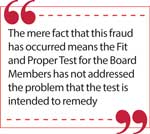
This large scale financial fraud has resulted in perhaps an entire years profit being wiped off. The mere fact that this fraud has occurred means the Fit and Proper Test for the Board Members has not addressed the problem that the test is intended to remedy. The Fit and Proper Test is a test which determines the suitability of a person to serve as a Board Member of a Financial Institution and indeed of any public listed entity. Competence is a key factor which is considered in the application of the Fit and Proper Test. The other factors are honesty and financial soundness. In fairness to the Central bank of Sri Lanka (CBSL) at the time of the appointment of each of the Board Members there is no way that the occurrence of such a financial fraud could have been foreseen by them. Commercial Banks are licenced by CBSL and so they fall within the regulatory ambit of the CBSL. Has there been a supervisory lapse on the part of the CBSL for this fraud to have gone undetected?
The Colombo Stock Exchange (CSE) in 2023 has made provision in Section 9 of the CSE listing rules to deal with matters of corporate governance. The Institute of Chartered Accountants of Sri Lanka published a revised version of the Corporate Governance Code in that same year. The Banking Act Directions No.5 of 2024 also provide for matters of corporate governance. According to the NDB Annual Report 2025 the NDB Board Members seem to have gone to great lengths to do all the right things on matters of corporate governance. They have not left a stone unturned. That said, what has happened in practice is quite a different story involving a serious financial fraud.
The way forward seems to be as follows: 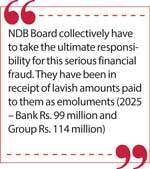
It is interesting to know who blew the lid off and brought this fraud to light.
(The author served as the Deputy General Manager of the Colombo Stock Exchange from 1992 to 2001. He later served as an Expert on Capital Market Regulation and performed several assignments internationally. These assignments were funded variously by the Commonwealth Fund for Technical Cooperation, the FIRST Initiative, the World Bank and National Governments)




