Tuesday Jul 07, 2026
Tuesday Jul 07, 2026
Tuesday, 7 July 2026 00:00 - - {{hitsCtrl.values.hits}}
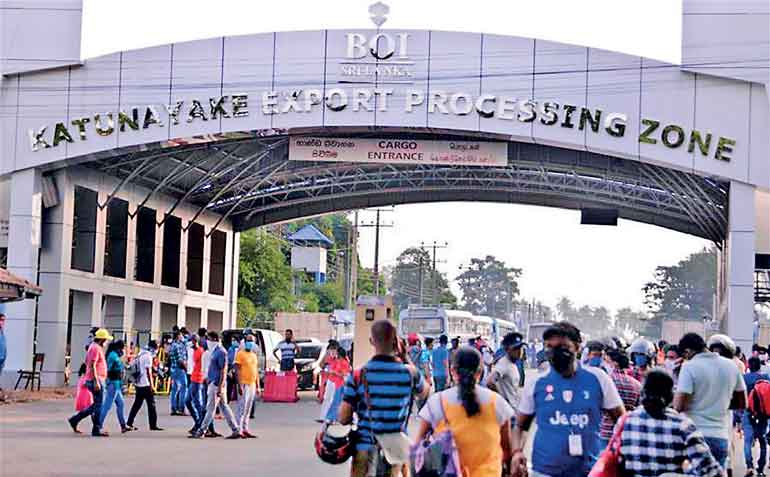
 Inside Sri Lanka’s free trade zones today sit hundreds of export enterprises with everything a trading nation could ask for. Their premises are bonded and under the watch of Sri Lanka Customs. Their raw materials enter duty-free. Their every import and export moves through ASYCUDA, the digital customs system that records each item in real time. Many of them have operated cleanly for thirty and forty years, audited, inspected, and compliant.
And yet re-exports account for less than two per cent of Sri Lanka’s merchandise exports. Singapore earns around fifty eight percent of its exports this way. Hong Kong is close to ninety eight percent. Vietnam built an entire export economy on the same freedom. The gap between us is not geography. We sit beside one of the busiest sea lanes on earth. It is not ports, not workforce, not industrial capability. On all of these, we compete well.
The gap is permission. Our firms are simply not allowed to do what firms in Singapore, Dubai, and Vietnam do every day.
Rules written for a different world
To understand why, we have to go back to the late 1970s, when our zone framework was created. In that world, a free trade zone was a fenced factory floor. A firm came in, set up machines, made one product, and shipped it out. The rules said, in effect, manufacture what you were approved to manufacture and nothing else. For its time, that was sensible policy, and it served the country well.
But world trade has changed beyond recognition. Global commerce today runs on supply networks, not single factories. Goods cross borders many times before they reach a consumer. They are sorted, graded, kitted, bundled, combined with other components, repacked, and moved on, often within days or hours. The countries that prosper are the ones whose firms are free to plug into these networks at any point.
Our zone enterprises watch this traffic pass through Sri Lanka every day. They can see it. They are asked to join it. Their agreements do not let them.
In 2018, the year of the decree, Vietnam exported goods worth about $ 243 billion. By 2025, the figure was $475 billion. The country’s exports doubled in the seven years after a single decree was signed. And more than three out of every four of those export dollars are earned by the very category of firms the decree set free. The firms did not change. The workers did not change. The geography did not change. The permission changed
What our members cannot say individually, I will say for them
As President of the Free Trade Zone Manufacturers Association, I hear a version of the same story from members across every zone, in every sector. A long-standing international customer asks a Sri Lankan supplier to receive components from a third country, combine them with local production, and ship a consolidated consignment onward. Or to hold and manage regional stock. Or to kit and bundle products for a global launch. These are routine requests in modern trade, and they come to our firms because our firms have earned the customer’s trust over decades.
And our firms must decline. Not because they lack the space, the systems, or the skill, but because the activity falls outside what their agreements permit. The customer does not argue. The customer simply routes the business to Vietnam, Dubai, or Malaysia, and often the manufacturing relationship weakens soon after, because in global supply networks, the partner who can do more is the partner who is kept.
Every one of those declined requests is foreign exchange Sri Lanka chose not to earn. No one records these losses in any statistic. They are invisible. But they happen quietly, month after month, year after year.
The countries that opened the gate
Every economy that has built a meaningful re-export and trading sector has done it the same way: by permitting firms to operate where they already stand, rather than forcing all trade through a handful of central warehouses. Singapore did it in the 1960s. Dubai did it in 1985. Mauritius, an island one eighteenth our size in our own ocean, did it in 1992 and moved $842 million through its Freeport network in 2024.
But the example that should command our closest attention is Vietnam, because Vietnam’s story is our story with a different ending.
In 1991, Vietnam created its export processing enterprises and locked them into manufacturing only, exactly the restriction our Section 17 firms live under today. For twenty-seven years, those firms could make and ship, and nothing more. Then in May 2018, the Government issued a single decree permitting those same enterprises to conduct purchase, sale, and trading activities from their existing premises, with separate accounting books as a safeguard. No new buildings. No new agency. One regulatory decision.
The results are now beyond debate. In 2018, the year of the decree, Vietnam exported goods worth about $ 243 billion. By 2025, the figure was $475 billion. The country’s exports doubled in the seven years after a single decree was signed. And more than three out of every four of those export dollars are earned by the very category of firms the decree set free. The firms did not change. The workers did not change. The geography did not change. The permission changed.
The decree was not the only reason for that surge. Global supply chains were shifting, and investment was looking for a home. But that is precisely the point: when opportunity came looking, Vietnam’s firms were legally able to receive it. The decree is the reason those flows could land inside Vietnamese enterprises instead of passing them by. Opportunity is knocking on our region’s door again today. The only question is whether our firms will be permitted to open it.
Re-exports account for less than two per cent of Sri Lanka’s merchandise exports. Singapore earns around fifty eight percent of its exports this way. Hong Kong is close to ninety eight percent. Vietnam built an entire export economy on the same freedom. The gap between us is not geography. We sit beside one of the busiest sea lanes on earth. It is not ports, not workforce, not industrial capability. On all of these, we compete well. The gap is permission. Our firms are simply not allowed to do what firms in Singapore, Dubai, and Vietnam do every day
Have we not tried this already?
Some will say Sri Lanka already permits re-export, and in a narrow sense, that is true. For about two decades, a small number of centrally licensed bonded warehouses have been allowed to conduct it. Those operators have done their work competently, and they proved something valuable: that bonded re-export can run safely under Sri Lankan law and customs control.
But after twenty years, the result is still less than two per cent of our exports. That is not a failure of the operators. It is the nature of the model. Re-export at scale is a velocity business, with thousands of separate, firm-specific, time-critical flows arriving, being worked on, and leaving within days or hours. A few central points can never carry that volume of distinct flows. They become a toll booth when what the country needs is an ecosystem. No country has built a real re-export economy through a handful of central warehouses. Not Singapore, not Dubai, not Vietnam, not Mauritius. Every one of them permitted the firms themselves, where they stand.
And there is a deeper cost. When trading runs only through a central warehouse, the learning stays in the warehouse. The manufacturing firm never handles the customer’s global flows, never builds the systems, never earns the trust that leads to assembly work and, eventually, to advanced products. The centralised model does not just limit volume. It switches off the ladder.
What the opportunity looks like for Sri Lanka
For Sri Lanka, the equivalent step is modest and contained. Permit the Section 17 enterprises operating inside our customs-bonded free trade zones to engage in re-export, kitting, bundling, and value-added trade from their existing premises, alongside their existing manufacturing.
Notice what this does not require. No state capital. No new agency. No new buildings. No new legislation. No Treasury allocation. The zones exist. The bonded premises exist, paid for by the private sector over four decades. The digital customs controls exist. The audit machinery exists. Everything is built. The only missing element is the line of permission.
Taiwan in 1965 was assembling plastic flowers and umbrellas inside its export zones. Today it makes the most advanced semiconductors on earth. Vietnam in 1991 was stitching garments. Today it assembles smartphones and chipsets. In both countries, the legal framework stayed essentially the same. What changed was the rung the firms climbed to, once they were free to climb
The fears do not survive contact with the facts
Whenever wider trading rights are discussed, the same worry surfaces: goods leaking into the local market. Inside a customs-bonded zone, that worry has the least force it could have. Every item entering a zone already comes in duty-free, so there is no duty advantage to abuse. Every movement in and out is already recorded on ASYCUDA. The premises are already subject to customs inspection and BOI audit. Opening new activities inside this fence adds not one loophole, because the fence itself does not change. Existing licensed bonded warehouse operators lose nothing either. In every economy that has walked this road, both models operate side by side, and the total trade grows for everyone.
Foreign exchange, the country does not have to spend a rupee to earn
There is a measure in our investment framework called the Net Foreign Currency Contribution, the foreign exchange a firm brings in after deducting what it spends abroad. It is the truest test of what an export activity actually gives the nation.
Re-export and value-added trade from the zones would be almost a pure new contribution. The premises are paid for. The systems are running. The people are employed. Every trading dollar earned through this facility is foreign exchange added on top of existing manufacturing exports, at no cost to the state. With the country’s external obligations rising in the years ahead, Sri Lanka needs new inflow channels that can open in months rather than decades. This is one of the very few that can.
There is a further effect worth naming. The moment this permission exists, our zones become attractive to an entirely new class of investor: trading and logistics-driven businesses, local and foreign, that today choose Dubai or our region’s other hubs because Sri Lanka’s zones have nothing to offer them. New enterprises mean new zone occupancy, new employment, new BOI revenue, and new foreign exchange from businesses that do not exist in Sri Lanka today. The facility not only grows our existing exporters. It grows the population of exporters.
For Sri Lanka, the equivalent step is modest and contained. Permit the Section 17 enterprises operating inside our customs-bonded free trade zones to engage in re-export, kitting, bundling, and value-added trade from their existing premises, alongside their existing manufacturing. Notice what this does not require. No state capital. No new agency. No new buildings. No new legislation. No Treasury allocation. The zones exist. The bonded premises exist, paid for by the private sector over four decades. The digital customs controls exist. The audit machinery exists. Everything is built. The only missing element is the line of permission
The door to the industries we say we want
It would be a mistake to see this as being merely about trading margins. Re-export is the entry rung of a well-documented ladder. Firms that begin by kitting and bundling learn their customers’ global rhythms, their quality systems, and their speed. Then they begin light assembly. Then sub-assembly. Then full assembly, and in time, design and product ownership.
Taiwan in 1965 was assembling plastic flowers and umbrellas inside its export zones. Today it makes the most advanced semiconductors on earth. Vietnam in 1991 was stitching garments. Today it assembles smartphones and chipsets. In both countries, the legal framework stayed essentially the same. What changed was the rung the firms climbed to, once they were free to climb.
No country has jumped directly to a sophisticated industry. Every one of them walked through this door. Sri Lanka keeps declaring its ambition to move up the value chain. Here is the staircase, already built, already paid for, waiting inside our own zones.
Ready when the decision comes
Our zones are ready. Our firms are ready. Customs systems are ready. The international customers are not hypothetical; they are the same companies our members have served faithfully for decades, asking to give us more business, not less.
Once the permission is granted, results will come quickly. The first re-export consignments can leave our zones within weeks. The first new foreign exchange can be shown in the national accounts within a few months. Very few options before any Government can deliver new dollars this fast, without spending a single rupee, and with so many successful countries already showing the way.
Vietnam waited twenty-seven years after starting its export processing zones to realise the cost of the restriction and allowed re-export to its firms in 2018. We have waited forty-eight long years. How long more should we wait?
(The writer is the Chairman of the Free Trade Zone Manufacturers Association of Sri Lanka, which represents export manufacturing enterprises operating under the Board of Investment of Sri Lanka. He is also a Board Member of the Industrial Development Authority (WP) and a Council Member of the National Institute of Occupational Safety and Health. An engineer and human resource expert by profession, he is a Fellow of CIPM Sri Lanka and holds a master’s degree in human resource management. He is currently a Vice President of the Organisation of Professional Associations of Sri Lanka (OPA) and Chairman of its Standing Committee on Construction and Other Industries.)



