Wednesday Sep 09, 2026
Wednesday Sep 09, 2026
Saturday, 6 June 2026 01:43 - - {{hitsCtrl.values.hits}}
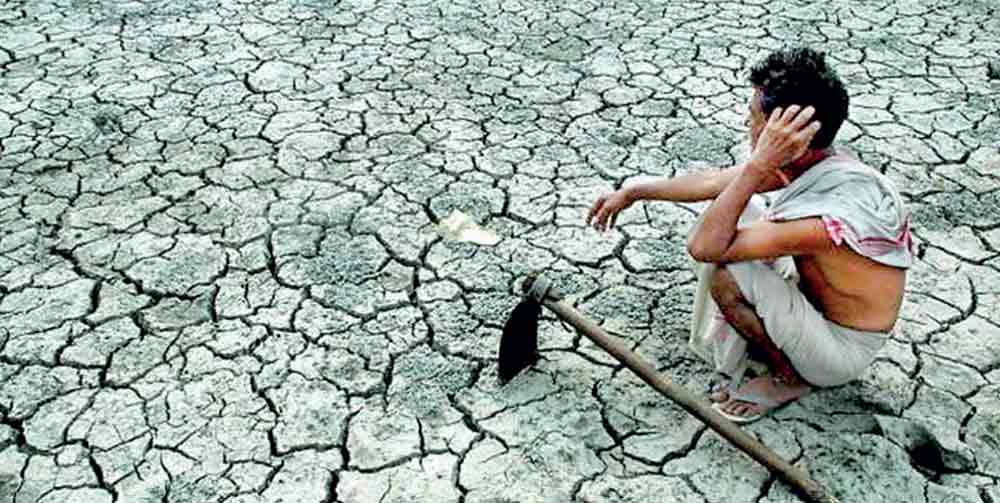
 An El Niño is now all but certain for the year ahead. We cannot argue the weather out of arriving — but we can decide, in the ninety days before the Maha planting window shuts, whether it becomes a squeeze we manage or a crisis we have seen before and somehow keep repeating.
Some disasters announce themselves.
This one has sent a calling card months in advance, and my worry is that we will do with it what we so often do with advance notice — file it, nod gravely, and stir only once the reservoirs are already empty. The world’s big weather agencies do not often sing in unison. The Americans at NOAA, Columbia University’s forecasters and the Australian bureau are, on the 2026-27 El Niño, very nearly doing so. NOAA now puts the odds of the event peaking over our Maha season, roughly December to February, at about 96%. When forecasters who normally delight in hedging start agreeing at those levels, the sensible response is not to argue with them. It is to count the days.
And the days are not falling on firm ground. We are still sweeping up after Cyclone Ditwah, a storm the World Bank put at around $ 4.1 billion — close to 4% of everything the economy makes in a year — which drowned an estimated 106,000 hectares of paddy, near enough a fifth of this season’s planting, before the season had properly begun. Our reserves have slipped back below $ 7 billion. The rupee has softened. Inflation, which was actually below zero this time last year, has turned and is climbing again. And the IMF money that has been quietly holding the recovery together — the latest instalment is some $ 700 million — rests on conditions that a drought makes harder to keep, not easier. We are being asked to take a punch we can see coming, with our guard already low.
Two bills, arriving together
El Niño does not reach us as an abstraction. It reaches us as two bills, arriving together. The first is rice. A feeble south-west monsoon parches the Yala crop and pulls down the tank cascade that waters the fields. The second is electricity. In an ordinary year hydropower gives us close to 37% of our generation; when the water drops, the gap is plugged with imported diesel, coal and gas at six to eight times the cost of running water through a turbine — and we settle the difference in the very dollars we can least afford to spend. The unkindness is that the two arrive hand in hand. Less rain means dearer rice and dearer power in the same month, and it is the household that pays both: at the rice counter, and in the hours the fan stops turning on a thirty-five-degree night.
 The part that decides which crisis we get is not the weather. It is us
We do not have to imagine any of this. We have lived it. In 2016 and 2017 the worst drought in forty years took our major reservoirs down to about 28%, halved the paddy harvest, sent us abroad for 700,000 tonnes of rice, and reached into the lives of 2.2 million people. Go back to the super El Niño of 1997-98 and you find up to eight hours a day of load-shedding and a national blackout that ran for four days. The milder event of 2023, by contrast, we absorbed without much drama. Somewhere between those memories is where 2026-27 will land — and the part that decides which one we get is not the weather.
What we don’t know — and why it still argues for acting
Let me be plain about what we cannot yet see, because anyone who tells you they have the severity pinned down is selling something. The agencies are confident an El Niño is coming; they are not yet confident how fierce it will be, and no single strength bracket is better than a one-in-three bet today.
There is a second card still face-down — the Indian Ocean Dipole, a separate quirk of the sea that, in its positive phase, can actually hand back some of our Maha rain even as El Niño steals the Yala. The models lean towards that kindness by September. They do not promise it. Which is exactly the case for the cheap, fast preparations that earn their keep whether the season turns out merciful or mean. You do not wait until you can read the whole forecast to fill the tank; you fill it while filling is still cheap.
What to do with ninety days
The good news, and there is some, is that the response asks for neither genius nor a fortune.
A pre-emptive package of perhaps $ 226-345 million — two or three tenths of 1% of GDP — could, on reasonable workings, save several times that in a bad year. The whole trick is to spend it before prices spike and before fields are left bare. Order matters, so let me put it in order.
Start with seed. If there is one rupee in this entire exercise that works hardest, it is the one spent closing the seed-paddy gap before the October planting — because what stands between a farmer and a crop is often not money but the plain physical absence of seed for land that could still be sown. Get drought-tolerant varieties out through the Agrarian Service Centres now, while there is still a season to save. Alongside that, sign the rice and fertiliser deals early — with India and Pakistan, at today’s prices rather than next year’s frightened ones. And let the fertiliser actually arrive, in full. The 2021 adventure of going without is not an experiment any of us should care to run twice.
Then fill the tanks before the taps run dry. The Norochcholai coal stockpile and the fuel stores ought to be at capacity before September, and the Ceylon Petroleum Corporation should carry a clear, Cabinet-blessed mandate to hedge a slice of its expected fuel bill. Hedging is not a flutter on the markets; it is the decision not to gamble — which is exactly what leaving the bill unhedged amounts to. And publish the water plan. Some of the ugliest scenes of past droughts — farmer against power station, district against district — were made worse by a suspicion that water was being shared out in back rooms. A drawdown and irrigation plan laid openly on the table would take the heat out of those quarrels before they catch.
Finally, protect the people who feel it first, and do it narrowly. Targeted top-ups through Aswesuma to the poorest households cost a fraction of blanket subsidies and keep us on the right side of the IMF at the same time. Hold the line on cost-recovery tariffs, unpopular as that is, because the alternative is a hidden hole that someone fills later, with interest added. And open the contingency credit lines with the World Bank and the ADB now, while the sky is clear; they are always cheaper to arrange before the emergency than in the thick of it.
A little now, or a great deal later
The sum is not hard. Spend a little, early, and most of this is manageable. Spend nothing, gamble on a kind season, and a severe El Niño could take one to two points off growth, push inflation back into double figures, lean on the rupee again, and stall the IMF review at the worst imaginable moment. We have spent three brutal years rebuilding our credibility one painful reform at a time. To hand a piece of it back to a shock the forecasters flagged months ago would not be bad luck. It would be a choice.
I am not a climate scientist, and I hold no brief for alarm — the season may yet prove gentle. But preparation is not alarm; it is the ordinary work of a serious state, and it is cheap insurance against a risk we have been handed in writing. The technical steps are the easy part. The hard part is temperament: the discipline to spend before the crisis rather than after it, and the honesty to tell people the truth about trade-offs instead of promising relief the Treasury cannot pay for. The costliest error of recent years was precisely that sort of comforting over-promise. We need not make it again.
The weather is not ours to command. But whether this becomes a difficult season or another reckoning is, this once, largely ours to decide — if we use the warning while it is still only a warning. The ninety days are already running.
(The author is Founder and Chief Investment Officer of Impact Capital Asset Management Ltd., a Singapore-incorporated fund management company. He writes on macroeconomic and policy matters affecting Sri Lanka.)
Disclaimer. The views expressed are the writer’s own and personal, and do not constitute investment, financial, legal or policy advice, nor an offer or solicitation of any kind. They do not necessarily represent the views of Impact Capital Asset Management or its affiliates. Figures cited are drawn from public sources — including NOAA, the IRI at Columbia University, Australia’s Bureau of Meteorology, the IMF, the Central Bank of Sri Lanka, the World Bank and the FAO — believed reliable as at the time of writing but not independently warranted. Drafting was assisted by large language model tools under the writer’s direct supervision; all factual claims have been reviewed by the writer.




