Thursday Jul 09, 2026
Thursday Jul 09, 2026
Thursday, 9 July 2026 03:37 - - {{hitsCtrl.values.hits}}
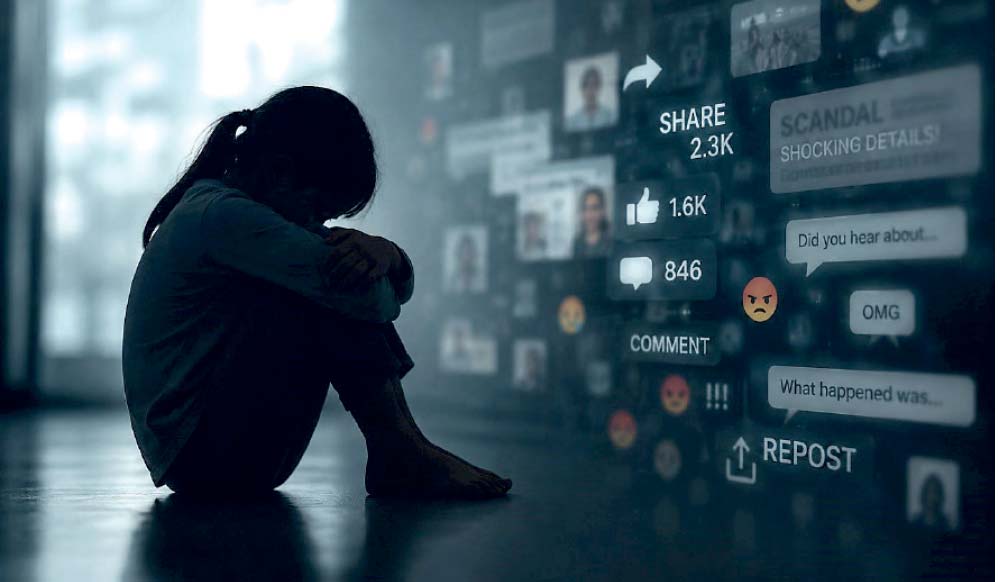
 The recent child abuse case that shocked Sri Lanka has generated intense discussion across television, newspapers, online news platforms, and social media. Public concern is understandable. When allegations involve powerful and respected individuals, society has a legitimate interest in demanding accountability and justice. The investigation, legal proceedings, and institutional responsibilities are matters of public importance. Yet amid the public outrage, media attention, and demands for accountability, one crucial question has received far less attention: what happens to the child after the headlines fade?
For the public, the incident may be a news story. For the child, it may become a lifelong identity imposed by the digital memory of others. From a communication and media studies perspective, the abuse itself may not be the only source of harm. The way society communicates about the abuse can create a second layer of suffering long after the original crime has ended.
The power of media frames
In his influential work Frame Analysis (1974), communication scholar Erving Goffman argued that people understand social events through interpretive “frames.” These frames influence what audiences notice, how they assign meaning, and how they evaluate an issue. Media do not simply tell us what happened; they also shape how we think about it.
This idea is highly relevant when discussing child abuse cases. Public communication can frame an issue around justice, child protection, and institutional accountability. Alternatively, it can focus on sensational details, rumors, speculation, and emotionally charged commentary. Unfortunately, social media discussions often move towards the latter.
When this happens, the victim risks becoming the central object of public curiosity rather than a child in need of protection and support. The issue is not whether society should discuss abuse. Public discussion is essential for accountability. The issue is whether those discussions are conducted in ways that protect the dignity and future of the victim.
The victim’s future
Public conversations about abuse often focus on the accused, the investigation, and the court process. People pay much less attention to the child’s future life.
In ten years, most people will have forgotten this case while discussing it on social media. The news cycle will have moved on. Yet the child at the center of today’s headlines may still be living with its consequences. She may return to school, pursue higher education, seek employment, and attempt to build personal and professional relationships. Recovery requires privacy, dignity, and the opportunity to move beyond a traumatic experience.
However, the permanent and searchable nature of digital communication can make this process significantly more difficult. Even if a victim’s name remains unpublished, the community can indirectly identify them through the repeated circulation of details, screenshots, comments, and local information. Friends, neighbors, classmates, and future acquaintances may connect the information to the survivor.
Consequently, the child may be compelled to bear the weight of public exposure long after the legal proceedings have concluded. While society focuses on punishment and accountability, the survivor may continue to face unwanted attention, stigma, and emotional distress. This situation is a reality that is often overlooked in public discussions. The child may endure the consequences of the adult debate for years to come.
Secondary victimisation in the digital age
Researchers use the term “secondary victimisation” to describe additional harm experienced by victims after the original abuse has occurred. This harm may result from social stigma, insensitive treatment, public exposure, or repeated retelling of traumatic experiences.
In the digital environment, secondary victimisation can occur when a survivor’s trauma becomes the subject of endless online discussion. Every repost, comment, and speculative discussion has the potential to reopen emotional wounds. The abuse may have ended, but the communication surrounding it continues.
Unlike traditional media, digital communication rarely disappears. People can share posts thousands of times, preserve screenshots indefinitely, and keep information searchable for years. The internet often remembers what society forgets. Consequently, the very technologies that enable public discussion may extend the impact of abuse.
Towards trauma-informed communication
The challenge facing contemporary society is not whether abuse should be reported. It should. The challenge is how such reporting can be conducted without causing additional harm to survivors. Public accountability remains essential in a democratic society. However, reporting and discussion must be guided by ethical responsibility.
Trauma-informed communication encourages journalists, content creators, and social media users to consider the long-term impact of their words. The goal is to inform the public while minimising harm to survivors. This means avoiding sensationalism, respecting privacy, and focusing attention on justice, prevention, and child protection rather than intimate details of a victim’s suffering.
The recent case serves as a reminder that while digital visibility can strengthen accountability, it also creates new responsibilities. Justice is not achieved merely by exposing wrongdoing. It is also achieved by protecting those who have already suffered.
For many victims, the crime is not the end of the story. Long after public attention fades, the digital traces of trauma may remain. The true measure of a society’s commitment to justice is not only how it punishes offenders, but also how it protects survivors and allows them to build a future beyond their suffering.
(The author, MSSC (Communication), University of Kelaniya; BA (Hons) Mass Communication, University of Sri Jayewardenepura, is a Lecturer in Communication, Department of Humanities, Rajarata University of Sri Lanka)



