Monday Sep 28, 2026
Monday Sep 28, 2026
Monday, 3 August 2026 00:20 - - {{hitsCtrl.values.hits}}
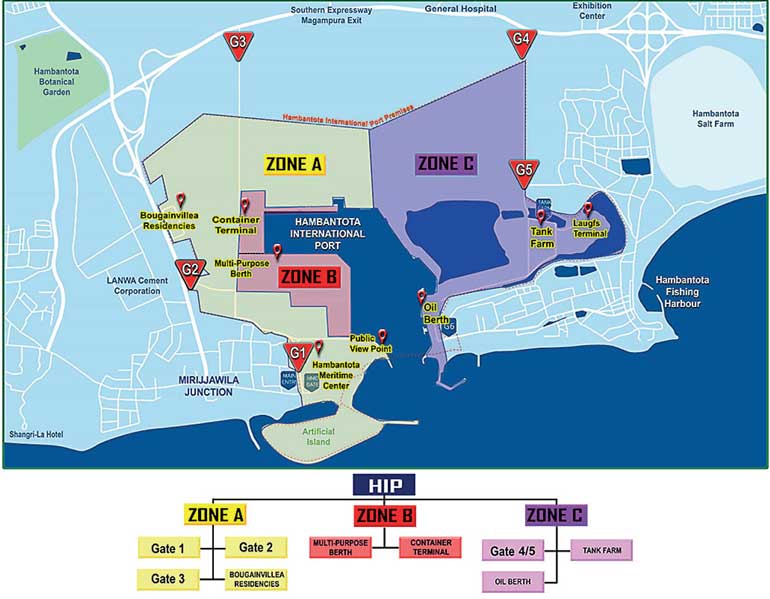
 Airports, ports, logistics zones, and industrial clusters should no longer be viewed as isolated projects. Instead, they should be developed as interconnected components of a wider regional connectivity network capable of generating long-term economic value. The future of Hambantota Port represents one of Sri Lanka's most important opportunities to transform strategic infrastructure into a commercially successful regional hub.
Strategic infrastructure requires a long-term vision
When Mattala Rajapaksa International Airport (MRIA) was inaugurated, many questioned the decision to construct an international airport in Sri Lanka's deep south. Critics focused heavily on its initial passenger numbers and described it as an underperforming investment, it was mocked internationally as "the world's emptiest airport." However, strategic infrastructure should not be judged solely by its first few years of operation. Major infrastructure projects are designed to support changing economic patterns, trade routes, aviation networks, and geopolitical realities over decades.
Mattala Rajapaksa International Airport was developed with a 2% concessional loan from the Export-Import Bank of China under the Belt and Road Initiative's regional connectivity vision.
During the time, China’s objective was to establish a new aviation corridor connecting East Asia and the Indian Ocean through Kunming, Yunnan, westwards. The broader vision was to create an alternative connectivity route that could complement traditional aviation hubs such as Singapore and Malaysia while strengthening Sri Lanka's position as a regional gateway.
The Kunming Airport, with around 150 terminal gates, was developed around the same period as Mattala Airport and has now become a major aviation hub. It has successfully diverted a portion of transit traffic traditionally passing through Singapore, Malaysia, and Thailand towards Chinese aviation hubs such as Shanghai, Kunming, and Chengdu.
Today, many Sri Lankans returning home from Japan, South Korea, and Australia who used to transit through Singapore, Malaysia, and Thailand now transit via Chinese airports. At the same time, China's annual outbound travel market around 150 million passengers continues to support strong regional aviation demand and keeps these routes active.
Even though the MIRA was not yet able to venture into Kunming air traffic, the long-term potential of this vision is gradually emerging. In 2025, Mattala handled more than 150,000 passengers and over 700 international flights. In 2026, the airport attracted 19 Expressions of Interest (EOIs) from potential investors, demonstrating increasing commercial confidence in its future.
The experience of Mattala highlights an important lesson, strategic infrastructure should be measured by its future potential, not only by its initial performance. The same principle should now guide the next phase of Hambantota Port.
Hambantota Port: Winning the container competition together
As regional shipping patterns are changing rapidly, supply chains are becoming more diversified, manufacturing networks are expanding, and competition among Indian Ocean ports is intensifying.
The momentum is already visible in the numbers. China Merchants Port Group (CMPort), the Chinese company which operates the Hambantota port, handled 78.3 million TEUs across its global portfolio in the first half of 2026, a 4.5% YoY increase, with terminals in Greater China driving most of the growth at 5.5%, while overseas operations expanded by a more modest 1.6%.
Today, CMPort has investments in and operates 51 ports across 26 countries and regions, making it one of the world's largest global port operators. Within that international portfolio, Hambantota Port emerged as the standout performer. Container throughput surged 81.1% YoY to 326,000 TEUs, the fastest growth rate among CMPort's overseas terminals, while several other international facilities, including Colombo International Container Terminals (CICT) recorded declines over the same period. That is a significant indicator of Hambantota's potential. Yet it also reinforces the case for the proposed Eastern Expansion. Despite its rapid growth, Hambantota's throughput remains only a fraction of Colombo's, underscoring the need for additional capacity to sustain its long-term development.
To succeed, Hambantota Port must evolve beyond a traditional transshipment facility. It should develop into an integrated logistics platform offering container operations, bonded warehousing, domestic cargo handling, customs clearance, and value-added services. In this strategy, both Sri Lanka and China should share the same objective: strengthening Sri Lankan ports' competitiveness against other regional players.
There is already a precedent for this kind of partnership paying off. In the early 2010s, as shipping lines began moving toward ultra-large container vessels, SLPA struck a Build-Operate-Transfer agreement with China Merchants Port for the CICT an 85/15 joint venture that funded the cranes and 18-metre draft needed to berth the newest generation of mega-ships. When CICT opened in 2013, it became the only Deepwater terminal in South Asia capable of handling vessels of that size, at a time when India's own ports were, and largely still are, too shallow to do so. That single capability advantage is a major reason Colombo has spent the last decade-plus capturing transshipment business that would otherwise have gone to Singapore, Malaysia, or Dubai cargo bound for the Indian subcontinent that gets transferred onto feeder vessels at Colombo rather than passing Sri Lanka by. The CICT model shows that a well-structured SLPA–Chinese joint venture, with Sri Lanka retaining a stake and oversight, can convert a purely commercial infrastructure gap into a durable regional advantage. Hambantota's Eastern Expansion is an opportunity to replicate that outcome this time with SLPA and international investors.
The recent agreements involving MSC and number of regional ports, demonstrate the importance of attracting global shipping leaders to Sri Lanka. Having a major international shipping company such as MSC operate a dedicated terminal presence here creates significant strategic value. Similar opportunities could be considered for future Hambantota Port's Eastern Expansion or the future development of Colombo Port's North Port expansion.
For China, enabling Hambantota to handle domestic container cargo and customs operations would allow the port to function as a complete logistics hub rather than simply a transshipment facility.
Greater operational flexibility could attract additional cargo flows where commercially viable while, over time, creating a complementary relationship between Hambantota and Colombo within a balanced national port strategy. For example, China's east coast alone hosts more than eight of the world's busiest ports, supporting the world's second-largest economy. As India moves toward becoming the world's third-largest economy, the same logic raises an obvious question: how many ports will it need to serve its own consumers?
The Sri Lanka Ports Authority should therefore begin discussions on Hambantota's Eastern Expansion while continuing Colombo's North Port development. Both Sri Lanka and China share an interest in ensuring regional shipping activity remains anchored in Sri Lankan ports rather than shifting elsewhere.
A new opportunity for Hambantota's eastern expansion
The Hambantota Port agreement has been one of the most politically debated infrastructure decisions in Sri Lanka's history. The project faced sustained domestic criticism, and internationally it became a central exhibit in broader debates over China's overseas infrastructure financing.
The next stage of Hambantota's development is an opportunity to build a new model, one grounded in commercial openness, transparency, and shared benefit.
Hambantota Port's Eastern Expansion, the undeveloped eastern side of the port should be returned to Sri Lankan control and opened for international competitive investment through transparent tenders under the Sri Lanka Ports
Authority (SLPA).
For Sri Lanka, regaining control over part of the port would be a meaningful political and economic achievement, demonstrating that the country retains ownership of its strategic assets even as it courts global investment. For China, this is the more counterintuitive and more important point, backing a more commercially open Hambantota model would actually strengthen, not weaken, Beijing's long-term position in the Indian Ocean.
A Hambantota that operates transparently under Sri Lankan ownership, with Chinese firms competing and winning contracts on commercial terms, defuses the "debt-trap" narrative that has dogged Belt and Road projects globally and given India, the United States, and Japan a ready-made argument against Chinese infrastructure investment across the region. Every additional example of BRI maturing into a market-driven partnership, rather than a bilateral lease seen as encroaching on a partner's sovereignty makes it easier, not harder, for China to expand its economic footprint in the next country and the one after that. For international investors, opening the Eastern Expansion would create new opportunities in logistics, manufacturing, warehousing, and maritime services and a commercially competitive Hambantota would strengthen Sri Lanka's claim to being the Indian Ocean's logistics hub while reducing the political controversy that has followed the project since 2017.
Why the Hambantota Port still draws skepticism
None of this optimism is universally shared, and a balanced case for Hambantota's future has to reckon with why the port remains one of the most scrutinised infrastructure assets in the world. The debt-trap framing, even if contested, shaped the deal's politics. The 99-year lease signed in 2017, after Sri Lanka struggled to service the loans that built the port, became, fairly or not the textbook global example cited for "debt-trap diplomacy," with critics such as strategist Brahma Chellaney arguing that Chinese loans are often collateralised against strategically valuable assets Beijing knows recipient states may struggle to repay. Academic reassessments, including work published by Chatham House and the Georgetown Journal of International Affairs, have pushed back hard on that narrative, noting the port project was proposed by Sri Lanka itself, that the lease was a commercial concession rather than a debt-for-equity swap, and that Chinese debt made up a modest share of Sri Lanka's total external debt at the time. But the perception has proven far stickier than the underlying facts, and any renegotiation of the Eastern Expansion will be read internationally through that same lens, whatever the economic merits.
India and other regional powers view expanded Chinese port access as a security question, not just a commercial one. New Delhi has repeatedly raised concerns about the port's potential dual-use function, most visibly around the 2022 and subsequent port calls by Chinese research and tracking vessels such as Yuan Wang 5, which India feared could be used to monitor missile tests and naval movement nearby.
Sri Lanka's own safeguards, port security overseen by a committee including the Sri Lankan navy, with Chinese naval vessels barred from operational use of the port have not fully quieted these concerns, and any move to deepen Chinese commercial control over the Eastern Expansion will likely be scrutinised in New Delhi, Washington, and Tokyo as part of the broader contest for Indian Ocean influence, not evaluated purely on logistics grounds.
Economic viability skepticism has not disappeared, even as traffic improves. Hambantota's container throughput and Mattala's passenger numbers are recovering, but both projects spent years as case studies in underused "white elephant" infrastructure, and critics link that underperformance to the financial mismanagement associated with the Rajapaksa-era projects that preceded Sri Lanka's 2022 economic crisis. Proponents of the current proposal need to show that 19 EOIs and improving passenger and container figures reflect a durable commercial turnaround rather than a cyclical uptick, particularly given how expensive it would be, politically and financially, to make the same long-horizon bet twice.
Rather than deepening cooperation with China on the Eastern Expansion, some Sri Lankan and Indian analysts argue the country's post-crisis priority should be diversifying away from reliance on any single external partner, pointing to India's own recent investments (the Trincomalee oil tank farms, the Colombo West Container Terminal with Adani, and the Colombo Dockyard) as evidence that Sri Lanka already has leverage to play investors off one another, rather than negotiating a new phase of an already politically costly relationship.
Rather than weakening the proposal, these concerns reinforce the case for an internationally competitive and transparent tender under SLPA ownership. Such an approach directly addresses sovereignty concerns while preserving Hambantota's commercial potential.
The Indian Ocean will remain central to both global trade and strategic competition. Different stakeholders will naturally view Hambantota through different strategic lenses, but Sri Lanka's objective should remain clear, maximising the economic value of its location while ensuring the next phase of development is commercially transparent, nationally owned, and responsive to legitimate sovereignty and security concerns. Such an approach serves Sri Lanka's interests while also demonstrating that Belt and Road projects can evolve through partnership rather than political controversy.
The race for future shipping demand
If Sri Lanka fails to expand Hambantota's logistics capabilities, the next wave of regional shipping demand may be captured by competing ports, particularly along India's rapidly developing coastline, the Middle East, or Singapore.
That competition is no longer hypothetical. India's Vizhinjam International Seaport in Kerala, built specifically to end India's dependence on foreign transshipment hubs, handled 1.57 million TEUs and 740 vessel calls in roughly its first year of operation, reaching the 83rd busiest container port globally by early 2026. In January alone it posted a record monthly throughput of 123,092 TEUs and a Gross Crane Rate of over 30 container moves per hour, an automation benchmark that puts it in the same league as the world's most efficient terminals. Vizhinjam's operator, Adani Ports, announced a further ₹16,000-crore expansion in January 2026 to lift capacity from 1 million to 5.7 million TEUs by 2029, aimed squarely at the roughly 70% of India's transshipment cargo that currently moves through Colombo. Some Sri Lankan and regional shipping analysts argue the two hubs will end up complementing rather than replacing each other, given the sheer scale of India-bound cargo growth, others see Vizhinjam's natural deep draft and full automation as a direct structural threat. Either way, the message for Sri Lanka is the same, both Colombo and Hambantota need to keep investing in berth depth, automation, and digitalised customs and cargo systems, not just capacity, if they want to keep winning that competition rather than simply hoping it doesn't materialise.
Sri Lanka's greatest advantage remains its location at the centre of the Indian Ocean. The real question is no longer whether these strategic assets should have been built, but whether Sri Lanka can operationalise the economic vision behind them in a way that answers its critics rather than simply outlasting them.
Hambantota Port's next chapter should be defined by cooperation, commercial competitiveness, and national benefit. Returning the Eastern Expansion to Sri Lankan control through a transparent investment process would not diminish China's role, it would strengthen the credibility of its partnership with Sri Lanka while positioning Hambantota as a genuinely competitive Indian Ocean logistics hub.
(The author is the Founding Director of BRISL, a geopolitical analyst, and a graduate of Dalian Maritime University and Ocean University of China. His research focuses on BRI, international law, global governance, and China–Sri Lanka relations. He can be reached on X at @yranaraja or via email at [[email protected])




