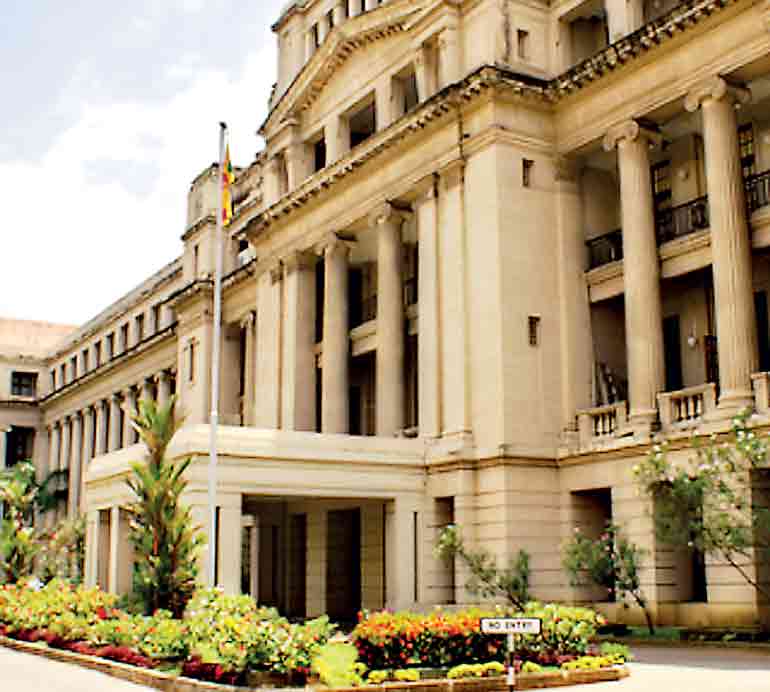
The Finance Ministry in Colombo
- 121 top global economists, academics propose new restructuring that restores debt sustainability under the new circumstances
- Framework should recognise climate-driven disasters as systemic, not exceptional, shocks
- Must provide significant debt cancellation with no punitive conditions to deal with disaster recovery, social protection, reconstruction and development.
- Urge prioritising human welfare, environmental protection, and long-term viability over financial obligations to external creditors
- Signatories include Joseph Stiglitz, Thomas Piketty, Yanis Varoufakis, Jayati Ghosh and Stephanie Kelton
A group of 121 leading economists and academics issued the following statement on ‘Sri Lanka’s Climate Crisis and IMF Restructuring Deal’.
Sri Lanka’s 17th IMF sovereign debt restructuring agreement is executed under the 48-month IMF Extended Fund Facility (EFF) and provides limited debt service relief. It therefore failed to provide a sustainable solution to Sri Lanka’s debt crisis and left Sri Lanka extremely vulnerable to external shocks - particularly climate-induced disasters.
Those shocks have now hit with the catastrophic aftermath of Cyclone Ditwah - marked by widespread flooding, deadly landslides, displacement of more than 1.4 million people, and nearly 800 individuals either dead or missing. The concern over the country’s future deepens.
Under the current IMF-supported arrangement, creditors agreed to reduce the size of Sri Lanka’s debt payments, measured in net present value terms, by 17%.
This left Sri Lanka with Government external debt payments of around 25% of revenue, one of the highest rates in the world. According to IMF staff, under the IMF’s own models, Sri Lanka has a 50% chance of defaulting and/or needing another debt restructuring, even after debt relief.
The IMF publicly said that “debt risks will remain high for many years”.
Sri Lanka is now confronting a severe economic shock triggered by the recent cyclone, extensive flooding and landslides, which has inflicted extensive damage to infrastructure, livelihoods, and key sectors of the economy. This environmental emergency is poised to absorb - and potentially exceed - the extremely limited fiscal space created by the current debt restructuring package.
Additional external debt is already being taken on from the IMF, and more lending to deal with the impacts of the disaster is likely.
Given Sri Lanka’s vulnerability to climate shocks, the scale of destruction underscores how insufficient the present debt deal is in safeguarding economic stability. The country’s already fragile socio-economic landscape heightens the risks: diminished revenues, rising reconstruction costs, and increased import needs could quickly undermine projected gains from the restructuring.
In this context, the nation remains acutely exposed to further external shocks, whether climatic or economic, highlighting the need for a more comprehensive, resilience-oriented debt solution.
The IMF itself has acknowledged that Sri Lanka’s path to “debt sustainability remains knife-edged,” with the country only narrowly meeting targets while social-spending benchmarks were missed.
In light of the current climate catastrophe that has hit Sri Lanka, we wish to highlight the following points:
- The existing restructuring - modest, conditional and tied to uncertain macroeconomic outcomes - is inadequate to protect the vulnerable majority from recurrent climate and external shocks.
- By prioritising debt service continuity over deep debt relief, the IMF programme perpetuates structural exposure of Sri Lanka’s economy and population to future disasters.
- Continuing to impose debt repayment obligations under these conditions fails to consider Sri Lanka’s capacity to service debt, which should instead be based on its foreign exchange (forex) earnings.
- Current onerous debt servicing undermines efforts to rebuild lives, restore agriculture, infrastructure, and provide social protection.
Therefore, we call for immediate suspension of Sri Lanka’s external sovereign debt payments, and a new restructuring that restores debt sustainability under the new circumstances. We propose the adoption of a genuinely sustainable framework that:
- Recognises climate-driven disasters as systemic, not exceptional, shocks.
- Provides significant debt cancellation - with no punitive conditions - to free up fiscal space for disaster recovery, social protection, reconstruction and development.
- Prioritises human welfare, environmental protection, and long-term viability over financial obligations to external creditors.
Only a fundamental rethinking of the global debt regime - one based on justice and sustainability - will offer Sri Lanka a realistic chance to recover from the climate impacts and build an equitable future for all.
Coordinated by: Professor Jayati Ghosh; Debt Justice, UK; Institute of Political Economy, Sri Lanka.
The signatories:
1. Prof. Jayati Ghosh – University of Massachusetts–Amherst, USA
2. Prof. Joseph Stiglitz – Columbia University, USA
3. Prof. Thomas Piketty – Sciences Po / Paris School of Economics, France
4. Prof. Yanis Varoufakis – University of Athens, Greece
5. Prof. Martin Guzman – Columbia University, USA
6. Prof. C. P. Chandrasekhar – University of Massachusetts–Amherst, USA
7. Prof. Stephanie Kelton – Stony Brook University, USA
8. Prof. Jason Hickel – ICTA–University of Barcelona, Spain / LSE, United Kingdom
9. Prof. Guy Standing – SOAS, University of London, United Kingdom
10. Prof. Fadhel Kaboub – Global Institute for Sustainable Prosperity, USA
11. Prof. Gary Dymski – University of Leeds, United Kingdom
12. Prof. Sudip Chaudhuri – Indian Institute of Management Calcutta, India
13. Prof. Kevin Gallagher – Boston University, USA
14. Prof. Radhika Balakrishnan – Rutgers University, USA
15. Prof. Gerald Epstein – University of Massachusetts, USA
16. Prof. Utsa Patnaik – Jawaharlal Nehru University, India
17. Prof. Mariana Reis Maria – Universidade Estadual de Campinas, Brazil
18. Prof. Irene van Staveren – Erasmus University Rotterdam, Netherlands
19. Prof. Juan Carlos Moreno-Brid – UNAM, Mexico
20. Prof. Surajit Mazumdar – Jawaharlal Nehru University, India
21. Prof. Howard Nicholas – International School of Business, Ho Chi Minh City, Vietnam
22. Prof. A. Haroon Akram-Lodhi – Trent University, Canada
23. Prof. Gunseli Berik – University of Utah, USA
24. Prof. Sergio Cesaratto – University of Siena, Italy
25. Prof. Yavuz Yazar – University of Denver, USA
26. Prof. Suzanne Bergeron – University of Michigan–Dearborn, USA
27. Prof. S. Subramanian – Madras Institute of Development Studies, India
28. Prof. David Ruccio – University of Notre Dame, USA
29. Prof. M. V. Lee Badgett – University of Massachusetts–Amherst, USA
30. Prof. Julie Nelson – University of Massachusetts–Boston, USA
31. Prof. Farida Khan – University of Colorado, USA
32. Prof. Smriti Rao – Assumption University, USA
33. Prof. Gustavo Indart – University of Toronto, Canada
34. Prof. R. Ramakumar – Tata Institute of Social Sciences, Mumbai, India
35. Prof. Randy Albelda – University of Massachusetts–Boston, USA
36. Prof. Yana Rodgers – Rutgers University, USA
37. Dr. Isabella Weber – University of Massachusetts–Amherst, USA
38. Dr. Lucas Chancel – Sciences Po / Paris School of Economics, France
39. Dr. Dean Baker – University of Massachusetts–Amherst, USA
40. Dr. Ndongo Samba Sylla – IDEAS, Senegal
41. Dr. Pedro Rossi – Global Fund for a New Economy, Brazil
42. Dr. H. Himanshu – Jawaharlal Nehru University, India
43. Dr. Ingrid Kvangraven – King’s College London, United Kingdom
44. Dr. Surbhi Kesar – SOAS, University of London, United Kingdom
45. Dr. Narayani Sritharan – AidData, USA
46. Dr. Tracey Freiberg – John Jay College, USA
47. Dr. Ajit Zacharias – Levy Institute, Bard College, USA
48. Dr. Smita Ramnarain – University of Rhode Island, USA
49. Dr. Sheba Tejani – King’s College London, United Kingdom
50. Prof. Vijay Prashad – Tricontinental Institute, Argentina
51. Prof. Barbara Harriss-White – University of Oxford, United Kingdom
52. Prof. Shirin Rai – SOAS, University of London, United Kingdom
53. Prof. Kanchana N. Ruwanpura – University of Gothenburg, Sweden
54. Prof. Alessandra Mezzadri – SOAS, University of London, United Kingdom
55. Prof. Raj Patel – University of Texas at Austin, USA
56. Prof. Kanishka Goonewardena – University of Toronto, Canada
57. Prof. Vasuki Nesiah – New York University, USA
58. Prof. Aram Ziai – University of Kassel, Germany
59. Prof. Matthias Goldman – EBS University, Germany
60. Prof. Nata Duvvury – National University of Ireland Galway, Ireland
61. Prof. Maggie Leung – University of Amsterdam, Netherlands
62. Prof. Padraig Carmody – Trinity College Dublin, Ireland
63. Prof. Bart Klem – Ghent University, Belgium
64. Prof. Roar Høstaker – Inland Norway University of Applied Sciences, Norway
65. Prof. Benjamin Selwyn – University of Sussex, United Kingdom
66. Prof. John Morrissey – National University of Ireland Galway, Ireland
67. Prof. Kanishka Jayasuriya – Murdoch University, Australia
68. Prof. Wilfried Swenden – University of Edinburgh, United Kingdom
69. Prof. Roger Jeffery – University of Edinburgh, United Kingdom
70. Prof. Naomi Hossain – SOAS, University of London, United Kingdom
71. Prof. Paige West – Columbia University, USA
72. Prof. Dina Siddiqi – New York University, USA
73. Prof. Christopher Cramer – SOAS, University of London, United Kingdom
74. Prof. Ruvani Ranasinha – King’s College London, United Kingdom
75. Prof. Maria Heim – Amherst College, USA
76. Prof. John Harris – Simon Fraser University, Canada
77. Prof. Nirmala Salgado – Augustana College, USA
78. Prof. Vinay Gidwani – University of Minnesota, USA
79. Prof. Dia da Costa – University of Alberta, Canada
80. Prof. Atilio Boron – University of Buenos Aires, Argentina
81. Prof. Anne Blackburn – Cornell University, USA
82. Prof. Deepta Chopra – University of Sussex, United Kingdom
83. Prof. Muthucumaraswamy Sornaraha – National University of Singapore, Singapore
84. Prof. Rahul Mukherji – Heidelberg University, Germany
85. Dr. Juan Pablo Bohoslavsky – CONICET / National University of Rio Negro, Argentina
86. Dr. Mieke Lopes Cardozo – University of Amsterdam, Netherlands
87. Dr. Thiruni Kelegama – University of Oxford, United Kingdom
88. Dr. Giselle Thompson – University of Alberta, Canada
89. Dr. Nimanthi Rajasingham-Perera – Colgate University, USA
90. Dr. Andrew Newsham – SOAS, University of London, United Kingdom
91. Dr. Bhumika Muchhala – The New School, USA
92. Dr. Alexandre da Costa – University of Alberta, Canada / Brazil
93. Dr. Sharika Thiranagama – Stanford University, USA
94. Dr. Amali Wedagedara – Bandaranaike Centre for International Studies, Sri Lanka
95. Dr. Eva Ambos – University of Tübingen, Germany
96. Dr. Paul Gilbert – University of Sussex, United Kingdom
97. Dr. Priyadarshini Premarathne – University of Peradeniya, Sri Lanka
98. Dr. Farah Mihlar – Oxford Brookes University, United Kingdom
99. Dr. MeeNilancko Theiventharan – University of Oslo, Norway
100. Dr. Shyamain Wickramasingha – University of Sussex, United Kingdom
101. Dr. Joeri Scholtens – University of Amsterdam, Netherlands
102. Dr. Susantha Rasnayake – University of Peradeniya, Sri Lanka
103. Dr. Alicia Yamin – Harvard University, USA
104. Dr. Lara Merling – UCL Institute for Innovation and Public Purpose, United Kingdom
105. Dr. Rohith Jyothish – O. P. Jindal Global University, India
106. Dr. Jon Phillips – SOAS, University of London, United Kingdom
107. Anne Pettifor – Jubilee Campaign, United Kingdom
108. Tim Jones – Debt Justice, United Kingdom
109. Kate Raworth – Environmental Change Institute, Canada
110. Veronica Gróndona – ICRICT, Argentina
111. Maia Colodenco – Suramericana Visión, Argentina
112. Dr. Farwa Sial – IDEAS, Asia Region
113. Emma Bury – AidData, USA
114. Robin Jespert – Goethe University Frankfurt, Germany
115. Kevin Cashman – John Jay College, CUNY, USA
116. Gabriele Koehler – UNRISD, Switzerland
117. Vincent Chee – Raffles College of Higher Education, Singapore
118. Matheus Machado – IBMEC, Brazil
119. Chiara Subrizi – University of Urbino Carlo Bo, Italy
120. Kowsalya Duraiswamy – Sri Lanka
121. Emma Burgisser – Christian Aid, United Kingdom




