Saturday Oct 10, 2026
Saturday Oct 10, 2026
Thursday, 4 June 2026 00:00 - - {{hitsCtrl.values.hits}}
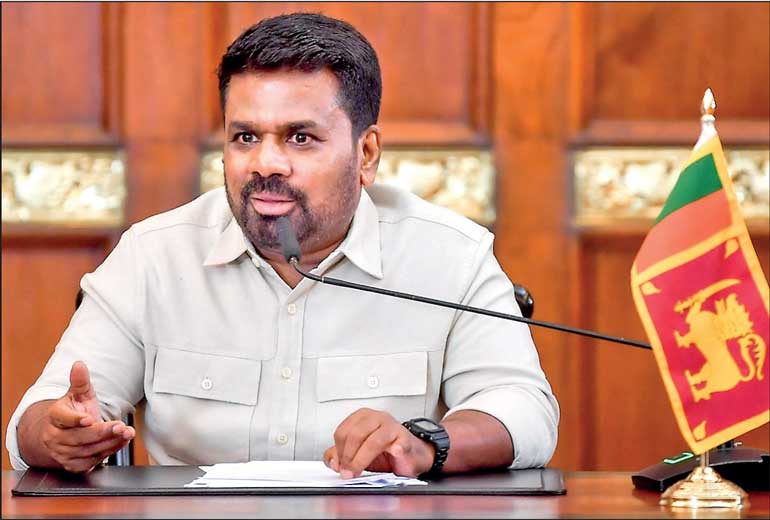
President Anura Kumara Dissanayake
By Citizen Silva
The defining challenge facing the current administration is not merely the emergence of allegations of corruption, mismanagement, and abuse of authority. It is the immense weight of expectations that accompanied its rise to power.
The National People's Power (NPP) coalition and President Anura Kumara Dissanayake secured an unprecedented electoral mandate largely on a promise to dismantle the culture of corruption that had allegedly become deeply entrenched in Sri Lankan politics. Millions of citizens voted not only for a change of Government but for a new standard of governance. The promise was clear: transparency, accountability, integrity, and equal application of the law.
It is precisely because of that promise that the present Government finds itself under intense scrutiny. A Government elected on an anti-corruption platform is inevitably judged by a higher standard than those it replaced. Actions that may once have been dismissed as routine administrative failures are now examined through the lens of the Government's own commitments.
Series of controversies
Since assuming office, the administration has been confronted by a series of controversies that have raised serious questions regarding governance, competence, and accountability.
Among the issues that have generated public concern are allegations surrounding the coal procurement process, including claims that established procedures were manipulated to favour a preferred supplier and that substandard coal was subsequently supplied.
Questions have also been raised regarding the declared assets of several ministers and deputy ministers, prompting calls for greater transparency and public disclosure.
The Government's response to the Ditwah cyclone has likewise come under criticism, with concerns expressed over whether available early warning information was adequately acted upon to protect lives and property.
Allegations involving the Speaker of Parliament have further added to public unease regarding standards of conduct among senior office holders.
Particularly troubling are reports concerning the unauthorised release of containers from the Port of Colombo, an issue that has fuelled concerns about customs controls and regulatory oversight.
Similarly, allegations that selected parties may have received advance information regarding impending increases in customs duties on motor vehicles have raised questions about the possibility of unequal access to commercially sensitive Government decisions.
Controversies relating to rice imports, petroleum procurement, and fertiliser purchases have also attracted significant attention. Critics argue that these transactions require greater transparency and independent scrutiny to determine whether public funds have been managed prudently and in the public interest.
Principles
The central issue, however, extends beyond any individual controversy. The real question is whether the Government is living up to the principles upon which it was elected.
The public did not vote merely for new personalities. They voted for a new political culture. They expected openness rather than secrecy, accountability rather than excuses, and competence rather than complacency. They expected a Government that would subject itself to the same scrutiny it demanded of its predecessors.
A democracy cannot function on promises alone. It requires institutions that are transparent, leaders who welcome scrutiny, and mechanisms that ensure no individual or organisation is above the law. Allegations, whether against former Governments or the current administration, must be investigated fairly, independently, and without political favour.
The credibility of an anti-corruption Government is not tested when it exposes the failures of others. It is tested when allegations arise within its own ranks. The true measure of integrity is not the absence of controversy but the willingness to confront controversy openly and honestly.
Sri Lanka's citizens deserve answers. They deserve transparency. Most importantly, they deserve a Government that recognises that the mandate it received was not a blank cheque but a solemn responsibility.
The higher the promise, the higher the standard. Having come to power on a pledge to eradicate corruption and restore good governance, the current administration must understand that public trust will ultimately depend not on rhetoric but on results.




