Sunday Sep 13, 2026
Sunday Sep 13, 2026
Tuesday, 28 July 2026 00:03 - - {{hitsCtrl.values.hits}}
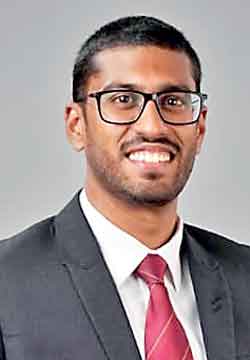 |
| Ceylinco Life Senior Assistant General Manager/Head of Marketing Dhiranjan Canagasabey |
Most people, when they think about retirement, think about income. Will there be enough to cover food, utilities, and the basics of daily life? That question is important. But there is a second question that sits right behind it, quieter and far more expensive, and most people do not ask it until it is already upon them. What happens when you get sick?
Healthcare in retirement is not an occasional inconvenience. For most Sri Lankans, it becomes one of the largest and most unpredictable expenses of the post-work years. It arrives gradually at first, and then all at once. A routine check-up becomes a specialist referral. A specialist referral leads to investigations. Investigations lead to a diagnosis. A diagnosis leads to medication that never stops. And running alongside all of it, quietly compounding, is an inflation rate for healthcare that outpaces most other costs a retiree faces.
This is the retirement expense that most financial plans either underestimate or ignore entirely. It is a gap that Ceylinco Life, Sri Lanka’s life insurance market leader for 22 consecutive years, has observed widen steadily across the communities it serves and the thousands of policyholders whose retirement journeys it has accompanied over three decades.
Ceylinco Life Senior Assistant General Manager/Head of Marketing Dhiranjan Canagasabey said: “Healthcare is the cost that most people acknowledge in the abstract but do not plan for in practice. We have seen, over many years and across many thousands of policyholders, that the single biggest financial shock in retirement is rarely a collapse in savings. It is an illness, or a prolonged condition, that was never budgeted for. Sri Lanka’s public health system has served this country well, but it was not built for an ageing population managing multiple chronic conditions over decades. The responsibility to bridge that gap sits with each individual, and the earlier that planning begins, the more manageable that gap becomes.”
A country that is ageing faster than its health system is preparing for
Sri Lanka is in the middle of a demographic shift that has no historical precedent in this country. By 2042, one in four Sri Lankans will be above the age of 60. Life expectancy, according to United Nations World Population Prospects 2024, now stands at approximately 77.67 years nationally. That means the average retiree is looking at roughly 17 years of post-work life, with health needs that become more intensive, and more expensive, with every passing year.
Non-communicable diseases are at the centre of that picture. According to research published in 2025 in the Journal of Clinical Medicine, NCD deaths in Sri Lanka have risen substantially over two decades, with total deaths due to diabetes alone rising by 169% between 2004 and 2020. Cardiovascular disease, hypertension, chronic kidney disease, and cancer all carry long-term treatment costs that can run for years or decades before they become fatal. These are not short-term medical events. They are sustained financial obligations.
Sri Lanka allocates approximately 4.4% of GDP to total health expenditure, well below the global average of 6.74%, according to World Bank data updated in December 2025. Government public health spending accounts for only around 8 to 9% of general government expenditure. The gap between what the public system offers and what the ageing population will need is already visible. It is going to widen considerably.
What free healthcare actually means for a retiree
Sri Lanka has long been proud of its free public healthcare system, and rightly so. It has delivered health outcomes well above what the country’s income level would typically produce. But pride in the system should not obscure what it cannot do, and increasingly, what it is struggling to do consistently.
According to the Institute of Policy Studies, access to primary healthcare fell from 95% of the population in 2019 to 82% in 2022 and 2023, with rural areas bearing the steepest decline. Household healthcare costs, in the same period, rose by 48% in a single year between 2020 and 2021. Medicine shortages, long queues, and limited specialist services in provincial hospitals are not new complaints. But for an elderly person managing a chronic condition, they translate directly into out-of-pocket spending that was never planned for.
On average, more than 60% of Sri Lankan households already incur private healthcare costs, according to a study published in the journal Health Policy. For households that include elderly members with chronic conditions, that proportion is higher, and the burden is heavier. The combination of a free system under strain and rising private costs is not a future risk. It is already the daily reality for many retirees.
The quiet toll of chronic illness
A 65-year-old managing type 2 diabetes, which is increasingly common in Sri Lanka, does not face a single large medical expense. They face a continuous one. Monthly medication. Quarterly blood tests. Periodic specialist consultations at a private facility, because the waiting list at the government hospital is too long or the specialist they need is unavailable locally. Annual check-ups. Occasional hospitalisation when blood sugar levels become difficult to control. Each item is manageable on its own. Together, across a fifteen-year retirement, they represent a substantial sum.
A specialist consultation at a private hospital in Colombo today can range from Rs. 2,000 to Rs. 5,000 or more, before any investigations or treatment. A single hospitalisation of three to five days in a private facility can run into hundreds of thousands of rupees. For a retiree living on EPF savings and whatever informal support the family provides, that kind of expense does not just strain the budget. It can eliminate months of accumulated savings in a single event.
The problem is compounded by the fact that medical costs do not inflate at the same rate as general consumer prices. Healthcare inflation has historically run faster than the headline rate across most economies, and Sri Lanka is not insulated from that pattern. A medical expense that costs Rs. 10,000 today is unlikely to cost Rs. 10,000 in ten years. For someone retiring today with a plan built on current price levels, the gap between what was anticipated and what is actually spent will widen every year.
When the family safety net is no longer there
For generations, the informal answer to healthcare in retirement in Sri Lanka has been family. Children, often daughters or daughters-in-law, provided care, managed medications, accompanied parents to hospital appointments, and covered expenses that EPF could not. That arrangement, common across South Asian cultures, was never formalised or costed. It simply existed.
It is becoming harder to rely on. A significant number of younger Sri Lankans have migrated abroad following the economic crisis of 2022, drawn by wage levels that the local economy cannot match. Those who remain are often managing their own financial pressures, two incomes covering a household in a city where the cost of living has risen sharply. The care that a previous generation could assume is now something that needs to be planned for, not assumed.
Rural retirees face a specific version of this challenge. In districts further from the Western Province, healthcare facilities are fewer, specialist services are limited or absent, and travel to access care is a cost in itself. An elderly person in a rural district who needs a specialist appointment in Colombo faces the cost of transport, accommodation, lost time, and the physical difficulty of the journey, layered on top of the medical expense itself. These are costs that urban retirement planning rarely accounts for, and that rural retirees rarely have the savings to absorb comfortably.
Planning for the bill that always arrives
The central problem is not that healthcare in retirement is unavoidable. It is that most people treat it as unpredictable when it is, in fact, highly predictable in its general shape. Almost everyone who lives into their 70s will face increasing medical costs. Almost everyone will deal with at least one chronic condition. Almost everyone will, at some point, need specialist care, medication, or hospitalisation. None of this is a surprise. It is biology.
What makes it financially dangerous is the combination of insufficient savings, no dedicated healthcare provision within the retirement plan, and an assumption that either the public system or the family will absorb what EPF cannot cover. That assumption is becoming less reliable every year.
A retirement plan that does not include a realistic and separately structured provision for healthcare is incomplete. Not inadequate. Incomplete. The income question and the healthcare question are two different financial problems, and they need two different answers built into the same plan, from the earliest possible stage.




