Monday Oct 12, 2026
Monday Oct 12, 2026
Thursday, 30 April 2026 00:00 - - {{hitsCtrl.values.hits}}

By a Banker
There is a quiet myth in corporate Sri Lanka that serving on a bank Board is a mark of distinction — a final badge of honour for a successful career. For too many, it is treated as prestige, networking, a comfort role, or a retirement supplement wrapped in titles, Board fees, and ceremonial influence. That mindset is precisely where the danger begins.
Banking is not another corporate sector. It is not manufacturing, retail, or consulting. It is the management of other people’s money at scale, under leverage, trust, and regulatory dependency. A bank does not fail slowly without consequence. It collapses abruptly, and when it does, it is depositors, pensioners, SMEs, and the real economy that bleed first — not directors. Yet, across too many Boards, one sees individuals who have never operated inside a credit culture, never managed liquidity stress, never understood asset-liability mismatches, and never had to face the discipline of banking supervision. They bring experience from unrelated industries and assume it is transferable. It is not. The CBSL allows this without any scrutiny of relevance.
Dangerous misconceptions
 The most dangerous misconception is this: that oversight is passive. In banking, non-executive directors are not ornamental. They are not there to “review papers” or nod through presentations. They are the last line of defence before systemic risk is created. When that line becomes passive or uninformed, governance collapses quietly — until it becomes a headline crisis.
Recent developments in the Sri Lankan financial sector have already exposed how fragile Board-level understanding can be. In more than one instance, concerns have emerged around credit quality, related-party exposure, and unusually rapid build-up of receivables and risk concentrations. Take NDB Bank: what were accountants in the Board, external auditors EY and CBSL inspectors doing? Anyone with basic accounting knowledge reading the annual report can see the receivables buildup. These are not complex signals. Any director with basic financial literacy and genuine engagement with the balance sheet would question them early. When they are missed, it is not an accounting failure alone — it is a governance failure. This raises an uncomfortable question: what exactly are some audit committees doing? Too often, audit committees in banks become procedural rather than forensic. They rely heavily on external auditors without interrogating the underlying assumptions. But auditing is not a substitute for governance; it is a test of it. If directors do not challenge, probe, and demand clarity, then even the best audit process becomes a formality. The role of regulators and external auditors is also under scrutiny globally, not just locally. But no regulator can replace Board vigilance. And no audit firm can compensate for a passive chairperson.
Huge risks
The risks for non-executive directors are no longer theoretical. In an increasingly regulated environment, accountability is shifting from institutions to individuals. Directors can face reputational destruction, civil liability, regulatory action, and in extreme cases — criminal exposure — when governance failures are proven to have enabled misconduct or negligence. This is not rhetoric. It is global precedent. The uncomfortable truth is that many directors underestimate this exposure. They assume “non-executive” means insulated. It does not. It means responsible without operational control — which is precisely why diligence must be higher, not lower.
Another structural issue is incentives. Some directors join Boards for status, influence, or supplementary income. That creates an implicit bias toward comfort rather than confrontation. But banking Boards do not need comfort. They need intellectual friction, informed scepticism, and directors who are willing to ask uncomfortable questions repeatedly.
If a director cannot read a bank’s balance sheet and immediately understand where risk is accumulating, they should not be on that Board. If they cannot interrogate credit concentration, provisioning adequacy, liquidity buffers, and related-party exposure with confidence, they are not adding value — they are adding risk.
The solution is not cosmetic reform. It is structural discipline.
Central banks must raise the bar for Board appointments in licenced banks. Civil society and independent nomination mechanisms should be strengthened to ensure competence, not convenience, determines Board composition. Directors should undergo mandatory banking literacy certification before appointment and continuous education thereafter. There is no justification for amateurs overseeing systemic financial institutions.
Trust
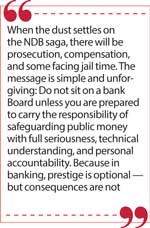
Ultimately, banks survive on one fragile asset: trust. Depositors do not read Annual Reports. They trust that someone competent is reading them on their behalf. When that trust is betrayed through negligence or ignorance, the damage is not just financial — it is systemic. When the dust settles on the NDB saga, there will be prosecution, compensation, and some facing jail time. The message is simple and unforgiving: Do not sit on a bank Board unless you are prepared to carry the responsibility of safeguarding public money with full seriousness, technical understanding, and personal accountability. Because in banking, prestige is optional — but consequences are not.




