Thursday Mar 12, 2026
Thursday Mar 12, 2026
Friday, 6 March 2026 00:26 - - {{hitsCtrl.values.hits}}
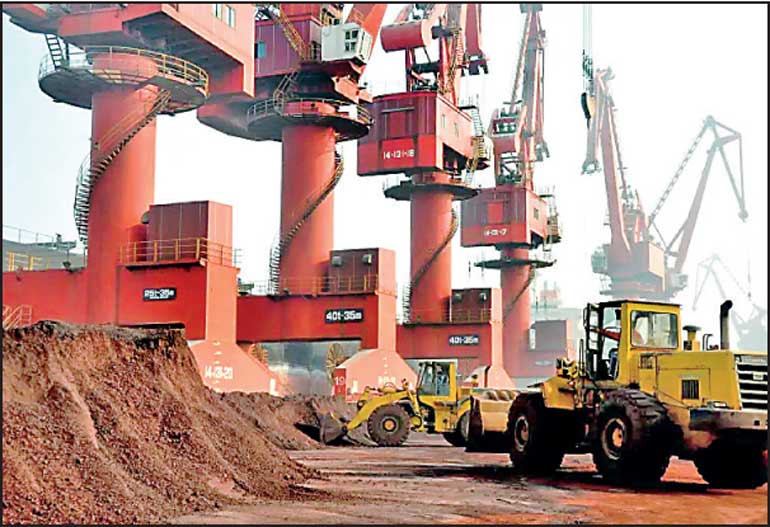
Workers transport soil containing rare earth elements for export at a port in Lianyungang, Jiangsu province, China
 The pandemic, the Russia–Ukraine conflict, and escalating trade tensions with China have exposed significant vulnerabilities in US supply chains, particularly in the supply of rare earth elements, where reliance on Chinese supply remains considerable.
The US–China trade war, which began in 2017–18, marked a major escalation in the strategic rivalry between the two nations and set off a wave of mutual de-risking. In response, Governments have increasingly scrutinised their economic and security frameworks to identify vulnerabilities and dependencies, and have taken corrective action where risks are considered unacceptable. The outbreak of the pandemic exposed significant weaknesses in supply chains across both critical and basic industries, a situation that was further exacerbated by the onset of the Russia–Ukraine war.
Unlike in previous decades, the US now seeks to anchor its supply chains within trusted partner countries to safeguard strategic relationships. Within this context, securing a stable supply of rare earth elements has become a central pillar of US policy.
Dominance
China continues to dominate the rare earth supply chain, accounting for roughly 65% of global mining capacity and a whopping 91% share of refining these minerals into oxides. It also leads in magnet manufacturing, producing about 94% of the world’s sintered magnets and 80% of bonded magnets, the highest-value applications of rare earth oxides. These magnets are critical inputs across a wide spectrum of industries, including consumer electronics, hard drives, medical devices, wind turbines, electric vehicles, and advanced defence and aerospace systems.
China’s dominance of the rare earth supply chain is no coincidence; it is the outcome of decades of strategic development. While several factors underpinned this rise, a critical inflection point came in the 1980s, when the US began phasing out its domestic rare earth industry amid rising environmental liabilities and the view that these materials had limited commercial applications. In contrast, China absorbed the environmental costs and methodically built an integrated value chain spanning extraction, processing, and finished products.
This dominance in the rare earth sector in China has also been supported by structural advantages, including lower labour costs, cheap state-backed financing, and subsidised energy. Importantly, this ecosystem did not evolve in isolation; it has been reinforced by China’s leadership in downstream industries such as electric vehicles, wind turbines, and consumer electronics, which further entrenches its control over the rare earth value chain.
US and allies
As the US and its allies attempt to reconfigure and relocate segments of the rare earth supply chain, they face formidable challenges in competing with China on labour, energy, and capital costs. Establishing new mines and processing facilities is a complex and time consuming process; recent efforts to expand refining capacity in the US, for instance, have taken approximately four to five years to reach full-scale development. Moreover, the costs associated with mitigating environmental damage and safely disposing of toxic chemicals and tailings are substantial. Local community opposition to new processing plants also remains a significant hurdle.
Consequently, the West is likely to find it difficult to rapidly erode China’s dominance in rare earth supply chains. Nevertheless, technological innovation could play a pivotal role. A number of emerging technologies, currently under development or approaching commercial viability, have the potential to significantly reduce environmental impacts and address longstanding community concerns, thereby easing the pathway for new capacity outside China.
It is evident that the US is unlikely to close the gap with China through adjustments in labour, regulatory, or input costs alone. Labour costs in China are not expected to rise sufficiently, nor those in the US to decline meaningfully, to narrow the gap. Likewise, although China may continue to strengthen its environmental standards, the US and other Western economies are unlikely to relax their own.
In this context, advancing promising technologies represents the most viable path forward. With greater Government support to mobilise private sector innovation and agility, the US and its allies can work toward building a more resilient rare earth supply chain, potentially at a faster pace than currently anticipated.
(The author works as a researcher in a private investment research firm with primary focus on researching broader economic issues, including monetary and fiscal policies, geopolitical developments, and sustainability matters, and their implications across various sectors. He holds a Master›s degree in Applied Finance from the University of Sri Jayewardenepura and a Bachelor›s degree in Business Economics with a first class division from the same university)




