By Nayak Adarsh Saubhagya
Some journeys are made to explore new places. Some are made to experience something beautiful. And then there are journeys that quietly change the way we look at life.
My journey to Vrindavan was one such experience.
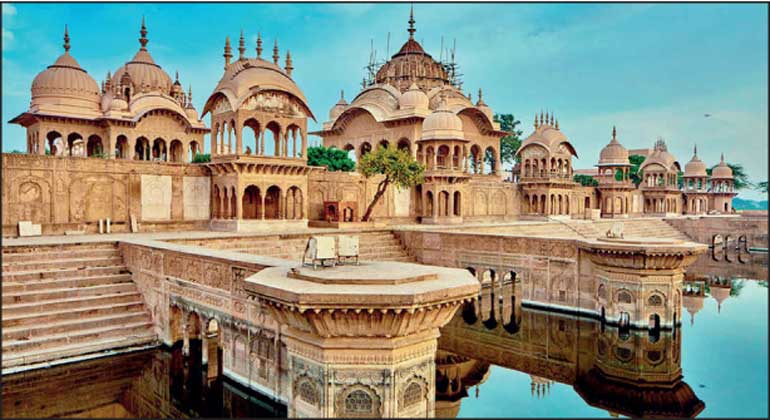
I had always been fascinated by this sacred land of Shree Radha and Lord Krishna, the land of divine love. The devotion of its people, the stories of divine love, the temples, the saints, the sacred River Maa Yamuna, and the lives of those who surrender themselves to the path of Bhakti had always drawn my attention.
I went there with curiosity, devotion, and a desire to experience something beyond ordinary travel.
When I finally arrived in Vrindavan, I felt as though I had entered a different world. The narrow streets were filled with people, vehicles, pilgrims, monks, and wandering animals. Yet, amidst all the noise and movement, one expression seemed to connect everyone: “Radhe Radhe!”
People greeted one another with Radhe Radhe. Shopkeepers, strangers, pilgrims, and devotees seemed to carry the name wherever they went. It was more than a greeting; it felt like the heartbeat of the city, a city that seemed to breathe Radhe Radhe.
That evening, I visited Nidhivan, Seva Kunj, and Shri Banke Bihari Ji Temple. Each place had its own atmosphere and carried its own stories of devotion.
But something about my visit to Banke Bihari Ji was especially beautiful. I felt a quiet anticipation, almost as though I were going to meet someone very dear to me. And when I finally stood before Bihari Ji, I felt as if He had been waiting for me all along.
What a beautiful feeling! It was something beyond ordinary words.
But the most wonderful experience of my journey was yet to come.
The Braj Raj: The adorable and tender touch of the sacred soil of Vrindavan
That night, I came across a group of monks preparing to perform Parikrama, a circumambulation of the sacred land. I was fortunate to be the part of it, and we began walking barefoot. Before starting, we bowed down, touched the sacred dust of Vrindavan, known as Braj Raj, and applied it to our foreheads. I had heard people speak about the holiness of this soil. But that night, I experienced something that words can hardly capture. As we walked along the banks of the Yamuna, I began noticing something extraordinary about the soil.
It was incredibly soft.
The tiny particles felt delicate, almost like flower petals. The texture reminded me of freshly prepared laddus, made with flour and ghee—soft, delicate, and gentle to the touch. Every particle seemed to carry that tenderness. With every step, I felt as though the earth itself was receiving my feet. The soil seemed to make space for each step, welcoming me and allowing me to move forward. I did not feel that I was simply walking on the ground. It felt as though the land itself was lovingly accepting my presence, almost embracing my feet. For a moment, I felt connected to something much deeper than the physical surroundings. The sacredness of Braj Raj was no longer just a belief I had heard from others. It had become a personal experience of tenderness, humility, and surrender.
I cannot fully explain that feeling. Perhaps the sacredness of a place is not always understood through explanations. Sometimes, it is experienced through the simplest contact with nature.
That night, I was physically tired and eventually fell asleep, but the experience remained with me.
Beyond the robes: The heart of a seeker
The following day, I visited an ashram. I do not wish to mention its name. What matters here is not the identity of the place or the people, but what the experience made me reflect upon.
When I entered, I saw a monk sitting peacefully on a raised platform built around a tree. His eyes were closed, and he held a Japamala (prayer beads) in his hands. His face appeared completely immersed in bliss. I stood there for a moment, observing the stillness around him. Suddenly, he opened his eyes and noticed my footwear. In a loud voice, he instructed me to remove my slippers, as wearing footwear inside the ashram, especially on the sacred soil of Vrindavan, was not permitted.
I immediately removed them. I respected the tradition and continued walking. However, something about the interaction stayed with me. The monk who had appeared so peaceful in meditation had spoken with such harshness. I could not understand the contrast.
Later, I was directed towards a place where Prasad was being distributed. It was around noon, and what I witnessed there was remarkable. Thousands of sadhus and other people were seated, waiting for food. Volunteers were serving meals to everyone. There was an abundance of food, and people were waiting patiently to receive it.
I stood there, observing the entire scene.
While looking around, I noticed a person holding a Japamala inside a cloth covering commonly used while performing Japa. His index finger remained outside the covering. I remembered hearing that, according to certain traditions, the index finger should not touch the beads during Japa because it is associated with the ego.
This made me think about the symbolism behind the practice. If the entire body belongs to God, why is one finger considered unsuitable for touching something sacred?
At that very moment, I noticed the same person pointing his index finger towards another individual and shouting angrily:
“Hey! Don't you know that using a mobile phone is prohibited here?”
I smiled.
The contrast was striking. The finger being kept away from the sacred beads was being used to point angrily at another human being.
I began thinking about the purpose of spiritual practices.
We are so careful about the way we hold a mala, but how careful are we about the words that come out of our mouths?
We protect the beads from our index finger, but do we protect our consciousness from ego?
We pay attention to the movements of our fingers during Japa, but are we equally attentive to the movements of our own ego?
Perhaps the real purity we need to cultivate is not merely in the way we hold a mala, but in the way we hold ourselves.
As I moved towards the exit, another unexpected encounter brought my thoughts back to the meaning of service.
The entrance to the food distribution area was closed, and a few monks were standing outside, waiting to enter and receive food. Among them, I recognised someone. He was the same monk whom I had encountered earlier during my walk, when I had asked for a little help with a lift. He had ignored my request and moved away. Now, I saw him standing outside the gate, politely requesting permission to enter. I watched him and smiled quietly. It was not about the lift or any personal grievance. What stayed with me was the nature of service. If someone is walking beside us and needs a little help, isn't that an opportunity to serve? If we believe that God exists in every living being, shouldn't our first response be kindness?
I remembered my Gurudev's words:
“If you cannot recognise God in everyone, how can you claim to have found God?”
It felt as though life itself was showing me a lesson through an unexpected situation.
Perhaps wearing the identity of a sadhu is one thing, but living with the heart of a sadhu is an entirely different journey. A spiritual life should not be limited to a particular dress, a mala, a tilak, or a place of residence. It should be reflected in the way we treat others, especially when nobody is watching.
Compassion has no boundaries
As I continued reflecting on these experiences, another observation from Vrindavan came to my mind. Throughout the city, I had seen people feeding monkeys, offering fruits to cows, and giving food to birds. It was beautiful to witness. People were buying fruits and distributing them among the animals. Perhaps they were doing it out of genuine love, devotion, or the belief that such acts would bring punya, or spiritual merit.
But I began thinking about what happens after the pilgrimage.
When we return to our homes, do we continue the same practices?
Do we feed the cows near their homes?
Do we care for the birds in their neighbourhoods?
Do we show the same compassion towards animals when they are no longer surrounded by the atmosphere of Vrindavan?
Why should a cow in Vrindavan be considered sacred, while a cow elsewhere becomes just another animal?
Why should a bird need to be in a holy place to receive our kindness?
If we believe that every living being carries the presence of God, shouldn't our compassion extend everywhere?
I understand that we all have different intentions, and many perform these acts with genuine devotion. I do not wish to judge anyone. But I felt that sometimes we become so attached to the idea of performing good deeds in a sacred place that we forget to make compassion a part of our everyday lives.
It is almost as though we believe that something becomes spiritually valuable only when performed in a particular location. I wondered whether we were following the feeling of devotion or simply following what everyone around us was doing. Because genuine compassion should not depend on geography. A cow does not become sacred only when it enters Vrindavan. A bird does not become worthy of kindness only when it flies over a temple.
If our love is genuine, it should not need a sacred address.
God is everywhere: Have we forgotten to see?
All these experiences brought me to a deeper reflection on the rituals we perform in the name of devotion.
We offer flowers, light lamps, burn incense, and decorate deities. These traditions can be beautiful expressions of love and reverence. But I began looking at them from another perspective.
When our father is alive, we don't simply stand before him with flowers and incense. We serve him, offer him food, care for him, and express our love through our actions.
Perhaps this is where we need to look more deeply at our relationship with God. Do we sometimes limit our devotion to external offerings while overlooking the divine presence in everyday life?
Perhaps God is already alive in everything around us—in the soil beneath our feet, the air we breathe, the birds, the animals, and every human being. Maybe it is not God who needs awakening, but our own consciousness.
We worship love, yet struggle to love. We worship compassion, yet sometimes fail to show kindness. We offer flowers to the divine, yet may find it difficult to offer a gentle word to another human being.
Perhaps the true purpose of rituals is not merely to perform them, but to allow them to transform the way we think, feel, and live.
The true expression of Bhakti is not simply how beautifully we worship the divine, but how genuinely we embody love, humility, and compassion towards every living being.
I arrived in Vrindavan seeking an experience of God. I left with a deeper understanding that the divine is not confined to a temple or a sacred place. The soil, the air, the animals, the birds, and the people all reminded me to look beyond appearances.
A question to myself and the readers
If God is already alive in everything around us, is it really God who needs awakening by doing rituals, or is it our own consciousness?
I remembered something my Gurudev used to say:
“If you cannot see God in all, you cannot see God at all.”
Those words began echoing within me.
Prem se Bolo
Radhe Radhe.


