Thursday Oct 22, 2026
Thursday Oct 22, 2026
Monday, 18 May 2026 00:24 - - {{hitsCtrl.values.hits}}
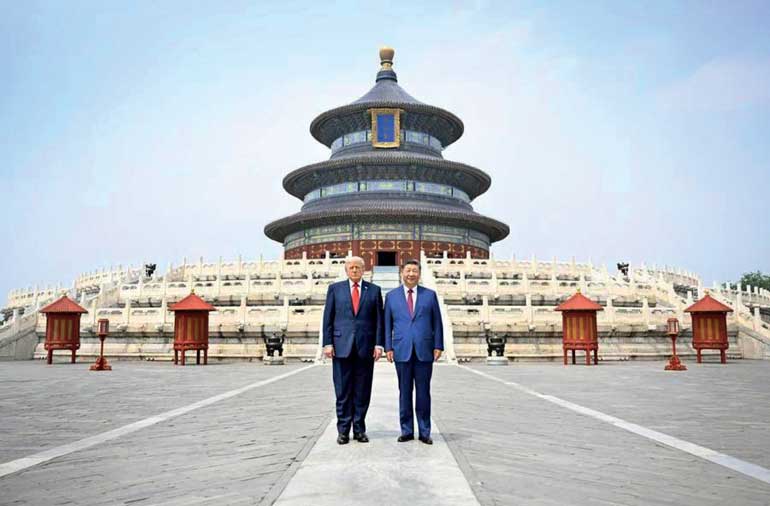
Chinese President Xi Jinping (right) and US President Donald Trump have a photo taken in front of the Hall of Prayer for Good Harvests while visiting the Temple of Heaven in Beijing, capital of China, 14 May 2026 (Xinhua/Shen Hong)
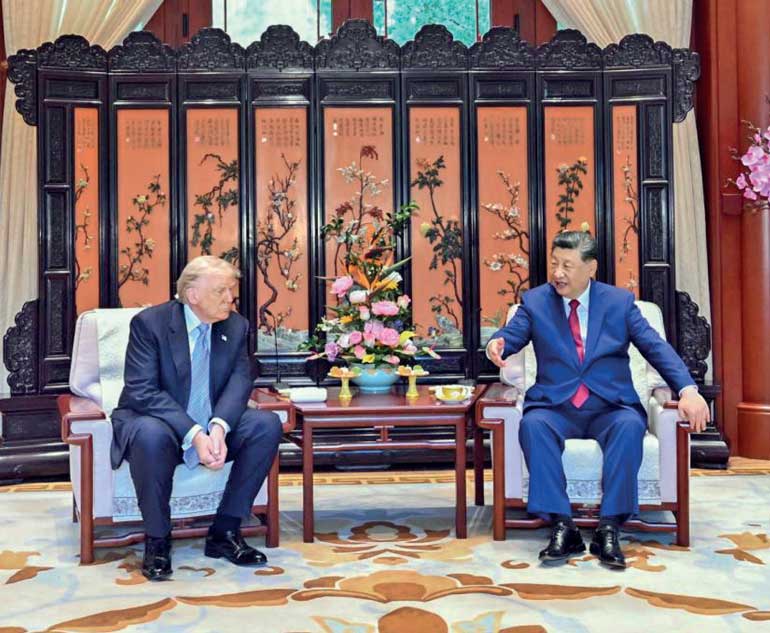

The recent meeting between President Donald Trump and President Xi Jinping in Beijing was far more than another diplomatic engagement between two powerful leaders. It was a reminder that the world is entering a period of profound geopolitical transition.
What made the meeting particularly significant was President Xi Jinping’s invocation of the “Thucydides Trap”, a concept that has increasingly become part of the global conversation surrounding the future of relations between the United States and China.
That reference should make the world pause and reflect.
When the leaders of the world’s two most powerful nations invoke one of history’s most dangerous geopolitical concepts, humanity must recognise the gravity of the moment.
International order at a critical juncture and “Thucydides Trap”
The international order today stands at a critical juncture. The largely unipolar world that emerged after the Cold War is steadily giving way to a more complex multipolar reality. China’s rise as an economic, technological and geopolitical power, the reassertion of Russia, the emergence of India and the growing influence of the Global South are reshaping the global balance of power in ways that cannot be ignored.
 History has always witnessed the rise and decline of powers. What becomes dangerous is when established powers perceive the rise of another as a threat, while rising powers seek greater strategic space, influence and recognition. This structural tension is what political scientist Graham Allison popularised as the “Thucydides Trap”.
The concept originates from the ancient Greek historian Thucydides and his account of the Peloponnesian War between Athens and Sparta nearly 2,500 years ago. Thucydides observed that it was the rise of Athens and the fear this created in Sparta that made war inevitable.
Athens had transformed itself into a major maritime and military power. Sparta, the dominant power in Greece at the time, increasingly viewed Athens with suspicion and fear. Rival alliances hardened. Militarisation intensified. Strategic mistrust deepened. Eventually, the Greek world was dragged into a devastating conflict that weakened all sides.
History has repeatedly shown similar patterns.
The years preceding the First World War offer one of the clearest modern examples. Following its unification in 1871, Germany rapidly emerged as a formidable industrial and military power, challenging Britain’s long-standing dominance. Naval rivalry intensified. Alliances hardened. Nationalism surged. Mutual suspicion deepened across Europe.
The assassination of Archduke Franz Ferdinand may have triggered the war, but the deeper structural tensions created by Germany’s rise and the anxieties of the existing European order had already made the continent dangerously unstable.
The result was catastrophic. Millions perished. Empires collapsed. Entire societies were shattered.
The rise of Imperial Japan and its challenge to Western dominance in Asia produced another devastating confrontation. Strategic rivalry, economic pressure, militarism and expansionism ultimately culminated in Pearl Harbor and the Pacific War.
The Cold War between the United States and the Soviet Union again brought humanity perilously close to destruction. The Cuban Missile Crisis demonstrated how rivalry between major powers could push the world to the edge of nuclear annihilation.
Yet history also teaches another lesson. Strategic rivalry does not inevitably lead to direct war if wisdom, restraint, diplomacy and institutional safeguards prevail over impulse and escalation.
The devastation of the Second World War compelled humanity to fundamentally rethink the nature of international relations. Out of the ashes of that catastrophe emerged a deliberate effort to build a rules-based international order designed to prevent another global calamity.
The establishment of the United Nations, the Bretton Woods institutions, international humanitarian law and multilateral systems governing trade, diplomacy and conflict resolution represented humanity’s attempt to replace raw power politics with cooperation and rules.
That post-war order was not perfect. It reflected the geopolitical realities and inequalities of its time. There were double standards and undeniable failures.
Yet despite its imperfections, the post-1945 multilateral framework helped prevent direct war between major powers for decades. It facilitated unprecedented global economic growth, expanded trade, reduced poverty and provided relative geopolitical stability compared to the catastrophic first half of the twentieth century.
The answer therefore is not to dismantle this system. The answer is to reform it, modernise it and strengthen it.
The world cannot afford a return to an era where military power alone determines legitimacy.
 One of the gravest dangers confronting humanity today is the gradual erosion of respect for multilateralism and international law. Increasingly, the world is witnessing attempts to normalise unilateral military action, invasions, coercive diplomacy and so-called pre-emptive strikes.
Every major power may justify exceptional circumstances for its conduct. But once the norms restraining aggression begin to weaken, the entire international system becomes fragile.
History repeatedly demonstrates that wars rarely remain limited or controlled for long. Aggression invites retaliation. Retaliation produces escalation. Escalation spreads instability far beyond the calculations of those who initiated the conflict.
Deeply interconnected world
In today’s deeply interconnected world, conflict cannot remain geographically confined. A major confrontation between global powers would devastate trade routes, financial markets, energy supplies, shipping lanes, food security and economic stability across continents.
Smaller nations would suffer enormously despite having played no role in causing such conflicts.
That is why the international community must resist the normalisation of invasions, unilateral coercion and military adventurism as acceptable instruments of international relations.
Against this backdrop, President Xi’s invocation of the Thucydides Trap carries profound significance. It reflects an unmistakable reality. The leadership of both the United States and China understands that the trajectory of their relationship may well determine the future of global peace and stability in the twenty-first century.
A balanced multipolar world
The United States remains the world’s dominant military and financial power. China has emerged as an economic, technological and geopolitical superpower.
Competition between them is inevitable. Conflict between them is not.
The challenge confronting both nations is whether they possess the maturity and statesmanship to manage rivalry without allowing it to descend into hostility and confrontation.
Dialogue is therefore not weakness. It is a strategic necessity.
 The absence of communication between major powers creates dangerous vacuums often filled by suspicion, nationalism and escalation.
The reality confronting the world today is unmistakable. The era of uncontested unipolarity is gradually fading. No nation, however powerful, can indefinitely dominate an interconnected and economically diversified world.
Attempts to preserve permanent dominance through coercion, sanctions, military pressure or economic warfare may ultimately deepen instability and accelerate fragmentation.
The answer is not chaos. Nor is it the abandonment of democratic values, international law or global cooperation.
The answer is a balanced multipolar world governed by rules, institutions, diplomacy and mutual respect.
Multipolarity must strengthen multilateralism, not weaken it.
The institutions created after World War II must evolve to reflect present geopolitical and economic realities rather than the power equations of 1945. Emerging economies and developing nations must feel that the international system is fair, representative and responsive to their aspirations.
Otherwise, frustration will continue to grow outside the system rather than within it.
For countries such as Sri Lanka, these are not abstract geopolitical debates. They are matters of national survival and economic stability.
Sri Lanka’s strategic location in the Indian Ocean places it directly within the sphere of great power competition. Escalating tensions among major powers affect trade, tourism, remittances, energy prices, shipping costs, food security and investment flows.
Historically, smaller nations pay the highest price for conflicts they neither initiate nor control.
That is why countries like Sri Lanka have a profound interest in defending multilateralism, peaceful coexistence, freedom of navigation, respect for sovereignty and a rules-based international order.
A stable multipolar world provides smaller nations with strategic space and the ability to maintain balanced relationships with multiple powers without being forced into dangerous alignments.
A polarised and militarised world dramatically reduces that space.
Humanity today faces a defining choice. We can either strengthen the multilateral, rules-based order painstakingly built after World War II while reforming it where necessary, or we can slide back towards an era dominated by spheres of influence, coercion, militarism and confrontation.
 History repeatedly teaches us that leaders often enter conflicts believing escalation can be controlled.
History also repeatedly teaches us how wrong they were.
The real lesson of the Thucydides Trap is not that war between great powers is inevitable. It is that unmanaged fear, arrogance and the refusal to adapt to changing realities have repeatedly driven civilisations towards catastrophe.
In a nuclear and economically interconnected world, humanity cannot afford to repeat those mistakes.
The challenge before our generation is therefore not merely to manage competition between great powers, but to build a genuinely inclusive multipolar order anchored in international law, mutual respect and multilateral cooperation.
The alternative is a world increasingly governed by force, suspicion and instability.
History has already shown us where that path can lead.
(The author is a Former Minister of Justice, Finance and Foreign Affairs of Sri Lanka)




