 The “Northern Gateway” Initiative transforms the Northern Province of Sri Lanka into a strategic economic powerhouse. The Government of India (GoI) should with the Government of Sri Lanka launch the “Palk Strait Corridor Excellence Program.” This initiative replicates the high-growth, industry-driven models of Southern Indian states to leverage India’s finance and markets, turning the North into a permanent bridge for bilateral prosperity.
The Northern Province must be reimagined as a Frontier Province, serving as a living laboratory for Growth-Led Development. Unlike traditional aid-dependent models, this “Frontier” status positions the region as a high-growth entry point for international capital, where the easing of regulatory bottlenecks and the deployment of “First-Mover” incentives create a competitive advantage over established industrial hubs. By leveraging its proximity to the trillion-dollar economy of Southern India, the North can pioneer a Subnational Economic Corridor—an example of how a formerly conflict-affected region can leapfrog national averages by integrating directly into global value chains through specialised maritime and digital infrastructure.
This transformation turns the Northern Province into a National Catalyst, proving that decentralised, export-oriented growth can stabilise a macro-economy. As a Frontier Province, it becomes the benchmark for “Green and Digital” transition; by hosting massive renewable energy arrays and satellite tech hubs, it demonstrates that regional development is not merely a social necessity but a strategic economic imperative. This model of growth-led development serves as a blueprint for other provinces, showcasing how targeted bilateral investment and industry-aligned skill building can convert regional potential into a permanent engine for national GDP expansion.
Frontier Province: Regulatory incentives and structural autonomy
To transition the North from a recovery zone into a “Frontier Province,” the GoI and the Government of Sri Lanka (GoSL) should implement a specialised regulatory regime that prioritises speed of execution and investor confidence.
“Fast-Track” Regulatory Environment
- Northern Single-Window Authority (NSWA): Establishing a localised version of the Colombo Port City Economic Commission for the Northern Province. This authority would have the power to grant licenses, work permits, and environmental clearances within 30 days, bypassing the bureaucratic delays of central ministries.
- Digital residence and professional visas: Introducing 5-to-10-year preferential visas for Indian tech professionals and specialised trainers, similar to the Port City framework, to facilitate immediate knowledge transfer.
- Labour flexibility: Implementing a “Specialised Labor Code» for the Northern Industrial Hubs that allows for project-based hiring and 24/7 operations in IT and Logistics, aligning with the «Bengaluru Tech Ecosystem» model.
Trade and connectivity integration
- Palk Strait Customs Corridor: Establishing a “Green Channel» at the Kankesanthurai (KKS) Port for goods originating from or destined for Southern Indian industrial clusters (Chennai, Thoothukudi). This includes simplified «Rules of Origin» certificates to encourage cross-border SME integration.
- Currency Normalisation: Formalising the use of Indian Rupee (INR) for direct trade settlement within the Northern Provincial Economic Zones to eliminate exchange rate volatility for MSMEs.
Tax-free status and fiscal frameworks
To attract “patient capital,” the Northern Gateway initiative utilises aggressive, time-bound tax concessions modeled after Sri Lanka’s Strategic Development Projects (SDP) Act and recent 2026 amendments.
1. Sector-Specific Tax Holidays (2026–2036)
- Technology and ICT: Establishments investing over $ 100 million and creating at least 50 local jobs qualify for 8-to-10-year corporate income tax holidays.
- Infrastructure and Utilities: Projects such as the Mannar wind energy arrays or KKS Port expansion (investments between $ 50 million - $ 150 million)receive a 6-year tax holiday.
- Manufacturing and Agriculture: Export-oriented manufacturing units (investments >$ 50 million) are eligible for 5-to-10-year tax holidays based on local job creation.
2. Import and operational exemptions
- Capital Goods Duty Waivers: Full exemption from Customs Import Duty (CID), Value Added Tax (VAT), and the Ports and Airports Development Levy (PAL) for all machinery and construction materials imported during the project implementation phase.
- Zero-Rated Export Services: All IT-enabled services (ITES) and software testing outsourced from Indian firms to Northern “Satellite IT Parks” will be zero-rated for VAT to maximise price competitiveness against other regional hubs.
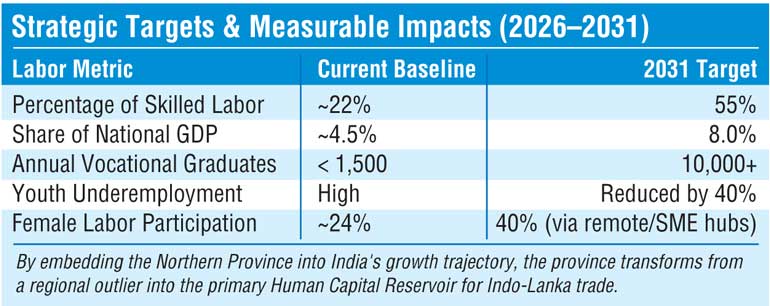
- Performance-Linked Renewals: To ensure “Growth-Led Development,” these incentives are subject to 5-year reviews. Renewals are tied to meeting specific human capital targets, such as the percentage of local skilled labor employed.
By combining these Strategic Development Project (SDP) incentives with the “Palk Strait Corridors”
connectivity, the North serves as the ultimate example of how a province can leverage subnational diplomacy and targeted fiscal policy to become a self-sustaining engine of national growth.
Core strategy: The Southern Indian blueprint
The program centers on three “replicable” pillars derived from the success of Southern Indian states:
- The Tamil Nadu Industrial Hub Model: Creating specialised Export Processing Zones (EPZs) in Jaffna and Mannar, integrated into the supply chains of Chennai and Coimbatore.
- The Bengaluru Tech Ecosystem: Establishing “Satellite IT Parks” to outsource software testing and back-office operations from Indian tech giants to Northern Sri Lankan youth.
- The Kerala Human Development Model: Transitioning the North’s high literacy into specialised technical capital through GoI-funded vocational frameworks.
- Implementation pillars: Finance, Infrastructure, and Markets
The “Gateway” financial architecture and infrastructure
This mechanism uses three layers to de-risk investment and provide “patient capital” for long-term growth:
- Indo-Lanka Northern Venture Capital (ILN-VC) Fund: A $150M evergreen fund co-anchored by the Indian EXIM Bank and private venture firms. Domiciled in GIFT City (Gujarat), it provides equity for Northern startups in Agri-Tech, FinTech, and Green Energy.
- Infrastructure SPV – “Palk Strait Infra-Link”: The Northern Gateway Development Corp (NGDC) functions as a Special Purpose Vehicle to manage large-scale works like the Kankesanthurai (KKS) Port modernisation and the Mannar-Dhanushkodi bridge feasibility. It utilises blended finance, combining Goal’s ($ 500 million
for KKS Port) with commercial loans.nEnergy Integration: Leveraging Goal’s $ 500 million renewable energy commitment to turn the North into a green energy exporter via power grid integration with India.
Markets, commerce and digital integration
- Currency and Digital Rail: Utilising RBI’s INR internationalisation for direct trade settlement and UPI-LankaPay integration to reduce cross-border transaction costs by 15%.
- Subnational diplomacy: Facilitating direct ties between the Northern Provincial Council and the Tamil Nadu Government to foster cross-border SME clusters.
- Knowledge and mentorship: Establishing a “Northern Gateway Business Council” and opening dedicated “Sri Lanka Northern Zones” in major Indian trade fairs.
Labor transformation: Building skilled capital
Adopting the “Dual Vocational Model” used in Tamil Nadu and Karnataka, the program transitions labor from a social challenge into a tradable asset through Industry-Led Training Centers (ILTCs) co-partnered with the National Skill Development Corporation (NSDC) and firms like Tata, Mahindra, or Infosys.
Skill-to-Market alignment
- Naan Mudhalvan (I am First) Integration: Based on the Naan Mudhalvan Platform, this segment provides industry-aligned courses in AI, Robotics, and STEM. It identifies «skill gaps» in the Northern Province and deploys 2,000+ mentors from Indian tech hubs to ensure youth are «industry-ready» for global standards.
- Vetri Nichayam (Assured Success) Hubs: Modeled after the Tamil Nadu Skill Development Corporation (TNSDC) initiatives, these hubs function as «Finishing Schools» for unemployed youth and school dropouts. They provide 100+ hours of intensive training in 165+ technical courses, focusing on sectors like construction, heavy machinery, and hospitality.
- TNAPEx (Apex Skill Development Centres): Establishing sector-specific Centers of Excellence for high-end training. These centers, modeled after the TN Apex Skill Development Centers, focus on high-value roles in Logistics, Healthcare, and Banking, Financial Services, and Insurance (BFSI), creating a specialised labor pool capable of servicing the entire Indian Ocean Rim.
Specialised clusters and mobility
- Blue Economy and Green Tech: Transitioning traditional fishermen into maritime technicians and training 5,000+ youth in turbine maintenance for the Mannar energy projects.
- Digital Outsourcing: Creating “Coding Bootcamps» modeled after Bengaluru’s institutes to align the region›s 92.7% literacy rate with the ₹10,000+ crore annual demand for specialised roles.
- Certification and Exchange: Formalising Mutual Recognition Agreements (MRAs) and a «Southern Bridge» apprenticeship program for 2,000 graduates annually to undergo 6-month residencies in Indian industrial corridors.




