Wednesday Apr 08, 2026
Wednesday Apr 08, 2026
Wednesday, 8 April 2026 03:17 - - {{hitsCtrl.values.hits}}
 On 31 March, 2026, Sri Lanka’s Supreme Court delivered a judgment in which the court found that the Colombo Municipal Council had violated the fundamental rights of residents by continuing to dump garbage at Meethotamulla
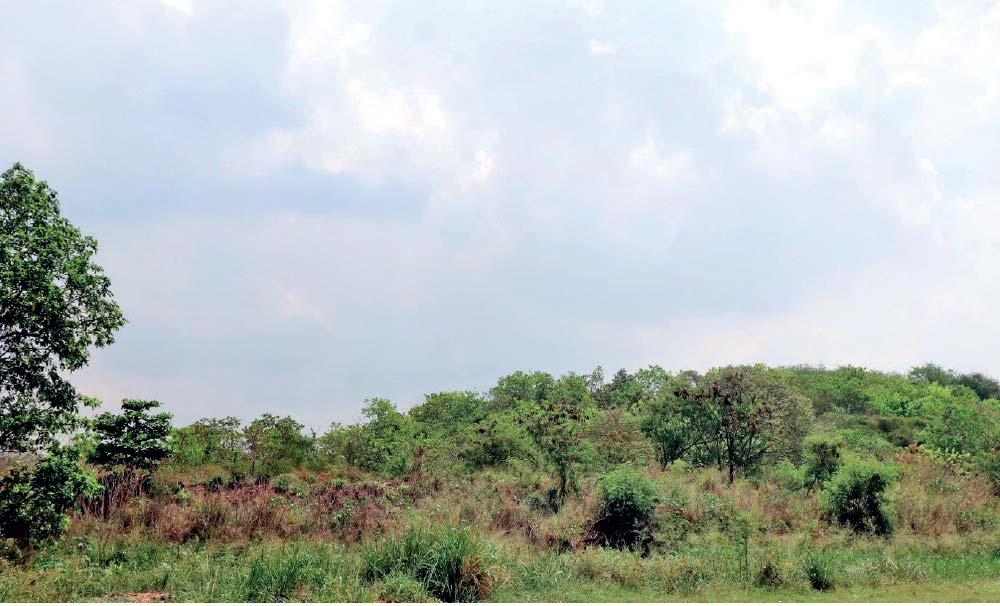
 The picture here is from the present-day Meethotamulla garbage dump which collapsed on 14 April 2017, killing 32 people. It looks almost like a forest now. Today people in the area have even used the hill to build replicas of Mihinthalaya and Siripada mountain-like structures from time to time during Vesak and Poson festivals. This former garbage dump stands as a quiet but powerful symbol of the environmental injustices faced by some segments of our society.
On 31 March, 2026, Sri Lanka’s Supreme Court delivered a judgment in which the court found that the Colombo Municipal Council had violated the fundamental rights of residents by continuing to dump garbage at Meethotamulla.
That judgment made me reach for my field notebook. In 2018, I spoke with some of the people who were part of the social movement against the Meethotamulla garbage dump for a case study on environmental injustices. I want to share some of their stories and experiences here, because I believe the Supreme Court judgment becomes more meaningful for citizens when understood in the context of what those people lived through, the questions they continuously raised, and about their desire for justice.
The impact
Since the early 2010s, the garbage dump had severely impacted the daily lives of the surrounding community. People raised concerns not only about the volume of garbage but also its nature. Waste from butcher shops, chicken feathers, and animal remains were a common sight around the area. Crows would carry scraps from the dump and scatter them across the neighbourhood. Residents described finding animal remains left on treetops by crows, which would rot, produce worms, and fall on people walking below.
Beyond the visible waste, the dump was slowly making the area unliveable. Houses closest to the dump show structural damage. The canal running alongside the dump became blocked with waste, causing floods, and the floodwater that entered homes was heavily contaminated. The smell was unbearable, and residents said they struggled simply to breathe. People began falling ill with increasing frequency, and some were advised by doctors to leave the area entirely.
The injustices
People from the area experienced the impact with a deep sense of injustice, since the dump consisted mainly of garbage not produced locally but brought in from the Colombo Municipal Council area. According to those I spoke to, the Kollonnawa Urban Council produced only around 15 tons of garbage per day, while the Colombo Municipal Council was collecting approximately 1,200 tons daily, a substantial amount of which ended up being dumped at Meethotamulla. Adding to the sense of injustice, this was also a period when the beautification of Colombo was among the main priorities of the Government. In that context, people questioned the fairness of being made to pay the price.
People were also angry about the fact that some were benefiting from their misery. Community members described how the dump had become a source of income for a network of politicians and businessmen. They alleged that members of the Colombo Municipal Council and the Kollonnawa Urban Council, along with private contractors, were financially benefiting from the operation through various arrangements including payments for machinery hire. According to those I spoke to, the higher the dump rose, the higher the commissions, since it demanded the use of more machinery. One local politician was specifically accused of exploiting the situation by allowing garbage from other urban councils to be brought in for a fee, and of employing people to collect recyclables from the dump. Representatives from the movement put it succinctly: “The garbage is an issue for us, but an asset for some.”
The movement
The people’s movement against the Meethotamulla garbage dump was the first organised response to emerge from the residents themselves. It began in 2012, when houses closest to the rising dump started to show damage. The movement was led by people who had some social capital in the community, such as retired Government servants, professionals, and businessmen. At the beginning, building wider support was difficult. Many families were in a daily struggle for their livelihoods, with little room to take on a political battle. Others were under the influence of local politicians who were silently profiting from the dump. But as the conditions worsened, more and more people joined. The movement eventually organised fifteen protests, many of which drew significant attention from authorities, particularly when demonstrators succeeded in blocking the entrance to the dump and halting the garbage trucks.
The movement carried a telling slogan, («We don›t want Colombo›s garbage»). It captured the nature of the frustration, rooted in the question of justice: why should a densely populated community, most of whom had lived there for generations, suffer Colombo’s waste in their backyard?
On 14 April 2017 Sinhala and Tamil New Year’s Day, part of the garbage dump collapsed, killing 32 people and destroying almost 300 homes. Tragically, among them were also people who had spent years fighting to prevent exactly this
The response
The responses to the demands of the movement to stop garbage dumping in Kollonnawa were far from satisfactory, and at times amounted to deliberate attempts to silence it. The first response was relocation. In 2012, a minister visited the area and offered residents a monthly rental allowance of Rs. 10,000 and a promise of a permanent house within two years, on the condition that they vacate within a week. Citizens considered this an irrational and unfair solution, and most critically, residents asked why they should be the ones to leave. It was the garbage dump that had come to them, not the other way around. According to one of the residents, “We were here all this time. There was no garbage dump like this. What we are asking for is to relocate the garbage dump, not us.”
When relocation failed to quell the movement, the response turned darker. On the night of 27 December 2015, protesters who had been blocking the entrance to the dump for four consecutive days were violently attacked. One of the movement’s representatives described what happened during our 2018 interview: a local politician from the area arrived in a bus with a group of men, and the attack began. The movement’s secretary was struck on the head with a nail-studded piece of wood. The organiser was beaten so severely that only the intervention of a family member prevented him from being thrown into the canal.
The message was obvious. As the movement’s organiser reflected afterwards: “We had to change our strategies after the attack. It was difficult to mobilise people after that. But we showed our continued commitment through judicial means.” Then came 14 April 2017 Sinhala and Tamil New Year’s Day. Part of the garbage dump collapsed, killing 32 people and destroying almost 300 homes. Tragically, among them were also people who had spent years fighting to prevent exactly this.
One of the movement’s leaders lost four members of his family that day. In our 2018 interview, he described what he witnessed:
“I lost four of my family members in front of my eyes on Avurudu Day. We lost our houses, our vehicles, and everything we had collected during our lives. But mostly, we lost the people we loved. My wife was under a cement block. Half of her body was visible and she was shouting, asking for help. I reached her but I could not remove the concrete blocks. I could see the hand of my granddaughter on the chest of my wife. I tried to get a backhoe from the Urban Council but was unable to until six in the evening. We got her out around nine, and she died the next day in the hospital. I lost my wife, my daughter, my son-in-law, and my granddaughter. My daughter’s body was found four days later. If we had not been attacked at the protest, we would have succeeded; we were determined to finish it with some kind of agreement. If so, we would not have lost our people.”
The Government’s response after the collapse was to evacuate residents from areas identified as being at risk of further slides.
The former dump is now green and used to celebrate Vesak and Poson, and beneath this new transformation, the people who died around ten years ago are still lying there. May this judgment bring some relief to the souls of those who perished, to those who were displaced, and to all who may face a similar fate in the future. And may it, at the very least, remind us to continuously engage with the question of justice in our society
A cry for justice
The fight of the people’s movement was, at its core, a cry for justice, not simply a demand for better waste management. The interviews revealed that residents were also hurt deeply by the injustices surrounding them as much as the environmental pollution itself. The sense of being neglected, of being subjected to corrupt politics, of being suppressed when they asked for nothing more than a decent life, these were the wounds which cut deepest.
This is why the Supreme Court judgment matters. The State has now formally acknowledged what the residents of Kollonnawa always knew: that their fundamental rights were violated. It will not bring back the 32 people who died. It will not return the years lost to illness, fear, and grief. I am not certain whether this judgment fully answers the questions of injustice they raised back then, yet it recognises that the lives and lands of the people of Kollonnawa, mostly from non-prestigious backgrounds, matter.
The former dump is now green and used to celebrate Vesak and Poson, and beneath this new transformation, the people who died around ten years ago are still lying there. May this judgment bring some relief to the souls of those who perished, to those who were displaced, and to all who may face a similar fate in the future. And may it, at the very least, remind us to continuously engage with the question of justice in our society.
(The author is a researcher attached to the Social Scientists’ Association)



