Friday Oct 09, 2026
Friday Oct 09, 2026
Wednesday, 6 May 2026 00:11 - - {{hitsCtrl.values.hits}}
 The war between Iran, the USA and Israel has taken a step back from a dangerous precipice. However, the horrifying images emerging from these wars remind us that humanity remains trapped in a cycle of violence that has claimed billions of lives.
The justifications and underlying ‘causes’ for war are numerous. Several culprits have been identified for the current cycles of violence, including actions against the dominance of the US petrodollar, a battle to gain energy security and ensure economic power, and an objective of curtailing the nuclear capabilities of Iran. Whatever the causes are, the consequences have been devastation of infrastructure, destruction of the environment, and deaths running into the thousands.
Amidst this darkness, Sri Lanka drew some admiration for rescuing Iranian sailors from a watery grave. This humanitarian act could echo the historic stand taken by former Prime Minister J.R. Jayewardene at the post-World War 2 Peace Conference in 1951. His strong support for a free and independent Japan set the tone for the conference – and his speech is taught in Japanese history textbooks to this day. The declaration of the Indian Ocean as a Zone of Peace by Prime Minister Sirimavo Bandaranaike was another instance in which we were on the centre stage of global peace. Does the Global Walk for Peace offer an opportunity for Sri Lanka to lead a global peace initiative?
 Why Peace? Counting the catastrophic costs of war
War is not merely a political or economic issue; it is a catastrophe for humanity from all dimensions. The effects of war on development, the environment and health are unimaginable.
War results in a catastrophe for human health of unimaginable proportions. Since the Second World War, conflicts between nations have killed and maimed more than a billion human beings. Wars have burnt alive millions within minutes – as witnessed in Hiroshima, Nagasaki, and in the use of napalm bombs in other wars. Wars have destroyed entire societies, displaced millions of families, and crippled or scarred millions mentally and physically for a lifetime. War is anti-health.
But these figures hide the consequences which go far beyond immediate death and injury, affecting people, society and the planet. A framework called "The Twelve Dimensions of Health Impacts of War" – or the 12 D Framework – reveals the scope of devastation related only to health. (See "The 12 dimensions of health impacts of war", freely accessible from https://doi.org/10.1136/bmjgh-2023-014749)
The first group: Direct harm to human bodies
War kills. That much everyone knows. But here's what the news doesn't tell you: for every person who dies in modern warfare, about ten others are left seriously injured. Broken.
Then comes the second wave – the diseases. When clean water disappears, when sewage systems collapse, when people are packed into camps with no space to breathe, illnesses like diarrhoea, measles, polio and chest infections spread like fire. And after that? Many survivors turn to alcohol and drugs just to cope with the trauma and loss. Addiction becomes another kind of wound.
But perhaps the most heartbreaking harm is to children not yet born. Chemicals from bombs and weapons seep into the soil, into the water, into the food chain. They cause birth defects. The most well‑known example is Agent Orange – sprayed during the Vietnam War, it caused generations of Vietnamese children to be born with severe deformities.
Given all their horrific consequences, wars should automatically be considered crimes against humanity.
The second group: What war does to society
War tears apart the fabric of society – and those tears last for generations. It widens the gap between rich and poor. While millions lose all their possessions and suffer, a small number of people profit enormously from arms deals and war contracts. It uproots entire populations. Millions flee their homes to live in makeshift refugee camps with little food, little shelter, and no safety. The UNHCR (the United Nations High Commissioner for Refugees, which is mandated to aid and protect refugees) states that at the end of 2024, 123.2 million people worldwide were forcibly displaced due to persecution, conflict, war and violence.
It destroys trust. Neighbours become strangers. Families are separated. Social networks collapse. And it reverses decades of hard‑won progress: schools are destroyed, health systems crumble, children grow up without education or opportunity. Countries are set back by a generation – or more. These costs are hidden from our news headlines.
The third group: What war does to the planet
War doesn't just harm people – it damages the world we all share. It destroys the physical infrastructure communities depend on: houses, hospitals, roads, bridges, schools, universities. All reduced to rubble. It poisons the environment. The current conflicts in the Middle East alone have released enormous quantities of pollutants and carbon dioxide into the atmosphere – worsening climate change for everyone on earth, not just those caught in the fighting. It depletes the natural resources that sustain life. Water sources are contaminated or destroyed, leaving communities without safe water long after the guns fall silent.
The simple truth is that war harms human bodies, tears apart societies, and damages the planet. Many of these harms last for decades, even generations.
The full cost of war is far greater than the deaths we see on the news. It is measured in the children born with deformities, the communities that never recover, and the environment that bears scars long after peace is declared.
Modern‑day militaries will soon gain the ability to annihilate whole societies with weapons of mass destruction, weaponised AI systems, drones and robots. A recent report outlines how swarms of drones could carry chemical or biological weapons to indiscriminately destroy populations. (See paper by Dresp‑Langley B, "The weaponisation of artificial intelligence: What the public needs to be aware of", in Frontiers in Artificial Intelligence, 2023 Mar 8;6:1154184). The AI targeting of sites to be attacked is already taking place in Gaza and Iran.
War will no longer be just a political issue – it will be one of the greatest existential risks facing humanity and the number one public health threat. Its opportunity costs are unbelievable.
According to a UN report, in 2024 the world spent $2.7 trillion on militaries. With 18% of that, we could provide basic healthcare and end hunger around the world by 2030. (Source: The Security We Need: Rebalancing Military Spending for a Sustainable and Peaceful Future. Report of the Secretary‑General on the impact of the global increase in military expenditure on the achievement of the Sustainable Development Goals.)
If we are serious about development, about health, about the future of our planet, we must seriously confront the scourge of war.
Confronting wars: The role of the Global Walk for Peace
Can smaller nations like Sri Lanka step forward with a bold new diplomatic push for global peace and neutrality without having to take sides and get sucked into a quagmire of conflicts? If so, what could be the justification to chart a 'radical peace'?
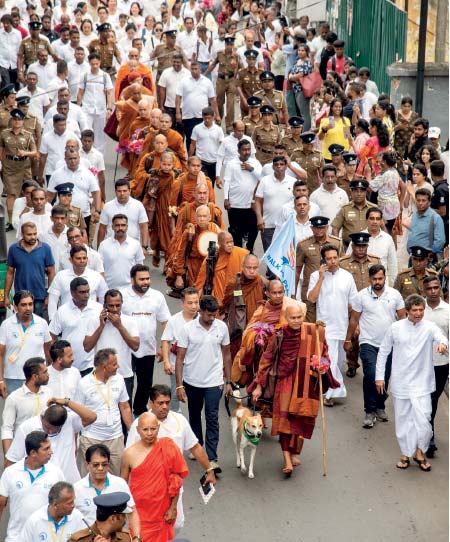
As a first step, these nations must internalise the importance of peace. The Global Walk for Peace, which took place in Sri Lanka is an opportunity for the public in Sri Lanka to realise why we should support peace and oppose all forms of war. This should be used as a reason not to enter into any agreements (e.g., the establishment of foreign military bases) which would affect our future neutrality.
A second step is to muster support for a global convention to oppose war. Today, most UN reports and discussions carefully avoid words like "war", "invasion" or "cross‑border conflict", focusing instead on "conflicts and violence within nations" and "human rights".
This evasion is probably no accident. The post‑2030 Agenda (i.e., after 15 years of the Sustainable Development Goals) is a historic opportunity to explicitly oppose wars between nations. War is the antithesis of health. It is the reverse of any form of human development.
My final parting question
Should Sri Lanka, together with other neutral, especially smaller nations like Bhutan, Nepal, and the Maldives, propose a declaration on the Elimination of All Wars? Should it urge the UN to adopt "end all wars" as an overarching goal? Can we be part of a global movement to finally wean humanity from the scourge of war?
(The author is Emeritus Professor, University of Colombo, Sri Lanka)




